 뒤로
Physics with Calculus: Step-by-Step Guidance for Example Quiz 1
스터디 가이드 - 스마트 노트
 자료에 맞춘 맞춤형 노트, 핵심 정의, 예시, 맥락을 확장해 제공합니다.
Q1. The density of a material is 7.50 g/cm³. Express this in kg/m³.
Background
Topic: Unit Conversion (Density)
This question tests your ability to convert units for density from grams per cubic centimeter to kilograms per cubic meter, a common skill in introductory physics.
Key Terms and Formulas:
Density (): mass per unit volume.
Unit conversions: ,
Step-by-Step Guidance
Start with the given density: .
Convert grams to kilograms: .
Convert cubic centimeters to cubic meters: .
Set up the conversion: .
Try solving on your own before revealing the answer!
Final Answer: kg/m³
By dividing kg by m³, you get kg/m³.
This conversion is essential for working with SI units in physics.
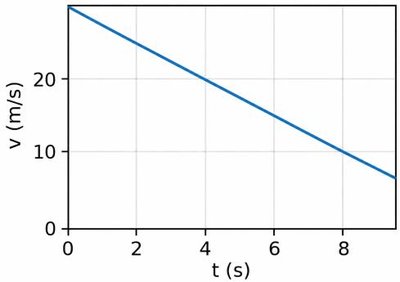
Q2. Find the magnitude of the acceleration (in m/s²) from the velocity-time graph.
Background
Topic: Kinematics (Acceleration from Velocity-Time Graph)
This question tests your ability to determine acceleration from a velocity vs. time graph, a fundamental concept in motion analysis.
Key Terms and Formulas:
Acceleration (): rate of change of velocity with respect to time.
Formula:
Step-by-Step Guidance
Identify two points on the graph where the line passes through grid intersections (e.g., and ).
Calculate the change in velocity: .
Calculate the change in time: .
Set up the formula for acceleration: .
Try solving on your own before revealing the answer!
Final Answer: 2.5 m/s²
Using the points (20 m/s, 4 s) and (10 m/s, 8 s): m/s². The magnitude is 2.5 m/s².
The negative sign indicates the car is slowing down, but the question asks for magnitude.
Q3. Is the car speeding up or slowing down?
Background
Topic: Kinematics (Velocity and Acceleration)
This question tests your understanding of how velocity changes over time and what it means for an object to speed up or slow down.
Key Terms:
Speeding up: velocity increases in magnitude.
Slowing down: velocity decreases in magnitude.
Step-by-Step Guidance
Observe the slope of the velocity-time graph: is velocity increasing or decreasing as time progresses?
If the velocity decreases as time increases, the object is slowing down.
Try solving on your own before revealing the answer!
Final Answer: Slowing down
The velocity decreases as time increases, so the car is slowing down.
Q4. What is the velocity at s for ?
Background
Topic: Calculus in Kinematics (Velocity from Position Function)
This question tests your ability to use calculus to find velocity from a position function.
Key Terms and Formulas:
Position function:
Velocity:
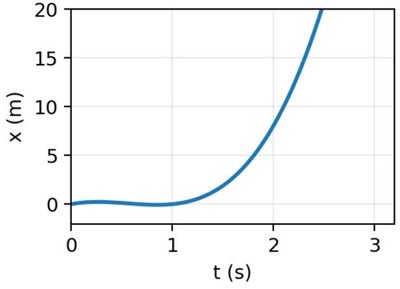
Step-by-Step Guidance
Write the position function: .
Take the derivative with respect to to find velocity: .
Compute the derivative: .
Substitute s into the velocity function to find .
Try solving on your own before revealing the answer!
Final Answer: 1 m/s
Plugging in s: m/s.
This matches the tangent to the curve at s.
Q5. What is the instantaneous acceleration at s for ?
Background
Topic: Calculus in Kinematics (Acceleration from Position Function)
This question tests your ability to use calculus to find acceleration from a position function.
Key Terms and Formulas:
Acceleration:
Velocity function:
Step-by-Step Guidance
Take the derivative of the velocity function to find acceleration: .
Compute the derivative: .
Substitute s into the acceleration function to find .
Try solving on your own before revealing the answer!
Final Answer: 26 m/s²
Plugging in s: m/s².
This is the instantaneous acceleration at s.
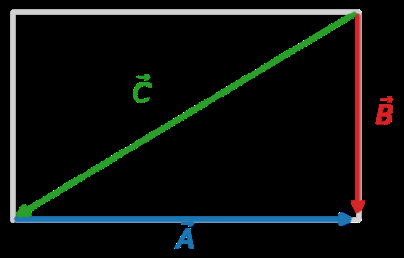
Q9. Three displacement vectors are drawn along edges/diagonals of a rectangle as shown. Which relation is correct?
Background
Topic: Vector Addition and Subtraction
This question tests your understanding of vector addition and subtraction using geometric representations.
Key Terms and Formulas:
Vector addition: tip-to-tail method
Vector subtraction:
Step-by-Step Guidance
Examine the diagram and identify the starting and ending points of each vector.
Use the tip-to-tail method to see how combining vectors and relates to .
Try rearranging the vectors algebraically to match the geometric path shown in the diagram.
Try solving on your own before revealing the answer!
Final Answer:
Following and then (leftward) gives the same displacement as , so .
