 뒤로
Physics with Calculus: Units, Physical Quantities, and Vectors (Chapters 1–3 Study Guide)
스터디 가이드 - 스마트 노트
 자료에 맞춘 맞춤형 노트, 핵심 정의, 예시, 맥락을 확장해 제공합니다.
Units, Physical Quantities, and Vectors
The Nature of Physics
Physics is an experimental science that seeks to understand the patterns and laws governing natural phenomena. These patterns are called physical theories, and well-established theories are known as physical laws or principles.
Physical theory: A model or explanation for observed phenomena.
Physical law: A theory that is widely accepted and used.
Example: Newton's Laws of Motion.
Solving Problems in Physics
Physics problems can be approached systematically using four steps:
Identify: Determine relevant concepts, target variables, and known quantities.
Set Up: Choose appropriate equations and sketch the situation.
Execute: Perform calculations and solve equations.
Evaluate: Check the answer for consistency and reasonableness.
Idealized Models
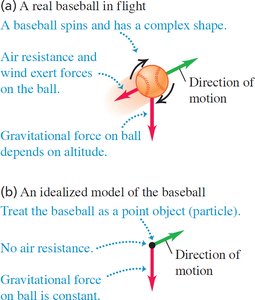
To simplify analysis, physicists often use idealized models that ignore complicating factors such as air resistance or the shape of objects.
Example: Modeling a baseball as a point object to ignore air resistance and treat gravitational force as constant.
Standards and Units
Three fundamental quantities in physics are length, time, and mass. The International System of Units (SI) is the standard system used:
Length: meter (m)
Time: second (s)
Mass: kilogram (kg)
Unit Prefixes
Prefixes are used to denote multiples or fractions of units:
Kilo- (k): $10^3$ (e.g., 1 km = $10^3$ m)
Milli- (m): $10^{-3}$ (e.g., 1 mg = $10^{-3}$ g)
Micro- (μ): $10^{-6}$ (e.g., 1 μm = $10^{-6}$ m)
Nano- (n): $10^{-9}$ (e.g., 1 ns = $10^{-9}$ s)
Unit Consistency and Conversions
Equations must be dimensionally consistent. Always carry units through calculations and convert to standard units as needed.
Example: To convert 3 minutes to seconds: $3 \text{ min} \times \frac{60 \text{ s}}{1 \text{ min}} = 180 \text{ s}$
Uncertainty and Significant Figures
Measured quantities have uncertainty, indicated by significant figures.
Multiplication/Division: Result has no more significant figures than the least precise factor.
Addition/Subtraction: Result is limited by the term with the fewest digits to the right of the decimal.
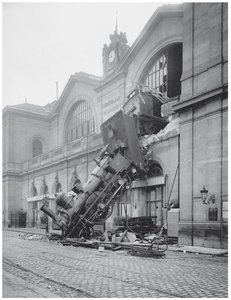
Example: Small percent errors can lead to large consequences, as illustrated by train mishaps.
Vectors and Scalars
Physical quantities are classified as scalars (magnitude only) or vectors (magnitude and direction).
Scalar: Temperature, mass, time.
Vector: Displacement, velocity, force.
Notation: Vectors are written in boldface with an arrow, e.g., $\vec{A}$.
Drawing Vectors
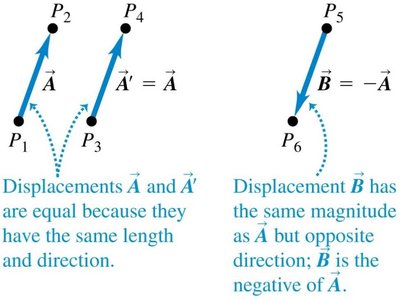
Vectors are represented as arrows; length indicates magnitude, direction indicates orientation.
Adding and Subtracting Vectors Graphically
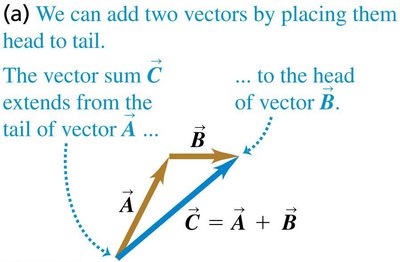
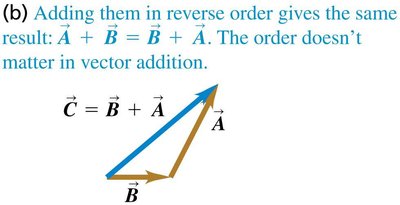
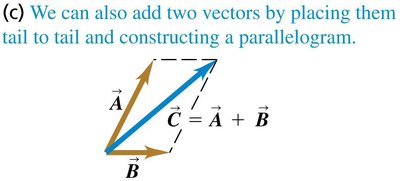
Vectors can be added using the head-to-tail method or by constructing a parallelogram.
Head-to-tail: Place the tail of one vector at the head of another.
Parallelogram: Place vectors tail-to-tail and complete the parallelogram.
Order: Vector addition is commutative: $\vec{A} + \vec{B} = \vec{B} + \vec{A}$.
Special Cases in Vector Addition
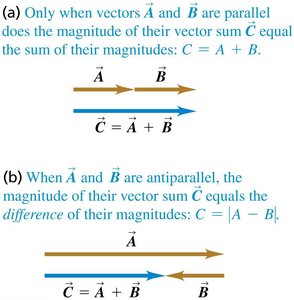
When vectors are parallel or antiparallel, their sum is the sum or difference of their magnitudes.
Parallel: $C = A + B$
Antiparallel: $C = |A - B|$
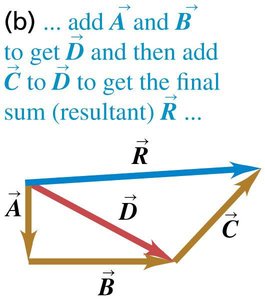
Adding More Than Two Vectors
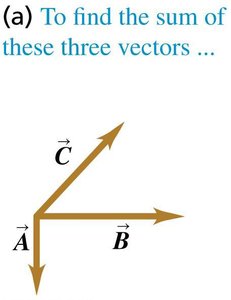
To add several vectors, use the head-to-tail method in any order. The resultant vector is the sum.
Example: Adding vectors $\vec{A}$, $\vec{B}$, and $\vec{C}$.
Subtracting Vectors
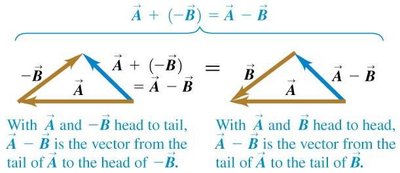
Subtracting a vector is equivalent to adding its negative.
$\vec{A} - \vec{B} = \vec{A} + (-\vec{B})$
The negative of a vector has the same magnitude but opposite direction.
Multiplying a Vector by a Scalar
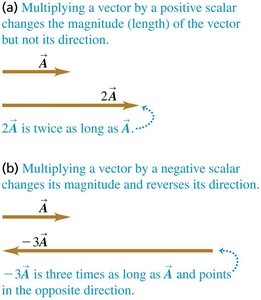
Multiplying a vector by a scalar changes its magnitude but not its direction (unless the scalar is negative).
Positive scalar: Length increases, direction unchanged.
Negative scalar: Length increases, direction reversed.
Addition of Two Vectors at Right Angles
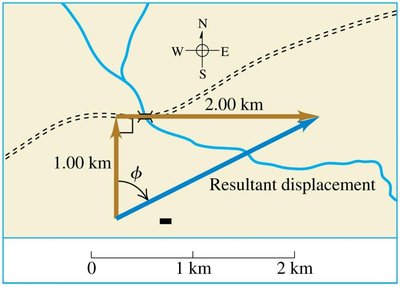
When vectors are perpendicular, use trigonometry to find the magnitude and direction of the resultant.
Magnitude: $R = \sqrt{A^2 + B^2}$
Direction: $\theta = \tan^{-1}(B/A)$
Components of a Vector
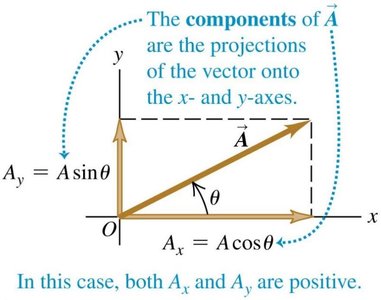
Any vector can be decomposed into components along the x- and y-axes.
$A_x = A \cos \theta$
$A_y = A \sin \theta$
Positive and Negative Components
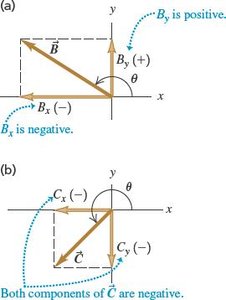
Vector components can be positive or negative depending on their direction relative to the axes.
Finding Components
Given a vector's magnitude and direction, calculate its components using trigonometric functions.
$A_x = A \cos \theta$
$A_y = A \sin \theta$
Calculations Using Components
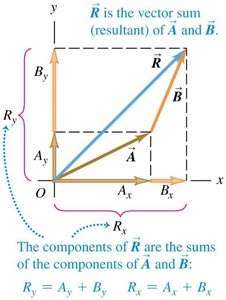
Use vector components to find the magnitude and direction of a vector, and to add vectors:
$A = \sqrt{A_x^2 + A_y^2}$
$\theta = \tan^{-1}(A_y/A_x)$
Sum: $R_x = A_x + B_x + C_x$, $R_y = A_y + B_y + C_y$
Unit Vectors
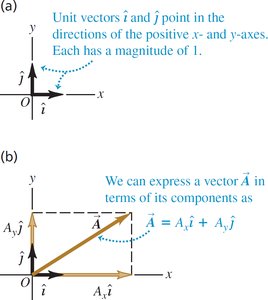
Unit vectors have magnitude 1 and indicate direction. Common unit vectors are $\hat{i}$ (x-direction), $\hat{j}$ (y-direction), and $\hat{k}$ (z-direction).
Any vector: $\vec{A} = A_x \hat{i} + A_y \hat{j} + A_z \hat{k}$
Scalar (Dot) Product
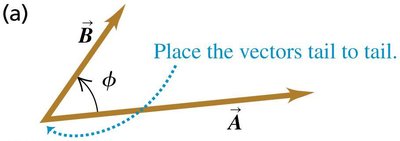
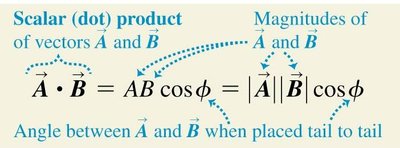
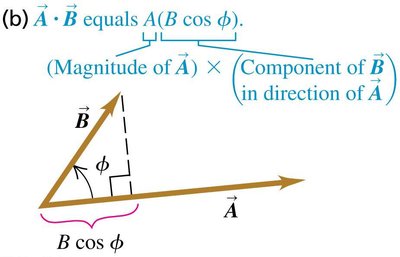
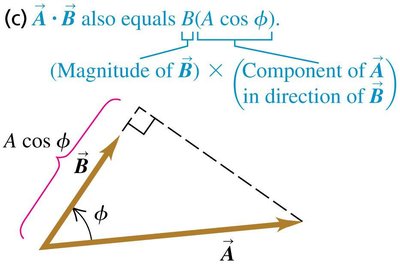
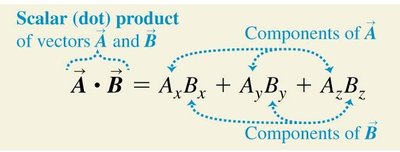
The scalar product (dot product) of two vectors is a measure of how much one vector extends in the direction of another.
$\vec{A} \cdot \vec{B} = AB \cos \phi$
Result is a scalar.
Can be positive, negative, or zero depending on the angle $\phi$.
Calculating a Scalar Product Using Components
In terms of components, the scalar product is:
$\vec{A} \cdot \vec{B} = A_x B_x + A_y B_y + A_z B_z$
Finding an Angle Using the Scalar Product
The angle between two vectors can be found using:
$\cos \phi = \frac{\vec{A} \cdot \vec{B}}{AB}$
Vector (Cross) Product
The vector product (cross product) of two vectors results in a vector perpendicular to both.
$\vec{C} = \vec{A} \times \vec{B}$
Magnitude: $C = AB \sin \phi$
Direction: Determined by the right-hand rule.
Anticommutative: $\vec{A} \times \vec{B} = -\vec{B} \times \vec{A}$
Motion Along a Straight Line
Kinematics and Motion
Kinematics is the study of motion without considering its causes. Key quantities are displacement, velocity, and acceleration.
Displacement: Change in position, $\Delta x = x_2 - x_1$
Average velocity: $v_{av-x} = \frac{\Delta x}{\Delta t}$
Instantaneous velocity: $v_x = \frac{dx}{dt}$
Average acceleration: $a_{av-x} = \frac{\Delta v_x}{\Delta t}$
Instantaneous acceleration: $a_x = \frac{dv_x}{dt}$
Rules for the Sign of Velocity and Acceleration
The sign of velocity and acceleration depends on the direction of motion and whether the object is speeding up or slowing down.
Motion with Constant Acceleration
For straight-line motion with constant acceleration, the following equations apply:
$v_x = v_{0x} + a_x t$
$x = x_0 + v_{0x} t + \frac{1}{2} a_x t^2$
$v_x^2 = v_{0x}^2 + 2 a_x (x - x_0)$
$x = x_0 + \frac{1}{2} (v_{0x} + v_x) t$
Freely Falling Objects
Free fall is motion under the influence of gravity alone. The acceleration due to gravity is $g = 9.8 \text{ m/s}^2$.
All objects fall with the same acceleration if air resistance is negligible.
Velocity and Position by Integration
If acceleration is not constant, integrate over time intervals:
$v = v_0 + \int_{t_0}^{t} a \, dt$
$x = x_0 + \int_{t_0}^{t} v \, dt$
Motion in Two or Three Dimensions
Position, Velocity, and Acceleration Vectors
In two or three dimensions, position, velocity, and acceleration are described by vectors.
Position vector: $\vec{r} = x \hat{i} + y \hat{j} + z \hat{k}$
Velocity: $\vec{v} = \frac{d\vec{r}}{dt}$
Acceleration: $\vec{a} = \frac{d\vec{v}}{dt}$
Projectile Motion
A projectile follows a curved path determined by its initial velocity and gravity. The horizontal and vertical motions are independent.
Horizontal motion: Constant velocity, $a_x = 0$
Vertical motion: Constant acceleration, $a_y = -g$
Equations: $x = v_{0x} t$, $y = v_{0y} t - \frac{1}{2} g t^2$
Motion in a Circle
Uniform circular motion is motion with constant speed along a circular path. The acceleration points toward the center (centripetal acceleration).
$a_{rad} = \frac{v^2}{R}$
Period $T$ for one revolution: $a_{rad} = \frac{4 \pi^2 R}{T^2}$
Relative Velocity
The velocity of an object depends on the observer's frame of reference. Relative velocity is calculated by vector addition.
One dimension: $v_{P/A} = v_{P/B} + v_{B/A}$
Two/three dimensions: Use vector addition.
Additional info: Some explanations and equations were expanded for academic completeness and clarity.
