뒤로
Ch7: Potential Energy and Energy Conservation
스터디 가이드 - 스마트 노트
 자료에 맞춘 맞춤형 노트, 핵심 정의, 예시, 맥락을 확장해 제공합니다.
Potential Energy and Energy Conservation
Introduction to Energy Concepts
Energy is a fundamental concept in physics, describing the ability of a system to perform work or produce change. In mechanical systems, energy can be stored and transformed between different forms, such as kinetic and potential energy. Understanding how energy is conserved and transferred is essential for analyzing physical phenomena.
Gravitational Potential Energy
Gravitational potential energy is the energy associated with an object's position in a gravitational field. It is particularly relevant in problems involving vertical motion.
Definition: The gravitational potential energy of a particle near Earth's surface is given by , where m is mass, g is acceleration due to gravity, and y is the vertical coordinate.
Key Point: As an object descends, its gravitational potential energy is converted to kinetic energy, increasing its speed.
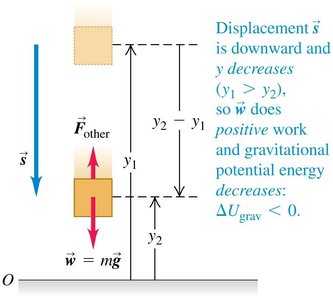
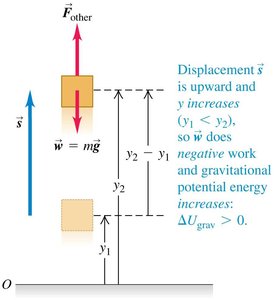
Work and Energy: The change in gravitational potential energy is related to the work done by gravity. If an object moves downward, ; if it moves upward, .
Formula:
Work Done by Gravity:
Example: A basketball falling toward the hoop converts potential energy to kinetic energy as it descends.


Conservation of Mechanical Energy
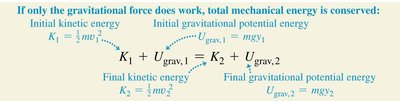
The total mechanical energy of a system is the sum of its kinetic and potential energies. When only conservative forces (such as gravity) act, mechanical energy is conserved.
Conserved Quantity: A quantity that remains constant in a system is called a conserved quantity.
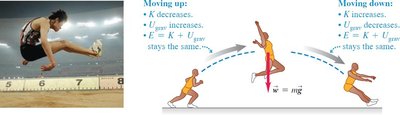
Conservation Law: If only gravity does work, , where is kinetic energy and is gravitational potential energy.
Example: A long jumper's energy is conserved as she moves upward and downward; kinetic and potential energies interchange, but their sum remains constant.
Nonconservative Forces and Energy Loss
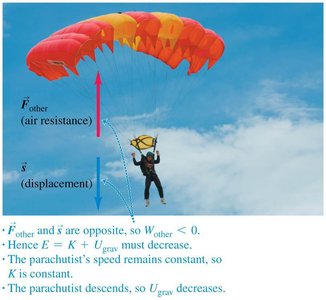
When forces other than gravity (such as friction or air resistance) do work, mechanical energy is not conserved. These forces are called nonconservative or dissipative forces.
Nonconservative Forces: These forces convert mechanical energy into other forms, such as internal energy or heat.
Example: Air resistance acting on a parachutist causes mechanical energy to decrease as internal energy increases.
Work and Energy Along a Curved Path
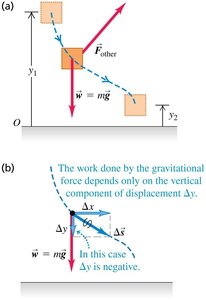
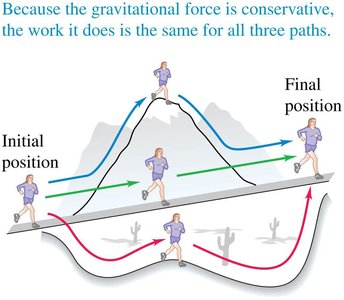
The expression for gravitational potential energy applies regardless of whether the object's path is straight or curved. The work done by gravity depends only on the vertical displacement.
Formula:
Key Point: The work done by gravity is independent of the path taken between two points.
Elastic Potential Energy
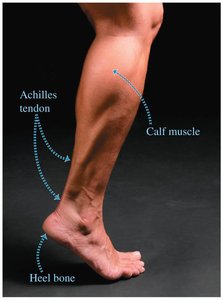
Elastic potential energy is stored in objects that can return to their original shape after being deformed, such as springs or tendons.
Definition: For an ideal spring, elastic potential energy is , where k is the spring constant and x is the displacement from equilibrium.
Example: The Achilles tendon acts like a spring, storing and releasing energy during running.
Work Done by a Spring
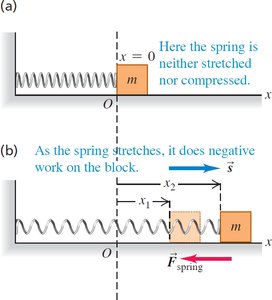
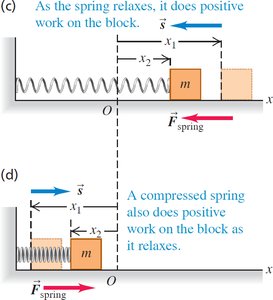
A spring does work on a block as it is stretched or compressed. The direction of work depends on whether the spring is being stretched or relaxed.
Key Point: The spring does negative work when stretched and positive work when relaxed.
Formula:
Situations with Both Gravitational and Elastic Forces
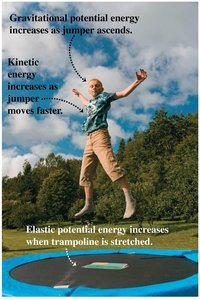
When both gravitational and elastic forces are present, the total potential energy is the sum of the two:
Formula:
Example: A trampoline jumper experiences both gravitational and elastic potential energy.
Conservative and Nonconservative Forces
Conservative forces allow conversion between kinetic and potential energy and have a potential energy function. Nonconservative forces dissipate energy.
Conservative Forces: Gravity and spring force are conservative. Work done is reversible, path-independent, and zero for closed paths.
Nonconservative Forces: Friction and internal forces convert mechanical energy to internal energy.
Example: Tire friction increases internal energy, raising temperature and pressure.

Conservation of Energy
The law of conservation of energy states that energy is never created or destroyed, only transformed. Nonconservative forces change internal energy but do not store potential energy.
Formula:
Force and Potential Energy in One Dimension
In one-dimensional motion, the value of a conservative force at a point is the negative derivative of the potential energy function:
Formula:
Key Point: The force is large where the potential energy changes rapidly with position.

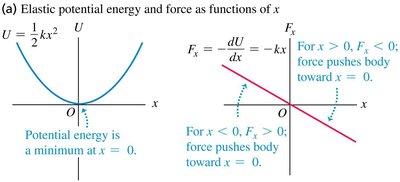
Elastic Potential Energy and Force as Functions of x
Elastic Potential Energy:
Force:
Key Point: The force always acts to restore the system to equilibrium.
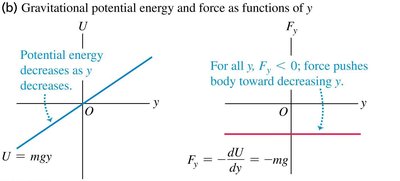
Gravitational Potential Energy and Force as Functions of y
Gravitational Potential Energy:
Force:
Key Point: The force always acts downward, toward lower potential energy.
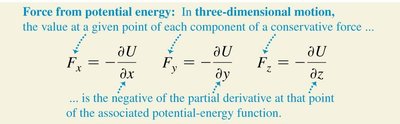
Force and Potential Energy in Three Dimensions
In three dimensions, the components of a conservative force are obtained from partial derivatives of the potential energy function:
Formulas:
Gradient: The vector value of a conservative force is the negative gradient of the potential energy function:
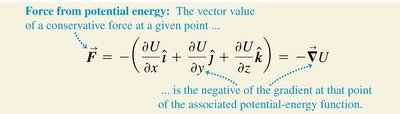
Force and Potential Energy: Physical Example
In mountainous regions, the gradient of gravitational potential energy is large where slopes are steep, resulting in strong forces pushing objects toward lower elevation.
Energy Diagrams
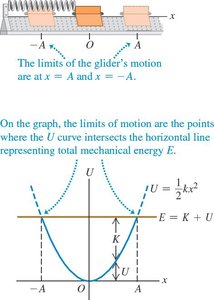
An energy diagram is a graph showing the potential-energy function and total mechanical energy. It helps visualize the motion limits and equilibrium points.
Key Point: The limits of motion are where the total energy line intersects the potential energy curve.
Example: A glider attached to a spring on an air track.
Force and Graph of Potential Energy Function
The force at any point is the negative slope of the potential energy graph. Points where the slope is zero are equilibrium points.
Stable Equilibrium: At a minimum of U, the force is restoring.
Unstable Equilibrium: At a maximum of U, the force drives the object away.
Unstable Equilibrium
In unstable equilibrium, any small displacement causes the system to move further from equilibrium. Constant attention is required to maintain balance.