 뒤로
Qualitative Dynamics of Circular Motion: Centripetal Forces
스터디 가이드 - 스마트 노트
 자료에 맞춘 맞춤형 노트, 핵심 정의, 예시, 맥락을 확장해 제공합니다.
Qualitative Dynamics of Circular Motion
Introduction to Circular Motion
Circular motion describes the movement of an object along a circular path. Common examples include a car on a circular track, a Ferris wheel, or a swinging pendulum. In this section, we focus on the simplest case: an object moving at constant speed around a circle, modeled as a point-like object. Understanding the forces involved in such motion is essential for analyzing more complex physical systems.
Forces in Circular Motion
When an object moves in a circle at constant speed, the sum of all forces acting on it is directed toward the center of the circle. This inward force is known as the centripetal force. The direction and nature of these forces can be explored through observational and testing experiments.
Observational Experiments
Experiment 1: A bowling ball is rolled around a smooth floor in a circle. The only force acting on the ball (neglecting friction) is directed toward the center of the circle.
Experiment 2: A bag is swung in a horizontal circle on a string. The tension in the string (exerted by the hand) points toward the center of the circle.
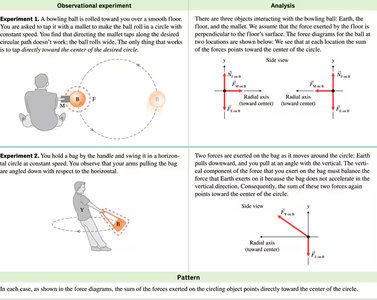
Analysis: In both cases, the force diagrams show that the sum of the forces (gravity, normal force, tension) always points toward the center of the circle, along the radial axis. This pattern is consistent for any object moving in a circle at constant speed.
Testing Experiments
Experiment 1: A marble is rolled against the inside wall of a circular ring. The force diagram shows the normal force from the wall points toward the center.
Experiment 2: A marble is rolled at constant speed inside a semicircular ring. The force from the wall again points toward the center.
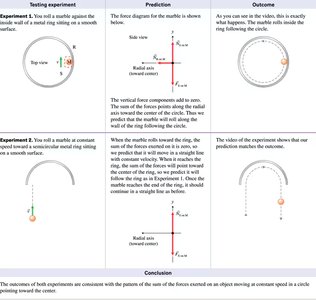
Prediction and Outcome: In both experiments, the vertical force components add to zero, and the sum of the forces points along the radial axis toward the center. The observed motion matches the prediction: the marble follows the circular path, confirming the force direction.
Explanation Using Newton's Second Law
According to Newton's second law, the sum of the forces on an object equals its mass times its acceleration (). For circular motion at constant speed, the acceleration is always directed toward the center of the circle (centripetal acceleration). Thus, the net force must also point toward the center.
The magnitude of the required centripetal force is given by:
where is the mass of the object, is its speed, and is the radius of the circle.
Summary Table: Forces in Circular Motion
Scenario | Source of Centripetal Force | Direction |
|---|---|---|
Car on a circular track | Friction between tires and road | Toward center |
Ball on a string | Tension in string | Toward center |
Marble in a ring | Normal force from wall | Toward center |
Key Points
Circular motion requires a net force directed toward the center of the circle (centripetal force).
The centripetal force is not a new type of force; it is provided by tension, gravity, friction, or normal force, depending on the situation.
Newton's second law explains why the net force and acceleration both point toward the center during uniform circular motion.
Example: Car on a Circular Track
A car of mass 1000 kg moves at 20 m/s around a track of radius 50 m. The required centripetal force is:
This force must be supplied by the friction between the tires and the road.
Additional info: The direction of acceleration and force in circular motion is always perpendicular to the velocity vector, pointing toward the center of the circle. This is called centripetal acceleration.
