 뒤로
Standing Waves and Fourier Analysis in Physics with Calculus
스터디 가이드 - 스마트 노트
 자료에 맞춘 맞춤형 노트, 핵심 정의, 예시, 맥락을 확장해 제공합니다.
Standing Waves
Wave Behavior in Tubes
Standing waves are formed when a wave is confined within a specific geometry, such as a tube, causing reflections and resonance. The placement of nodes and antinodes depends on the tube's geometry and the wavelength (\( \lambda \)) of the sound. - Node: A point of minimal or zero vibration, always at the closed end of a tube. - Antinode: A point of maximal vibration, always at the open end of a tube. - Constructive Interference: Occurs when incident and reflected waves are in phase, producing antinodes. - Destructive Interference: Occurs when waves are 180° out of phase, producing nodes. - Distance between nodes/antinodes: Successive nodes or antinodes are separated by \( \frac{1}{2} \lambda \). Example: Tubes open at both ends act as \( \frac{1}{2} \lambda \) resonators, while tubes closed at one end act as \( \frac{1}{4} \lambda \) resonators. 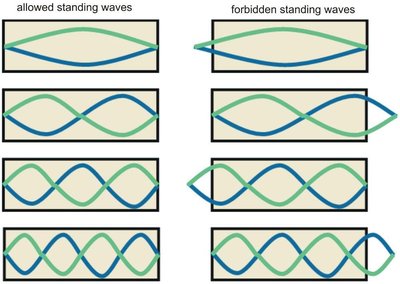
Summary of Standing Waves
- Standing waves result from waveform reflections in a confined geometry. - Resonance occurs when the geometry supports constructive interference. - Nodes and antinodes are determined by boundary conditions.
Complex Sounds and Fourier Analysis
Simple vs. Complex Waves
Most acoustic sounds are complex signals, composed of multiple sine waves. - Simple sine wave: A pure tone signal, described by \( A \sin(2\pi f t + \phi) \). - Complex wave: Formed by adding two or more sine waves with different amplitudes (A), frequencies (f), and phases (\( \phi \)). - Fourier's Theorem: Any complex sound can be represented as the sum of simple sinusoidal signals. Example: Animal vocalizations and musical notes are complex sounds. 
Fourier Series and Discrete Fourier Analysis
The Fourier series expresses a periodic function as a sum of sine and cosine terms: - \( C_0 \): DC component (average value) - \( C_n \): Amplitude spectrum (strength of each frequency) - \( \theta_n \): Phase spectrum (starting phase of each frequency)
Time Domain vs. Frequency Domain Displays
- Time Domain: Shows amplitude (e.g., pressure) as a function of time. - Frequency Domain: Shows the amplitude and phase of each frequency component. Example: A complex periodic sound with a 100 Hz fundamental frequency and harmonics. 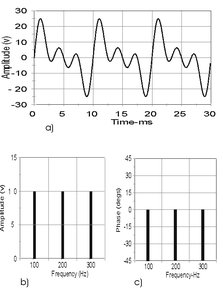
Harmonics and Their Effects
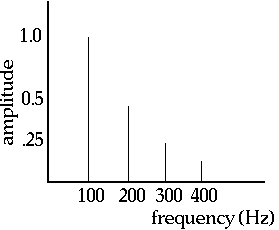
- Harmonics: Integer multiples of the fundamental frequency (\( f_0 \)). - Changing the amplitude of harmonics alters both the time domain and frequency domain displays. - Changing the phase of harmonics alters the time domain display but not the magnitude spectrum. 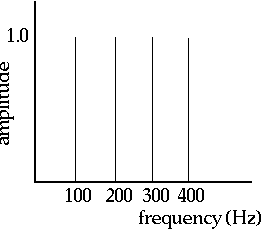
Square Waves and Fourier Synthesis
Square Wave Construction
Square waves are a classic example of complex periodic signals, constructed by summing odd harmonics of sine waves. - Fourier synthesis: The process of adding sine and cosine components to reconstruct a complex waveform. - Amplitude falloff: Harmonic amplitudes decrease as frequency increases. Example: The Fourier reconstruction of a square wave. 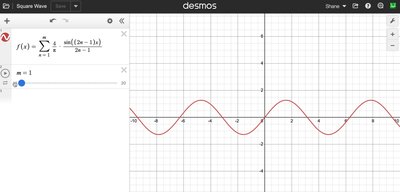
Amplitude and Frequency Modulation
Amplitude Modulation (AM)
Amplitude modulation occurs when the amplitude of a signal varies over time. - AM by addition: Adding two sine waves of different frequencies produces a beating effect. - AM by modulation: Modulating the amplitude of a single sine wave with another frequency. - \( F_c \): Carrier frequency - \( F_m \): Modulation frequency 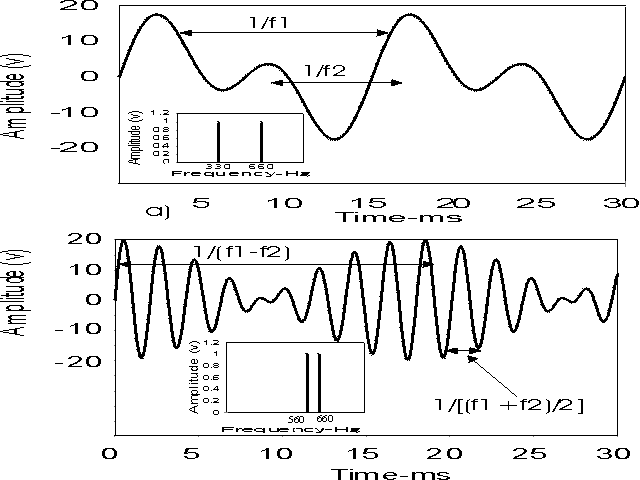
Frequency Modulation (FM)
Frequency modulation occurs when the frequency of a signal varies over time. - FM signals: Used in communication and animal echolocation. - Example: Big brown bats use frequency modulated calls for echolocation. 
Summary Table: Standing Waves in Tubes
Allowed vs. Forbidden Standing Waves
Allowed Standing Waves | Forbidden Standing Waves |
|---|---|
Node at closed end, antinode at open end | Antinode at closed end, node at open end |
Supports resonance | No resonance |
Constructive interference at open end | Destructive interference at open end |
Key Equations
Fourier Series for Periodic Signals
Amplitude Modulation
Node and Antinode Spacing
Additional info:
- Fourier analysis is foundational in both acoustics and optics, and is essential for understanding wave phenomena in physics. - The study of standing waves and Fourier synthesis is directly relevant to Physics with Calculus, especially in chapters on Waves & Sound, Fluid Mechanics, and Electromagnetic Waves.
