 뒤로
뒤로Study Notes: Representing Motion in Physics with Calculus
스터디 가이드 - 스마트 노트
 자료에 맞춘 맞춤형 노트, 핵심 정의, 예시, 맥락을 확장해 제공합니다.
Section 1.1 Motion: A First Look
Types of Motion
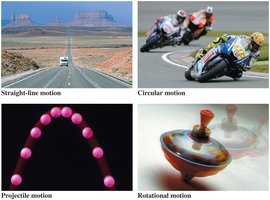
Motion is defined as the change of an object’s position or orientation with time. The path along which an object moves is called its trajectory. There are several fundamental types of motion encountered in physics:
Straight-line motion: Movement along a straight path.
Circular motion: Movement along a circular path.
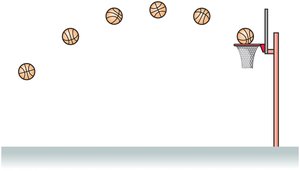
Projectile motion: Curved path under the influence of gravity.
Rotational motion: Spinning around an axis.
Making a Motion Diagram
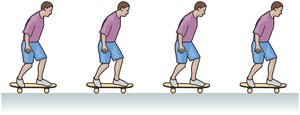
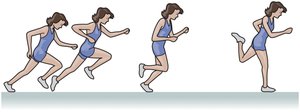
Motion diagrams are visual tools that represent an object's position at successive time intervals. They help distinguish between different types of motion:
Constant speed: Equal spacing between positions (e.g., skateboarder).
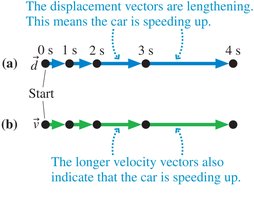
Speeding up: Increasing spacing between positions (e.g., runner).
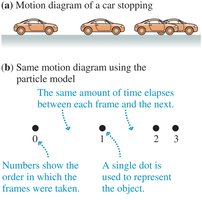
Slowing down: Decreasing spacing between positions (e.g., car).

Motion in Two Dimensions
Motion diagrams can also represent changes in both speed and direction, as seen in projectile or curved motion.
Section 1.2 Models and Modeling
Models in Physics
Models are simplified representations of physical systems that capture essential features while omitting unnecessary details. Two main types are:
Descriptive models: Describe properties in the simplest terms possible.
Explanatory models: Use physical laws to predict behavior.
The particle model is a key simplification where an object is treated as if all its mass is concentrated at a single point.

The Particle Model
In the particle model, a moving object is represented by a single point, making analysis of its motion more straightforward. This is especially useful for objects whose size and shape are not important to the problem at hand.
Section 1.3 Position and Time: Putting Numbers on Nature
Position and Coordinate Systems
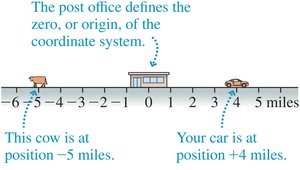
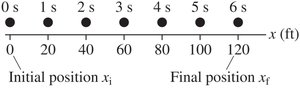
To specify an object's position, a reference point (origin), a distance from the origin, and a direction are needed. The combination of an origin and an axis marked in both positive and negative directions forms a coordinate system.
Time and Motion Diagrams
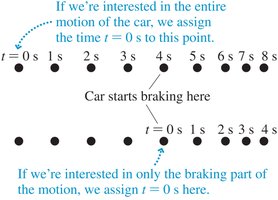
Each frame in a motion diagram is labeled with its corresponding time, denoted by the symbol t, as read from a clock.
Displacement
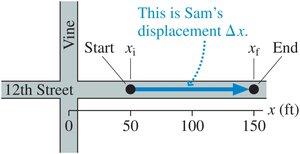
Displacement is the difference between an object's final and initial positions. It is a vector quantity, meaning it has both magnitude and direction.
Time Interval
A time interval measures the elapsed time as an object moves from an initial position at time t_i to a final position at time t_f. Time intervals are always positive.
Section 1.4 Velocity
Velocity and Speed
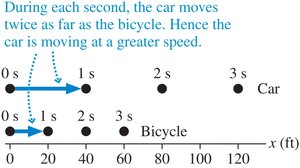
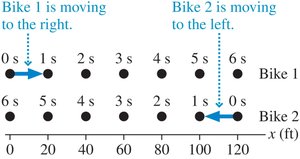
Uniform motion is motion at a constant speed in a straight line. Speed measures how fast an object moves, while velocity includes both speed and direction. The average velocity is defined as:
Speed: Scalar quantity (no direction).
Velocity: Vector quantity (includes direction).
Section 1.5 Significant Figures, Scientific Notation, and Units
Measurements and Significant Figures
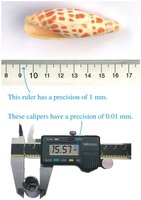
Measurements are limited by the precision of the measuring instrument. Significant figures are the digits in a measurement that are reliably known. The rules for significant figures are:
For multiplication/division, the answer has as many significant figures as the least precise number.
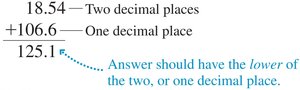
For addition/subtraction, the answer has as many decimal places as the least precise number.

Scientific Notation
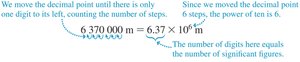
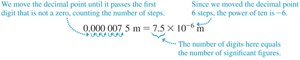
Scientific notation expresses very large or small numbers in the form a × 10^n, making it easier to handle and clarify significant figures.
Unit Conversion and Metric Prefixes
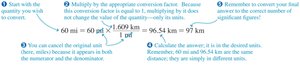
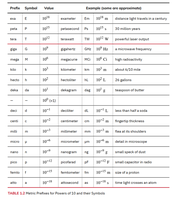
The SI system is the standard in science. Unit conversions are performed using conversion factors. Metric prefixes indicate multiples or fractions of units.
Section 1.6 Vectors and Motion: A First Look
Scalars and Vectors
A scalar is described by a single number (with a unit), while a vector has both magnitude and direction. The magnitude of a vector is its size or length. Vectors are represented graphically as arrows.

Displacement Vectors
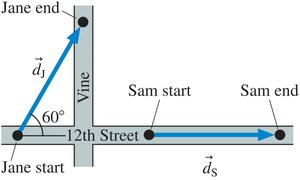
The displacement vector shows the straight-line distance and direction from an object's initial to final position, regardless of the path taken.
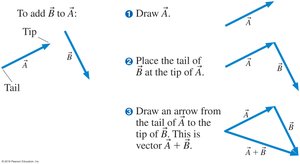
Adding Vectors
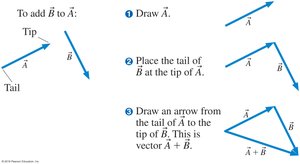
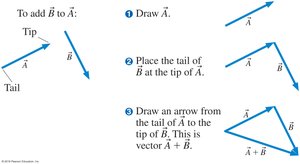
Vectors are added using the tip-to-tail method. The net displacement is the vector sum of individual displacements.
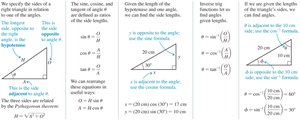
Vectors and Trigonometry
Trigonometry is used to calculate the lengths and angles of triangles formed by vectors, which is essential for decomposing vectors into components.
Example: Finding Net Displacement
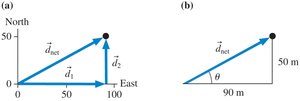
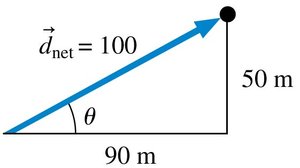
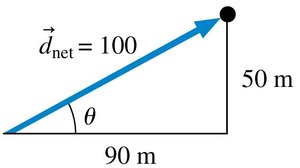
When an object moves in two perpendicular directions (e.g., east and north), the net displacement is found using the Pythagorean theorem:
If an object moves 90 m east and 50 m north, the net displacement is:
$ d = \sqrt{(90\ \text{m})^2 + (50\ \text{m})^2} = 100\ \text{m} $ $ \theta = \tan^{-1}\left(\frac{50}{90}\right) = 29^\circ $ north of east 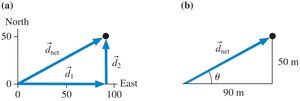
Velocity Vectors
The velocity vector points in the direction of motion and its magnitude equals the object's speed.
Summary
Motion can be described using diagrams, models, and vectors.
Position, displacement, velocity, and acceleration are fundamental concepts in kinematics.
Significant figures, scientific notation, and unit conversions are essential for precise measurement and calculation in physics.
Vectors are crucial for describing motion in more than one dimension.
