 뒤로
Superposition and Standing Waves: Chapter 16 Study Notes
스터디 가이드 - 스마트 노트
 자료에 맞춘 맞춤형 노트, 핵심 정의, 예시, 맥락을 확장해 제공합니다.
Superposition and Standing Waves
Introduction
This chapter explores the principle of superposition, interference phenomena, and the formation of standing waves. These concepts are fundamental in understanding wave behavior in various physical systems, including strings and sound tubes.
The Principle of Superposition
Definition and Basic Concept
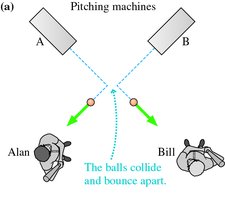
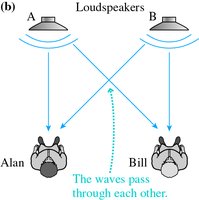
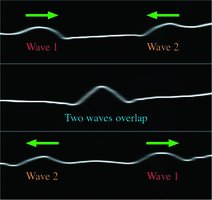
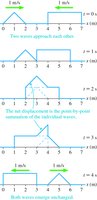
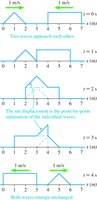
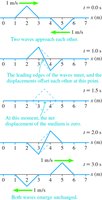
The principle of superposition states that when two or more waves are present at a single point in space, the displacement of the medium at that point is the sum of the displacements due to each individual wave. Unlike particles, which collide and alter each other's paths, waves can pass through one another without permanent alteration.
Key Point 1: Superposition applies to all types of waves, including mechanical and electromagnetic waves.
Key Point 2: The resulting displacement is calculated by adding the individual displacements at each point in the medium.
Example: Two sound waves from different sources overlap, and the sound heard is the sum of both waves' effects.
Constructive and Destructive Interference
Interference is the result of superposition. It can be constructive or destructive depending on the phase and amplitude of the overlapping waves.
Constructive Interference: Occurs when both waves have displacements in the same direction, resulting in a larger total displacement.
Destructive Interference: Occurs when the waves have displacements in opposite directions, reducing the total displacement. At points of perfect destructive interference, the medium may not move at all.
Example: Two water waves meeting can create a larger crest (constructive) or cancel each other out (destructive).
Standing Waves
Definition and Characteristics
Standing waves are waves that appear to oscillate in place rather than travel through the medium. They are formed by the superposition of two waves of equal amplitude and wavelength traveling in opposite directions.
Key Point 1: Individual points on the medium oscillate up and down, but the overall wave pattern remains stationary.
Key Point 2: Standing waves are common in strings fixed at both ends and in air columns.
Example: Vibrating guitar strings produce standing waves.


Formation of Standing Waves
Standing waves are created when two sinusoidal waves of equal wavelength and amplitude travel in opposite directions and interfere. The resulting wave is the sum of the individual displacements at each point.
Key Point 1: The observed wave is the result of superposition, often visualized as a stationary pattern.
Key Point 2: The pattern depends on the boundary conditions and the wavelength of the waves.
Nodes and Antinodes
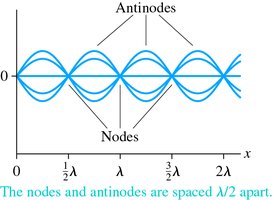
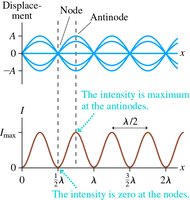
In a standing wave, nodes are points that remain stationary, while antinodes are points of maximum oscillation.
Key Point 1: Nodes are spaced apart by half the wavelength ().
Key Point 2: At nodes, destructive interference occurs, resulting in zero displacement. At antinodes, constructive interference results in maximum displacement.
Example: The distance between successive nodes or antinodes is .
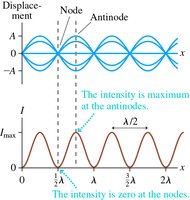
Standing Waves on a String
Reflection and Boundary Conditions
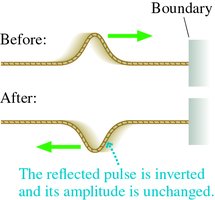
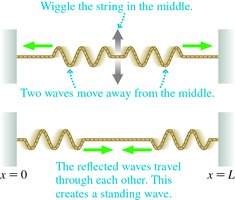
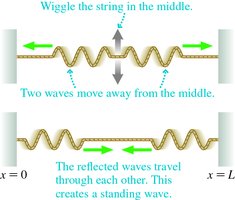
Standing waves on a string are formed by reflections at boundaries. When a wave pulse reaches a fixed boundary, it is reflected and inverted, but its amplitude remains unchanged.
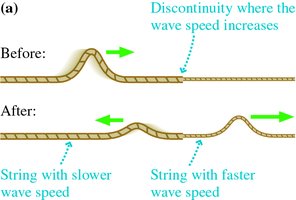
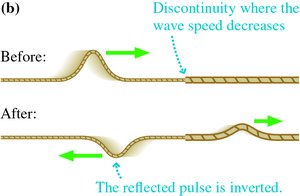
Key Point 1: At a discontinuity, some energy is transmitted and some is reflected.
Key Point 2: If the string on one side of the boundary is more massive, the reflected pulse is inverted.
Creating Standing Waves
Standing waves are created on a string with two fixed boundaries. The string must have nodes at both ends, and the spacing between nodes is determined by the wavelength.
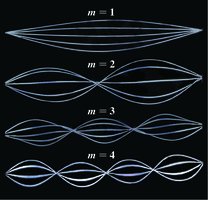
Key Point 1: The mode number m quantifies the number of possible standing wave patterns.
Key Point 2: The wavelength for mode m is given by:
where L is the length of the string and m is the mode number (1, 2, 3, ...).

Oscillation Frequency and Resonant Modes
The frequency of oscillation for mode m is:
where v is the wave speed on the string.
Key Point 1: The mode number m equals the number of antinodes.
Key Point 2: Resonant modes are frequencies at which the string naturally oscillates.

The Fundamental and Higher Harmonics
Harmonics and Frequency Relationships
The fundamental frequency is the lowest frequency at which a standing wave can form. Higher modes have frequencies that are integer multiples of the fundamental frequency.
Key Point 1: The sequence of possible frequencies forms a set of harmonics.
Key Point 2: The fundamental frequency is also known as the first harmonic; higher harmonics correspond to higher mode numbers.
Example: For a string of length L and wave speed v, the fundamental frequency is .

Summary Table: Standing Wave Properties
Mode Number (m) | Wavelength () | Frequency () | Number of Antinodes |
|---|---|---|---|
1 | 1 | ||
2 | 2 | ||
3 | 3 | ||
... | ... | ... | ... |
Additional info: The table summarizes the relationship between mode number, wavelength, frequency, and antinodes for standing waves on a string.
