 뒤로
뒤로Two-Dimensional Kinematics: Motion in a Plane and Projectile Motion
스터디 가이드 - 스마트 노트
 자료에 맞춘 맞춤형 노트, 핵심 정의, 예시, 맥락을 확장해 제공합니다.
Two-Dimensional Kinematics
Introduction to Motion in Two Dimensions
Two-dimensional kinematics studies the motion of objects that move in a plane, requiring analysis of both the x (horizontal) and y (vertical) components. The equations of motion for constant acceleration are applied separately to each direction, allowing for a systematic approach to solving problems involving vectors.
Position Equations:
Horizontal:
Vertical:
Velocity Equations:
Horizontal:
Vertical:
Velocity Squared Equations:
Horizontal:
Vertical:
Special Cases: For constant velocity, set . If there is no acceleration in one direction, set the corresponding acceleration to zero.
Vector Components in Two-Dimensional Motion
To analyze two-dimensional motion, it is essential to resolve vectors (such as velocity or displacement) into their horizontal and vertical components. This is especially important in projectile motion and other kinematics problems.
Component Formulas:
(or if directed downward)
Coordinate System: Choose the origin and positive directions for x and y axes based on the problem context.
Worked Examples in Two-Dimensional Kinematics
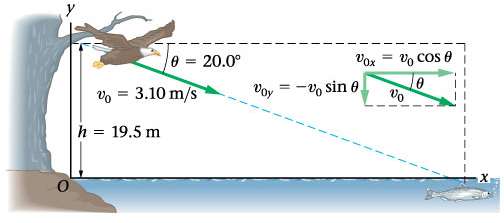
Example 1: Eagle Descending Toward Water
An eagle perched 19.5 m above water descends at a constant speed of 3.10 m/s at 20.0° below the horizontal. The problem involves finding the time to reach the water, the horizontal distance traveled, and the displacement.
Step 1: Resolve Velocity Components
m/s
m/s
Step 2: Find Time to Reach Water
Set (water level), m, (constant velocity):
→ s
Step 3: Find Horizontal Distance
m
Step 4: Displacement Vector
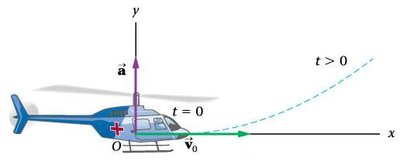
Example 2: Helicopter with Vertical Acceleration
A helicopter moves horizontally at 11 m/s and then accelerates upward at 0.96 m/s2. The problem asks for distances traveled, velocity components, and displacement after a given time.
Step 1: Horizontal and Vertical Distances in 5.3 s
m
m
Step 2: Velocity Components at 5.3 s
m/s (no horizontal acceleration)
m/s
Step 3: Velocity Vector
m/s
Magnitude: m/s
Direction: above horizontal
Step 4: Time to Move 18 m Vertically
s
Step 5: Horizontal Distance at 18 m Vertical
m
Step 6: Displacement
m
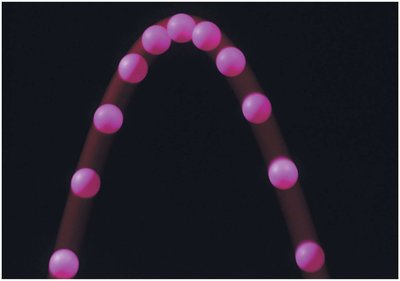
Projectile Motion
Definition and Equations
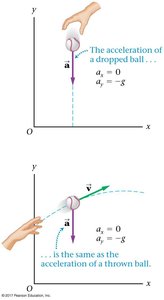
Projectile motion describes the motion of an object launched into the air and moving under the influence of gravity alone. The horizontal acceleration is zero (), and the vertical acceleration is m/s2 (downward).
Horizontal Motion:
Vertical Motion:
Key Point: The acceleration of a dropped object and a thrown object is the same: , .
Example: Projectile Launched at an Angle
A projectile is launched from the origin at 20.0 m/s at 35.0° above the horizontal. Find the x and y positions at various times, the velocity at those times, and the maximum height.
Step 1: Resolve Initial Velocity
m/s
m/s
Step 2: Find Positions at s
m
m
Step 3: Repeat for s and s
s: m, m
s: m, m
Step 4: Velocity at s
m/s
m/s
m/s
Step 5: Velocity at s
m/s
m/s
m/s
Step 6: Maximum Height
At max height, :
→ m
Step 7: Time to Maximum Height
→ s
Step 8: Times at Half Maximum Height
There are two times: on the way up and on the way down (e.g., s and s).
Additional info: The parabolic path of projectile motion is a direct result of constant horizontal velocity and constant downward acceleration due to gravity. The symmetry of the path means that for any height (except the maximum), there are two times when the projectile is at that height: once ascending and once descending.
