 뒤로
Units, Physical Quantities, and Vectors: Foundations of Physics with Calculus
스터디 가이드 - 스마트 노트
 자료에 맞춘 맞춤형 노트, 핵심 정의, 예시, 맥락을 확장해 제공합니다.
Units, Physical Quantities, and Vectors
Introduction to Physics and Problem Solving
Physics is an experimental science that seeks to uncover patterns in nature, known as physical theories. Well-established theories are called physical laws or principles. Problem-solving in physics typically follows four steps:
Identify relevant concepts, target variables, and known quantities.
Set Up the problem by choosing equations and drawing a sketch.
Execute the solution by performing calculations.
Evaluate the answer by comparing with estimates and checking for discrepancies.
Idealized models are often used to simplify complex real-world phenomena, such as treating a baseball as a point object to ignore air resistance and variable gravitational force.
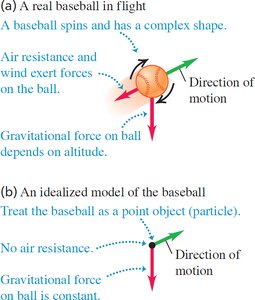
Fundamental Quantities and SI Units
Physics relies on three fundamental quantities: length (meter, m), time (second, s), and mass (kilogram, kg). The International System of Units (SI) is the standard system used worldwide. Prefixes are used to denote multiples or fractions of units, such as kilo- (103), milli- (10-3), and micro- (10-6).
Unit Consistency and Conversions
Equations in physics must be dimensionally consistent; all terms must have the same units. Unit conversions are performed by multiplying by ratios that equal one, ensuring the correct units are used throughout calculations.
Example: To convert 3 minutes to seconds:
Uncertainty and Significant Figures
All measurements have uncertainty, reflected in the number of significant figures reported. The rules for significant figures differ for multiplication/division and addition/subtraction:
Multiplication/Division: The result has as many significant figures as the factor with the fewest.
Addition/Subtraction: The result is limited by the term with the fewest digits to the right of the decimal point.
Scalars and Vectors
Scalars are quantities described by a single number (e.g., mass, temperature). Vectors have both magnitude and direction (e.g., displacement, velocity, force). Vectors are represented by arrows; the length indicates magnitude, and the arrowhead indicates direction.
Drawing and Representing Vectors
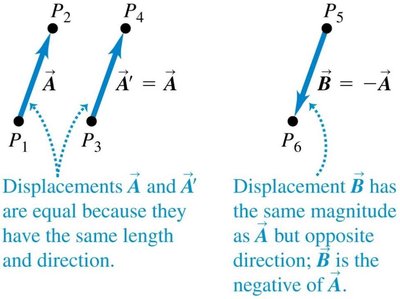
Vectors are drawn as arrows. Two vectors are equal if they have the same magnitude and direction, regardless of their initial points. The negative of a vector has the same magnitude but opposite direction.
Vector Addition and Subtraction
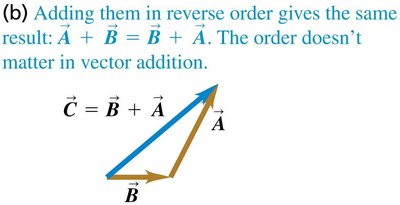
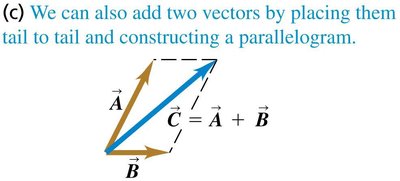
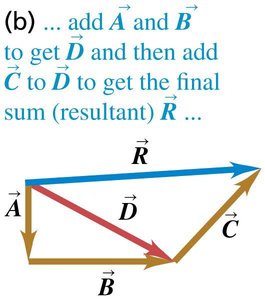
Vectors can be added graphically using the head-to-tail method or by constructing a parallelogram. Vector addition is commutative: .
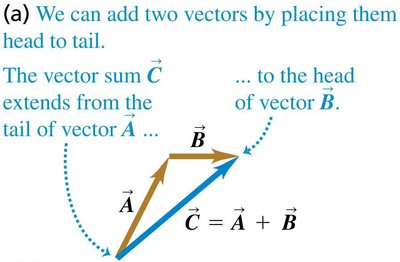
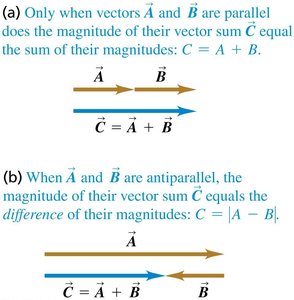
When vectors are parallel, their magnitudes add; when antiparallel, their magnitudes subtract.
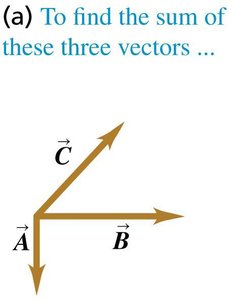
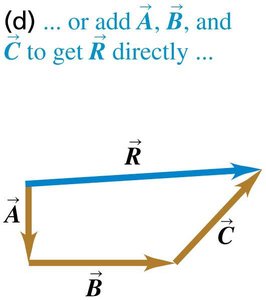
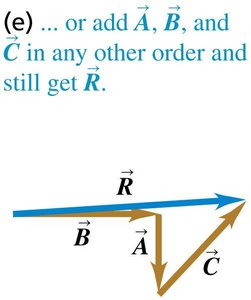
To add more than two vectors, use the head-to-tail method in any order. The resultant vector is independent of the order of addition.
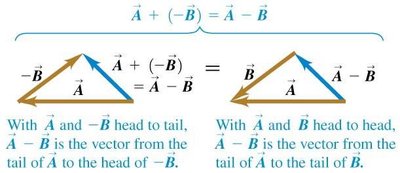
Vector subtraction is equivalent to adding the negative of a vector: .
Multiplying a Vector by a Scalar
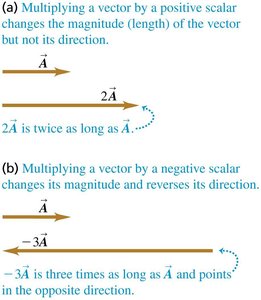
Multiplying a vector by a positive scalar changes its magnitude but not its direction. Multiplying by a negative scalar reverses the direction.
Adding Vectors at Right Angles
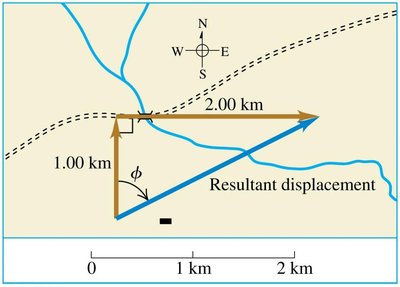
When adding two vectors at right angles, use the Pythagorean theorem and trigonometry to find the resultant's magnitude and direction.
Example: A skier travels 1.00 km north and then 2.00 km east. The resultant displacement is at east of north.
Components of a Vector
Any vector can be resolved into perpendicular components, typically along the x- and y-axes. The components are found using trigonometric functions:
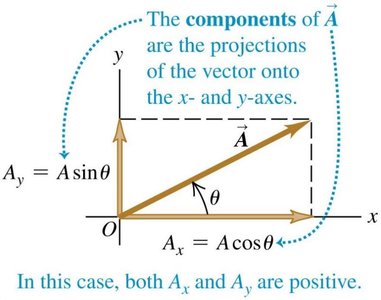
Components can be positive or negative, depending on the vector's direction.
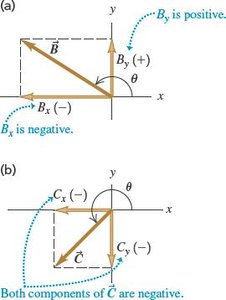
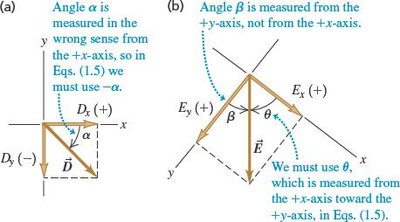
The magnitude and direction of a vector from its components are:
The components of the sum of vectors are the sums of the components of each vector.
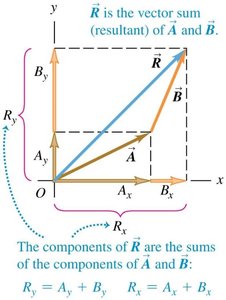
Unit Vectors
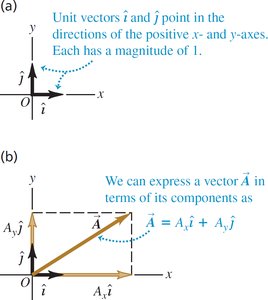
Unit vectors have magnitude 1 and indicate direction along coordinate axes. In three dimensions:
: +x direction
: +y direction
: +z direction
Any vector can be written as .
Scalar (Dot) Product of Vectors
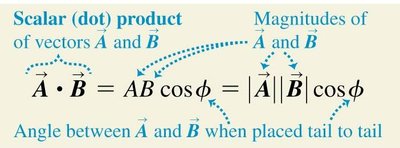
The scalar product (dot product) of two vectors and is defined as:
Where is the angle between the vectors when placed tail to tail.
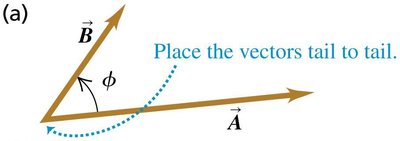
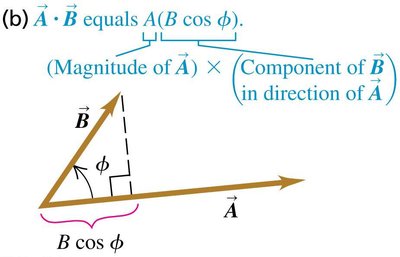
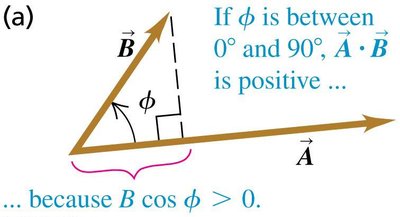
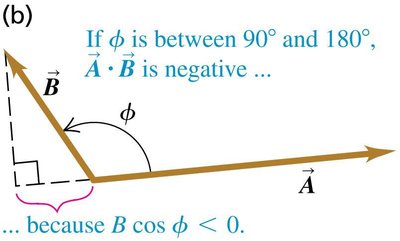
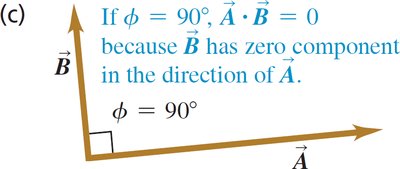
The dot product can be positive, negative, or zero depending on the angle:
: positive
: negative
: zero
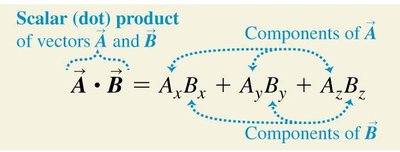
In terms of components:
Vector (Cross) Product of Vectors
The vector product (cross product) of two vectors and is a vector given by:
The magnitude is
The direction is perpendicular to the plane of and , determined by the right-hand rule.
The cross product is anticommutative:
Example: The torque produced by a force applied at position is .
