 뒤로
뒤로Vector Arithmetic: Scalar Multiplication, Addition, and Subtraction
스터디 가이드 - 스마트 노트
 자료에 맞춘 맞춤형 노트, 핵심 정의, 예시, 맥락을 확장해 제공합니다.
Vector Arithmetic
Scalar Multiplication
Scalar multiplication involves multiplying a vector by a scalar (a real number), which changes the magnitude of the vector and possibly its direction, depending on the sign of the scalar.
Definition: If \( \vec{A} \) is a vector and c is a scalar, then the product \( \vec{B} = c\vec{A} \).
Magnitude: \( B = |c|A \), where \( A \) is the magnitude of \( \vec{A} \).
Direction: The direction of \( \vec{B} \) is the same as \( \vec{A} \) if c is positive, and reversed if c is negative.
Components: If \( \vec{A} = (A_x, A_y, A_z) \), then \( \vec{B} = (cA_x, cA_y, cA_z) \).
Units: If c has units, \( \vec{B} \) may represent a different physical quantity than \( \vec{A} \). If c is dimensionless, \( \vec{B} \) has the same units as \( \vec{A} \).
Common Cases:
\( |c| > 1 \): Stretches the vector (increases magnitude).
\( |c| < 1 \): Shrinks the vector (decreases magnitude).
\( c = -1 \): Reverses the direction.
\( c = 0 \): Results in the zero vector (no direction).
Vector Addition
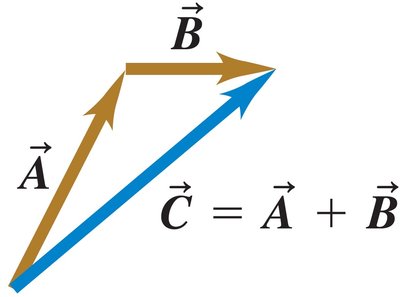
Vector addition combines two or more vectors to produce a resultant vector. This operation is fundamental in physics for combining forces, velocities, and other vector quantities.
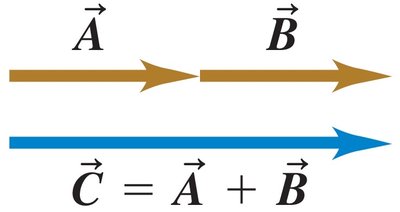
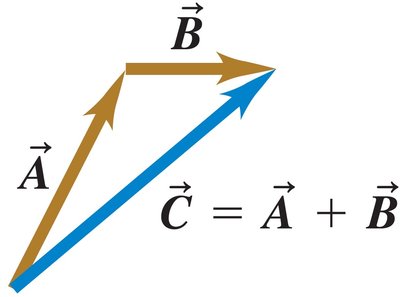
Definition: The sum of vectors \( \vec{A} \) and \( \vec{B} \) is \( \vec{R} = \vec{A} + \vec{B} \).
Graphical Method (Tip-to-Tail):
Draw \( \vec{A} \).
Draw \( \vec{B} \) starting from the tip of \( \vec{A} \).
The resultant \( \vec{R} \) is drawn from the tail of \( \vec{A} \) to the tip of \( \vec{B} \).
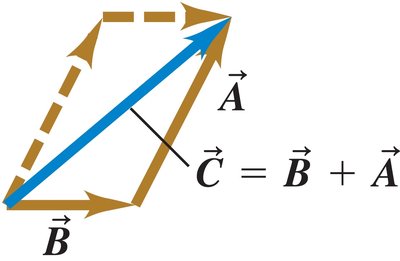
Commutativity: \( \vec{A} + \vec{B} = \vec{B} + \vec{A} \).
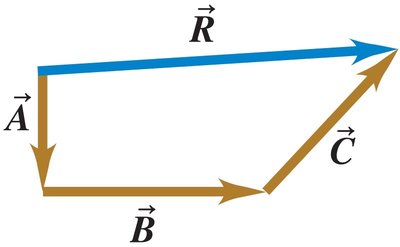
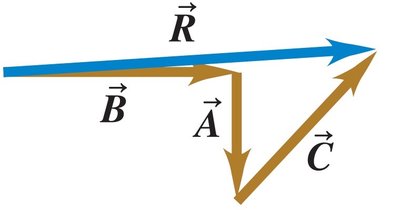
Adding Multiple Vectors: Repeat the tip-to-tail method for each additional vector. The resultant is from the start of the first to the end of the last vector.
Addition of Parallel and Antiparallel Vectors
If vectors are parallel, their magnitudes add directly.
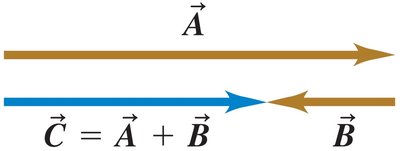
If vectors are antiparallel, their magnitudes subtract (direction is determined by the larger magnitude).
Vector Subtraction
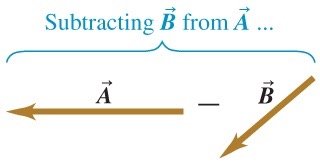
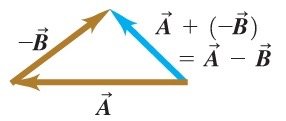
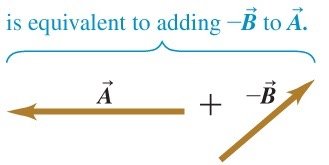
Vector subtraction finds the difference between two vectors. Subtracting \( \vec{B} \) from \( \vec{A} \) is equivalent to adding \( -\vec{B} \) to \( \vec{A} \).
Definition: \( \vec{R} = \vec{A} - \vec{B} \).
Graphical Method:
Draw \( \vec{A} \).
Draw \( -\vec{B} \) (reverse direction of \( \vec{B} \)) starting from the tip of \( \vec{A} \).
Resultant \( \vec{R} \) is from the tail of \( \vec{A} \) to the tip of \( -\vec{B} \).
Non-Commutativity: \( \vec{A} - \vec{B} \neq \vec{B} - \vec{A} \); in fact, \( \vec{A} - \vec{B} = - (\vec{B} - \vec{A}) \).
Methods for Calculating Resultant Vectors
Triangle (Geometric/Trigonometric) Method
This method uses geometric and trigonometric relationships to solve for unknown sides or angles in vector addition, especially useful for two vectors or three vectors summing to zero.
Redraw the vectors as a triangle, labeling all known sides and angles.
Apply the Pythagorean theorem for right triangles:
Use SOH CAH TOA for right triangles, or the Law of Sines and Cosines for general triangles:
Component Method
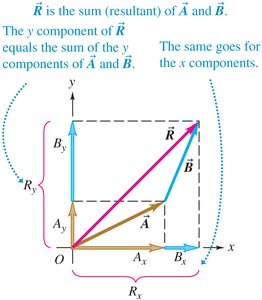
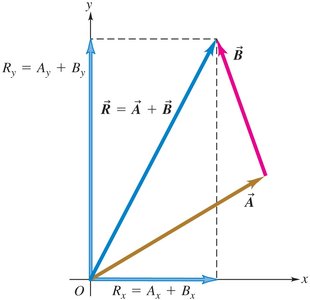
The component method breaks each vector into its x, y (and z, if needed) components, adds the components, and reconstructs the resultant vector.
Find components:
Add components:
Resultant magnitude and direction:
Review Quiz
If vector \( \vec{V} \) has a trig. direction of 115°, then \( -\vec{V} \) has a trig. direction of: Answer: 295° (add 180° to reverse direction)
True/False: Magnitude of (A+B) = (Magnitude of A) + (Magnitude of B) for any two vectors A & B. Answer: False (only true if vectors are parallel and in the same direction)
If (A–B) has a trig. direction of 70°, then (B–A) has a trig. direction of: Answer: 250° (add 180° to reverse direction)
