 뒤로
뒤로Vector Components, Decomposition, and Projectile Motion – Physics with Calculus Study Guide
스터디 가이드 - 스마트 노트
 자료에 맞춘 맞춤형 노트, 핵심 정의, 예시, 맥락을 확장해 제공합니다.
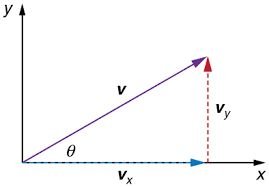
Q1. Which trigonometric relationship would allow us to determine the length of vector v using only its components (v_x, v_y)?
Background
Topic: Vector Decomposition and Magnitude
This question tests your understanding of how to find the magnitude of a vector when its x- and y-components are known. This is a fundamental concept in physics, especially when analyzing forces, velocities, or any vector quantity in two dimensions.
Key Terms and Formulas
Vector Components: The projections of a vector along the x- and y-axes, denoted as v_x and v_y.
Magnitude of a Vector: The length of the vector, found using the Pythagorean theorem when components are known.
Key formula:
Step-by-Step Guidance
Recall that the x- and y-components of a vector form a right triangle with the vector as the hypotenuse.
To find the length of the hypotenuse (the vector's magnitude), use the relationship between the sides of a right triangle.
Identify which trigonometric or geometric relationship connects the sides of a right triangle to its hypotenuse when both legs are known.
Try solving on your own before revealing the answer!
Final Answer: D) Pythagorean’s theorem
The magnitude of the vector is found using the Pythagorean theorem: . This relationship directly relates the components to the vector's length.
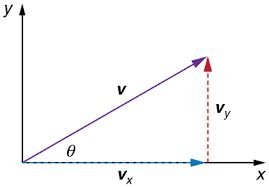
Q2. What are the x- and y-components of this vector? (Refer to the diagram provided.)
Background
Topic: Vector Components
This question tests your ability to read a vector diagram and correctly determine the signs and values of its x- and y-components based on its orientation in the coordinate system.
Key Terms and Formulas
Component: The projection of a vector along an axis (x or y).
Signs of Components: Determined by the direction of the vector relative to the axes.
Step-by-Step Guidance
Examine the direction of the vector in the diagram. Determine in which quadrant the vector lies.
Recall the sign conventions for each quadrant: Quadrant I (+,+), Quadrant II (−,+), Quadrant III (−,−), Quadrant IV (+,−).
Read the lengths of the x- and y-components from the diagram, paying attention to their signs based on the vector's direction.
Try solving on your own before revealing the answer!
Final Answer: B. 3, −4
The x-component is positive (to the right), and the y-component is negative (downward), so the components are (3, −4).
Q3. A car drives up a sloped road at a constant speed of 15 m/s. After 10 s, how much height has the car gained?
Background
Topic: Motion on an Incline, Vector Decomposition
This question tests your ability to decompose velocity into components and use trigonometry to relate distance traveled along a slope to vertical height gained.
Key Terms and Formulas
Constant Velocity: The car's speed along the slope does not change.
Vertical Component of Velocity:
Height Gained:

Step-by-Step Guidance
Calculate the total distance traveled along the slope: .
Use trigonometry to relate the distance along the slope to the vertical height: .
Alternatively, find the vertical component of velocity () and multiply by time to get the height gained: .
Set up the equation for height gained, but do not substitute the final values yet.
Try solving on your own before revealing the answer!
Final Answer:
The height gained is . You need the angle of the incline to compute the exact value. If the angle is given, substitute it in to find the height.
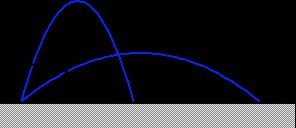
Q4. Two projectiles are fired from a cannon. For projectile A, the cannon is tilted upward at an angle twice that of projectile B. (Neglect air resistance.) Which projectile was in the air longer?
Background
Topic: Projectile Motion, Time of Flight
This question tests your understanding of how the launch angle affects the time a projectile spends in the air, assuming both are launched with the same initial speed.
Key Terms and Formulas
Time of Flight: The total time a projectile spends in the air.
Vertical Component of Velocity:
Time of Flight Formula: (for projectiles landing at the same height they were launched from)
Step-by-Step Guidance
Recall that the time of flight depends on the vertical component of the initial velocity.
Compare for the two angles: one is , the other is .
Determine which angle gives a larger value for , and thus a longer time of flight.
Try solving on your own before revealing the answer!
Final Answer: A) Projectile A
Projectile A, launched at a larger angle, has a greater vertical component of velocity and thus stays in the air longer (assuming both are launched from and land at the same height).
