 뒤로
Vectors and Kinematics: Foundations for Physics with Calculus
스터디 가이드 - 스마트 노트
 자료에 맞춘 맞춤형 노트, 핵심 정의, 예시, 맥락을 확장해 제공합니다.
Vectors in Physics
Scalar vs. Vector Quantities
Physical quantities in physics are classified as either scalars or vectors. Scalars have only magnitude, while vectors possess both magnitude and direction.
Scalar quantities: Examples include time, temperature, energy, and mass. Operations with scalars use ordinary algebra.
Vector quantities: Examples include position, velocity, and acceleration. Vector operations differ from scalar operations and require special rules.
Displacement Vector
The displacement vector represents the change in position from point A to point B. It depends only on the initial and final points, not the path taken.
Magnitude: Length of the vector.
Direction: Points from the initial to the final position.
Unit Vectors
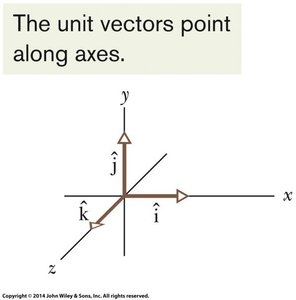
Unit vectors have a magnitude of 1 and indicate direction along a specific axis. In 2D and 3D, unit vectors are used to express directions.
Common unit vectors: (x-axis), (y-axis), (z-axis).
Vector Components
Breaking Vectors into Components
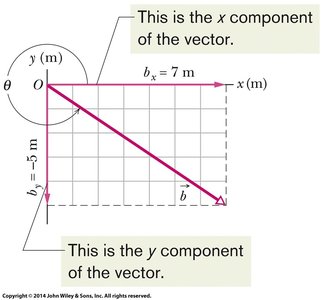
Any vector can be decomposed into components along the axes. The x and y components are projections of the vector along those axes and can be positive or negative.
In 2D: , where is the angle with the positive x-axis and is the magnitude.
In 3D: Components are , , .
Finding Magnitude and Direction from Components
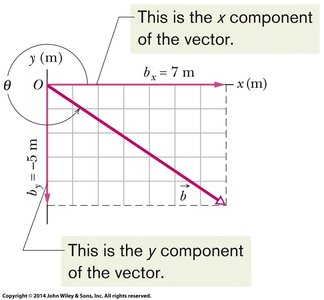
Once the components are known, the magnitude and direction of the vector can be calculated:
Magnitude:
Angle:
Trigonometric Functions in Vector Analysis
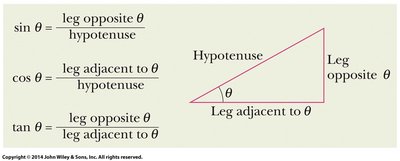
Basic trigonometric functions relate the sides and angles of a right triangle, which is essential for resolving vectors.
Coordinate Systems and Vectors
The magnitude and direction of a vector are independent of the coordinate system. Rotating or modifying the coordinate system does not affect the vector itself, only its representation.
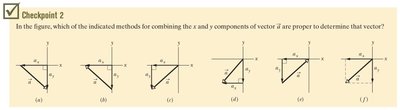
Combining Vector Components
Proper arrangement of vector components is necessary to reconstruct the original vector.
Vector Addition and Subtraction
Adding Vectors
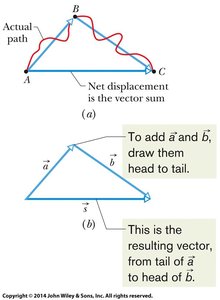
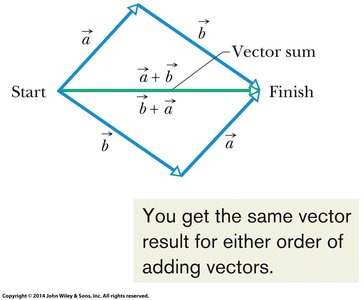
Vectors are added graphically by placing them head-to-tail. The resulting vector is drawn from the tail of the first to the head of the last.
Net vector: The sum of multiple vectors, such as total displacement.
Commutative property:
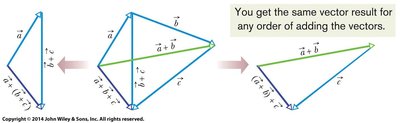
Associative property:

Subtracting Vectors
Subtracting a vector is equivalent to adding its negative. The negative of a vector points in the opposite direction.
Component-wise Addition and Subtraction
Vectors can be added or subtracted by combining their respective components.
Only vectors of the same physical quantity can be added.
Example: ;
Products of Vectors
Scalar Multiplication
Multiplying a vector by a scalar changes its magnitude but not its direction (unless the scalar is negative, which reverses the direction).
Example: doubles the magnitude.
Dot Product (Scalar Product)
The dot product of two vectors results in a scalar and is given by:
Commutative:
If , dot product is maximum; if , dot product is zero.

Cross Product (Vector Product)
The cross product of two vectors results in a new vector perpendicular to both original vectors. Its magnitude is:
Direction is given by the right-hand rule.
Not commutative:

Kinematics: Motion in One Dimension
Position, Displacement, and Reference Points
Position is a vector quantity that describes the location of an object relative to a reference point. Displacement is the change in position.
Position:
Displacement:
Velocity: Rate of Displacement
Velocity is the rate of change of displacement. Average velocity is defined over a time interval, while instantaneous velocity is the slope of the position vs. time graph.
Average velocity:
Instantaneous velocity:
Acceleration: Rate of Change of Velocity
Acceleration is the rate at which velocity changes with time. Average acceleration is defined over a time interval, while instantaneous acceleration is the slope of the velocity vs. time graph.
Average acceleration:
Instantaneous acceleration:
Constant Acceleration in One Dimension
Equations of Motion
For motion with constant acceleration, the following equations apply:
Velocity as a function of time:
Position as a function of time:
Velocity squared:
Free Fall
Objects in free fall experience constant acceleration due to gravity ( downward). The sign of velocity and acceleration depends on the direction of motion.
Upward motion: positive velocity, negative acceleration
Downward motion: negative velocity, negative acceleration
Summary: Position, velocity, and acceleration are fundamental concepts in kinematics. Constant acceleration leads to predictable motion described by quadratic and linear equations.
