 뒤로
뒤로Vectors and Motion in Two Dimensions: Study Notes for Physics with Calculus
스터디 가이드 - 스마트 노트
 자료에 맞춘 맞춤형 노트, 핵심 정의, 예시, 맥락을 확장해 제공합니다.
Vectors and Motion in Two Dimensions
Introduction to Vectors and Components
Understanding vectors is essential for analyzing motion in two dimensions. Vectors are quantities that have both magnitude and direction, and they are used to describe physical quantities such as displacement, velocity, and acceleration.
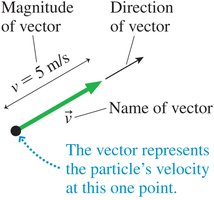
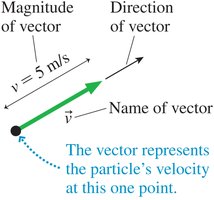
Vector Definition: A vector is represented by an arrow; its length indicates magnitude, and its orientation shows direction.
Magnitude: The size or length of a vector, always a positive quantity.
Direction: The orientation of the vector in space, often specified by an angle.
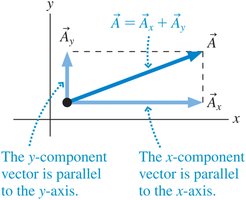
Component Vectors: Any vector can be decomposed into horizontal (x) and vertical (y) components, which are themselves vectors parallel to the axes.
Application: Vectors are used to describe the motion of objects such as basketballs, fish leaping in arcs, or cars moving along ramps.
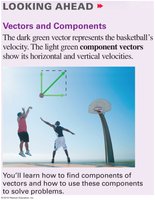
Projectile Motion
Projectile motion is a classic example of two-dimensional motion, where an object moves under the influence of gravity alone, following a parabolic path.
Independence of Motions: The horizontal and vertical components of projectile motion are independent of each other.
Vertical Motion: Governed by gravity, with acceleration .
Horizontal Motion: Constant velocity, with (if air resistance is neglected).
Examples: The leap of a fish or a basketball shot both follow projectile motion.

Circular Motion
When an object moves in a circle at constant speed, it experiences acceleration due to the continuous change in direction of its velocity vector. This is called centripetal acceleration.
Centripetal Acceleration: Always points toward the center of the circle.
Magnitude: , where is speed and is the radius of the circle.
Application: Amusement park rides and cars turning corners are examples of circular motion.

Section 3.1: Using Vectors
Vector Representation and Properties
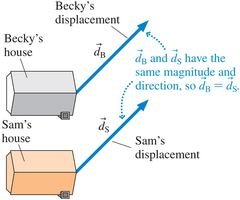
Vectors are fundamental in describing motion. The magnitude of a vector is always positive, and vectors are equal if they have the same magnitude and direction, regardless of their initial points.
Notation: Vectors are denoted with arrows, e.g., for velocity.
Magnitude: (example for velocity).
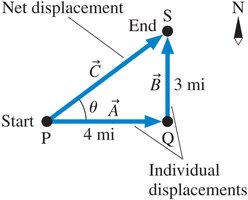
Displacement Vector: Connects the initial and final positions directly, regardless of the path taken.
Vector Addition and Subtraction
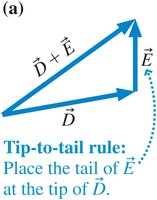
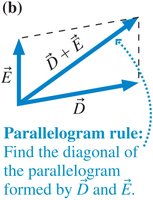
Vectors can be added or subtracted graphically or algebraically. The sum of two vectors is called the resultant vector.
Tip-to-Tail Rule: Place the tail of the second vector at the tip of the first.
Parallelogram Rule: The diagonal of the parallelogram formed by two vectors gives their sum.
Commutativity: .
Multiplication by a Scalar
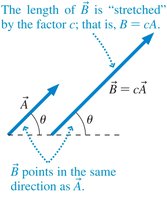
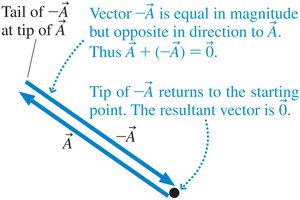
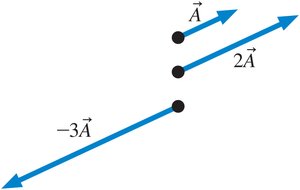
Multiplying a vector by a scalar changes its magnitude but not its direction (unless the scalar is negative, which reverses the direction).
Positive Scalar: points in the same direction as .
Negative Scalar: points in the opposite direction.
Zero Scalar: is the zero vector (no magnitude or direction).
Section 3.2: Coordinate Systems and Vector Components
Coordinate Systems
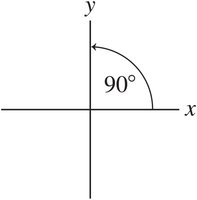
Coordinate systems, such as Cartesian coordinates, are used to describe the position and motion of objects in space. The origin is where the axes intersect, and each axis has positive and negative directions.
Cartesian Coordinates: Most common system, with x- and y-axes perpendicular to each other.
Component Vectors: Any vector can be written as the sum of its x- and y-components: .
Finding Components of a Vector
Trigonometry is used to find the components of a vector given its magnitude and direction.
Formulas:
Magnitude from Components:
Direction from Components:
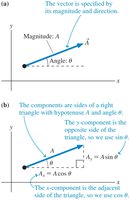
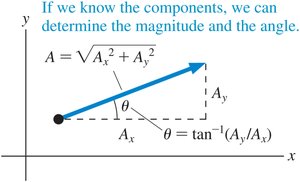
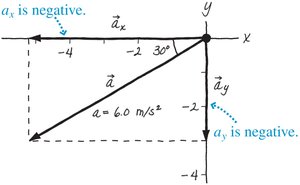
Example: Components of an Acceleration Vector
Given a vector with magnitude at below the negative x-axis, both components are negative:
Section 3.3: Motion on a Ramp
Constant-Velocity and Accelerated Motion on a Ramp
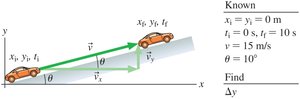
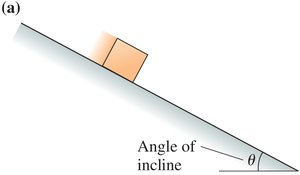
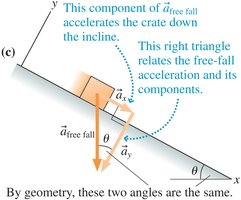
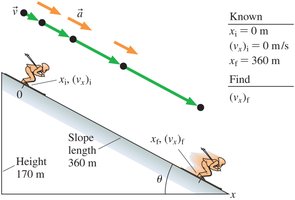
When analyzing motion on an incline, it is useful to align the coordinate axes with the ramp. The vertical component of velocity determines the height gained, and the acceleration down the ramp is a component of gravity.
Vertical Displacement: for constant velocity.
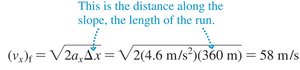
Acceleration Down Ramp:
Section 3.4: Motion in Two Dimensions
General Two-Dimensional Motion
In two-dimensional motion, both the magnitude and direction of displacement, velocity, and acceleration can change. Motion diagrams help visualize these changes.
Displacement Vector: Connects positions at different times.
Velocity Vector: Points in the direction of displacement over a time interval.
Acceleration Vector: Indicates change in velocity, either in magnitude or direction.
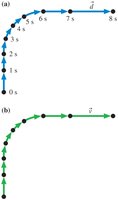
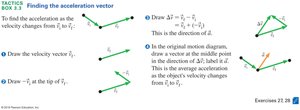
Finding the Acceleration Vector
To find the acceleration as velocity changes, draw the initial and final velocity vectors, then the change in velocity vector , which points in the direction of acceleration.
Formula:
Section 3.5: Projectile Motion
Characteristics of Projectile Motion
Projectile motion consists of independent horizontal and vertical motions. The path is a parabola, and the acceleration is always downward due to gravity.
Horizontal Motion:
Vertical Motion:
Time of Flight: Determined by vertical motion.
Range: The horizontal distance traveled, depends on initial speed and launch angle.
Section 3.7: Circular Motion
Uniform Circular Motion
In uniform circular motion, the speed is constant but the velocity changes direction, resulting in centripetal acceleration toward the center of the circle.
Centripetal Acceleration:
Velocity: Always tangent to the circle.
Acceleration: Always points to the center.
Section 3.8: Relative Motion
Relative Velocity
Relative velocity describes how the velocity of an object appears from different reference frames. The velocity of an object relative to one observer can be found by vector addition of velocities relative to other observers.
Formula:
Application: Used to analyze situations such as a plane flying in the wind or a runner observed from different moving platforms.
Summary Table: Key Concepts in Two-Dimensional Motion
Concept | Key Equation | Description |
|---|---|---|
Vector Magnitude | Magnitude from components | |
Vector Direction | Angle from components | |
Projectile Motion (Horizontal) | Constant velocity | |
Projectile Motion (Vertical) | Constant acceleration | |
Circular Motion | Centripetal acceleration | |
Relative Velocity | Velocity transformation between frames |
