 뒤로
Vectors in Physics: Components, Operations, and Applications
스터디 가이드 - 스마트 노트
 자료에 맞춘 맞춤형 노트, 핵심 정의, 예시, 맥락을 확장해 제공합니다.
Vectors in Physics
Introduction to Vectors
Vectors are fundamental mathematical objects in physics, representing quantities that have both magnitude and direction. Understanding vectors is essential for describing motion, forces, and many other physical phenomena.
Scalars Versus Vectors
Definitions and Examples
Scalar: A quantity described by a single value (magnitude) with appropriate units, but no direction. Examples: mass, temperature, energy.
Vector: A quantity that has both magnitude and direction. Examples: displacement, velocity, acceleration, force.
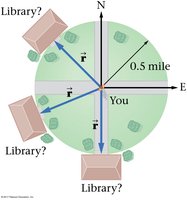
To fully specify a vector, both its length (magnitude) and its orientation (direction) must be given.
Vectors are often represented graphically as arrows, where the length indicates magnitude and the arrowhead indicates direction.
The Components of a Vector
Resolving Vectors into Components
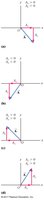
Vectors in two dimensions can be resolved into perpendicular components, typically along the x- and y-axes. This process simplifies calculations and allows for the use of algebraic methods.
Any vector \( \vec{A} \) can be described by its components \( A_x \) and \( A_y \):
Given a vector of magnitude \( A \) and angle \( \theta \) from the x-axis:
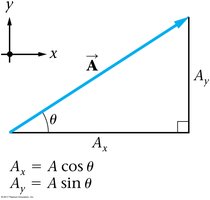
The vector can also be described by its length and direction angle, or by its x and y components.
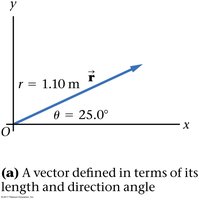
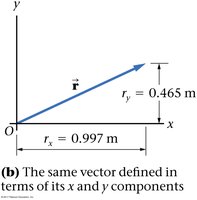
The signs of the components depend on the vector's direction relative to the axes.
Adding and Subtracting Vectors
Graphical and Component Methods
Vectors can be added or subtracted using graphical or algebraic (component) methods.
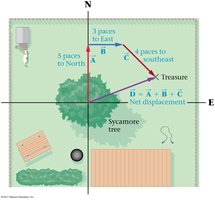
Graphical Addition: Place the tail of the second vector at the head of the first. The resultant vector points from the tail of the first to the head of the last.
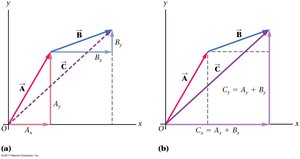
Component Addition: Add the x-components and y-components of each vector separately to find the resultant vector's components.
Resultant vector components:
Magnitude and direction of the resultant:
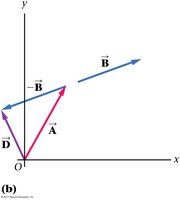
Vector Subtraction: The negative of a vector has the same magnitude but points in the opposite direction. Subtracting vectors is equivalent to adding the negative.
Unit Vectors
Definition and Use
Unit vectors are dimensionless vectors of unit length, used to specify directions in space. In Cartesian coordinates, the standard unit vectors are:
\( \hat{i} \): Points in the +x direction
\( \hat{j} \): Points in the +y direction
\( \hat{k} \): Points in the +z direction (for 3D)
Any vector can be written as a sum of its components multiplied by the corresponding unit vectors.
Multiplying a unit vector by a scalar changes its length and possibly its direction (if the scalar is negative).
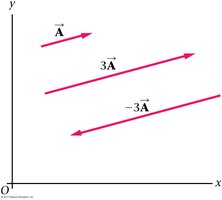
Position, Displacement, Velocity, and Acceleration Vectors
Definitions and Relationships
Position Vector (\( \vec{r} \)): Points from the origin to a specific location in space.
Displacement Vector (\( \Delta \vec{r} \)): Points from the initial position to the final position.
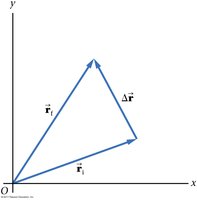
Average Velocity Vector: Defined as the displacement divided by the time interval:
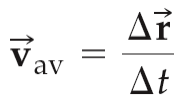
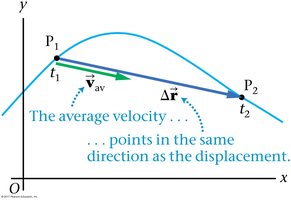
The average velocity vector points in the same direction as the displacement vector.
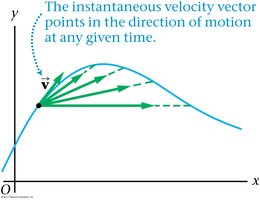
Instantaneous Velocity Vector: The velocity at a specific instant, tangent to the path of motion.
Average Acceleration Vector: Defined as the change in velocity divided by the time interval:
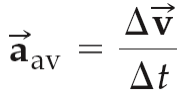
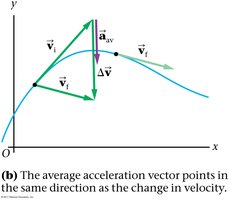
The average acceleration vector points in the direction of the change in velocity.
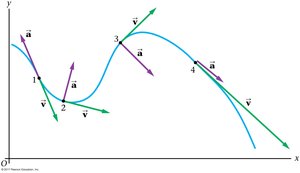
The velocity vector is always tangent to the path (direction of motion), while the acceleration vector can point in any direction, depending on how the velocity changes.
Relative Motion
Reference Frames and Relative Velocity
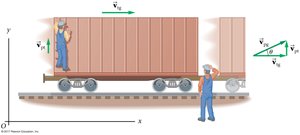
The observed velocity of an object depends on the observer's frame of reference. Relative motion problems involve adding or subtracting velocity vectors to find the velocity of one object as seen from another.
For example, the velocity of a passenger walking inside a moving train is the vector sum of the passenger's velocity relative to the train and the train's velocity relative to the ground.
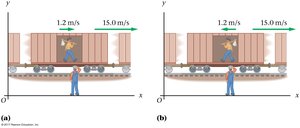
This principle extends to two dimensions, where vector addition is used to determine the resultant velocity.
Summary Table: Key Vector Concepts
Concept | Definition/Formula |
|---|---|
Scalar | Number with units (e.g., mass, temperature) |
Vector | Quantity with magnitude and direction (e.g., displacement, velocity) |
Components | , |
Magnitude | |
Direction | |
Vector Addition | Add components: , |
Unit Vectors | Dimensionless, length = 1; |
Position Vector | Points from origin to location |
Displacement Vector | Points from initial to final position |
Average Velocity | |
Average Acceleration | |
Relative Motion | Vector sum of velocities in different frames |
