 뒤로
뒤로Vectors in Physics: Definitions, Representations, and Operations
스터디 가이드 - 스마트 노트
 자료에 맞춘 맞춤형 노트, 핵심 정의, 예시, 맥락을 확장해 제공합니다.
Vectors in Physics
Scalars and Vectors
In physics, quantities are classified as either scalars or vectors. Scalars are defined by a single value and units, while vectors possess both magnitude and direction.
Scalar: A physical quantity described by a number and units (e.g., distance, speed, temperature).
Vector: A physical quantity with both magnitude (numerical value with units) and direction (e.g., position, displacement, velocity, acceleration).
Vector Notation: Vectors are denoted in boldface with an arrow above the symbol, such as .
Magnitude: The length of the vector, denoted as or .
Equality: Two vectors are equal if they have the same magnitude and direction, regardless of their initial position.
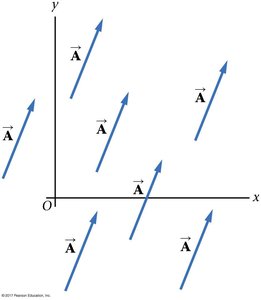
Example: Temperature is a scalar; velocity is a vector.
Vector Representations: Polar and Component Forms
Vectors can be represented in two main ways: by their magnitude and direction (polar form), or by their components along coordinate axes (component form).
Polar Representation: Defined by length and direction angle.
Component Representation: Defined by projections onto the x and y axes.
Conversion: Use trigonometry and the Pythagorean theorem to convert between forms.
Key Formulas:
Magnitude:
Direction:
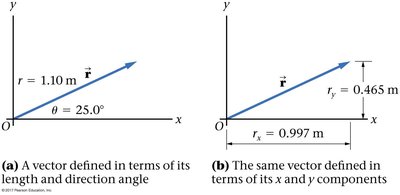
Example: If m and m, then m and .
Vector Components and Quadrants
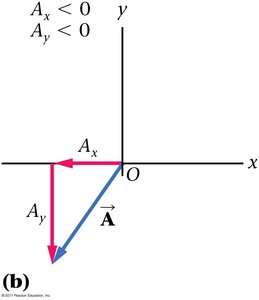
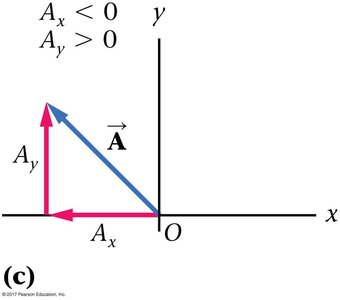
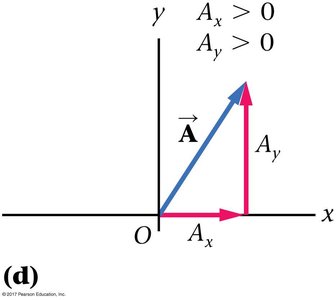
The components of a vector can be positive or negative, depending on its orientation in the coordinate system. The angle is measured counterclockwise from the positive x-axis.
Component Formulas: ,
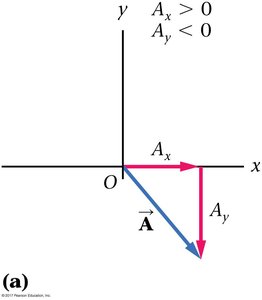
Draw the vector in the correct quadrant to determine the signs of and .
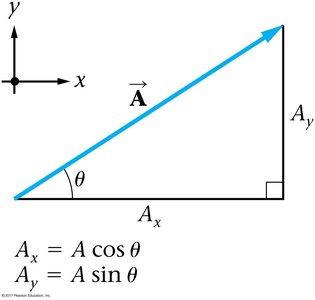
Quadrant Analysis:
First Quadrant: ,
Second Quadrant: ,
Third Quadrant: ,
Fourth Quadrant: ,
Vector Addition and Subtraction
Vectors can be added or subtracted using graphical or component methods. Vector addition is commutative, meaning the order does not affect the result.
Graphical Method: Place vectors tip-to-tail; the resultant vector extends from the tail of the first to the tip of the last.
Component Method: Add corresponding components.
Formulas:
Subtraction:
Components: ,
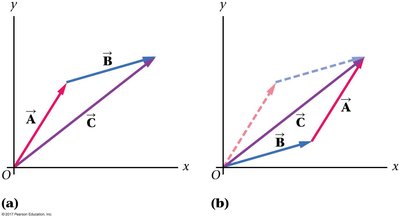
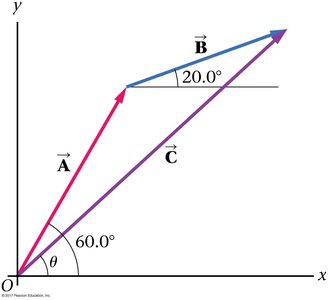
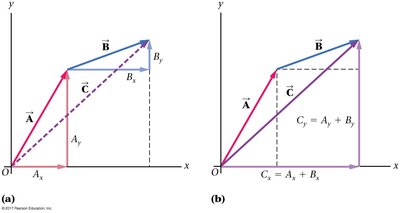
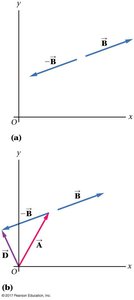
Example: Adding vectors and by components yields .
Scalar Multiplication and Unit Vectors
Multiplying a vector by a scalar changes its magnitude but may reverse its direction if the scalar is negative. Unit vectors are used to express vectors in terms of their components along coordinate axes.
Scalar Multiplication: has magnitude times that of ; direction is same if , opposite if .
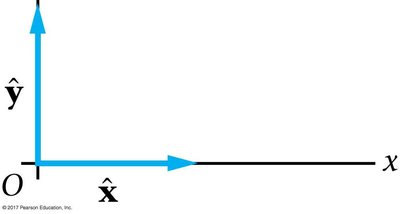
Unit Vectors: and are dimensionless vectors of magnitude 1 pointing in the positive x and y directions, respectively.
Vector Notation:
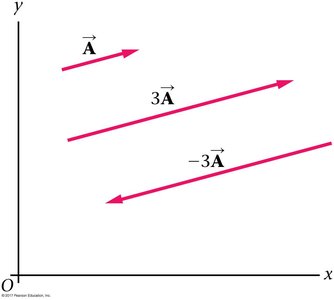
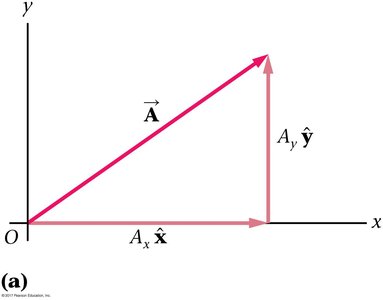
Example:
Worked Example: Vector Addition and Unit Vector Notation
Consider vectors and with given magnitudes and directions. The steps below illustrate how to find their components, add them, and express the result in unit vector notation.
Step 1: Find components using trigonometric functions.
Step 2: Add corresponding components to find resultant vector .
Step 3: Calculate magnitude and direction of .
Step 4: Express all vectors in unit vector notation.
Vector | x component (m) | y component (m) |
|---|---|---|
43.3 | -25.0 | |
37.5 | 65.0 | |
80.8 | 40.0 |
Magnitude: m
Direction: above the positive x-axis
Unit Vector Notation:
Example Application: Vector addition is used in physics to combine forces, velocities, and other vector quantities.
Vector | x component (m) | y component (m) |
|---|---|---|
43.3 | -25.0 | |
37.5 | 65.0 | |
80.8 | 40.0 |
Additional info: The tabulation of vector components is a standard practice in physics problem-solving, facilitating the use of unit vector notation and simplifying calculations.
