 뒤로
뒤로Vectors in Physics: Magnitude, Direction, and Applications
스터디 가이드 - 스마트 노트
 자료에 맞춘 맞춤형 노트, 핵심 정의, 예시, 맥락을 확장해 제공합니다.
Vectors in Physics
Introduction to Vectors
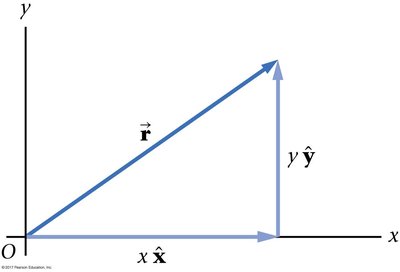
Vectors are quantities that possess both magnitude and direction, making them essential for describing physical phenomena such as displacement, velocity, and acceleration. In physics, vectors are typically represented in component form using unit vectors along the coordinate axes.
Vector Notation: A vector \( \vec{A} \) in two dimensions can be written as \( \vec{A} = A_x \hat{x} + A_y \hat{y} \).
Magnitude: The magnitude of a vector is found using the Pythagorean theorem:
Direction: The direction (angle \( \theta \)) is given by:
Unit Vectors: \( \hat{x} \) and \( \hat{y} \) are unit vectors in the x and y directions, respectively.
Example: Calculating Magnitude and Direction
Given: \( \vec{A} = 1.50\,\text{m}\,\hat{x} - 2.40\,\text{m}\,\hat{y} \)
Magnitude:
Direction: (calculator result).Measured counterclockwise from the positive x-axis:
Example: Vector in the Third Quadrant
Given: \( \vec{B} = -1.20\,\text{m}\,\hat{x} - 3.50\,\text{m}\,\hat{y} \)
Magnitude:
Direction: (calculator result).Since both components are negative, the vector is in the third quadrant:
Position, Displacement, Velocity, and Acceleration Vectors
Position Vector
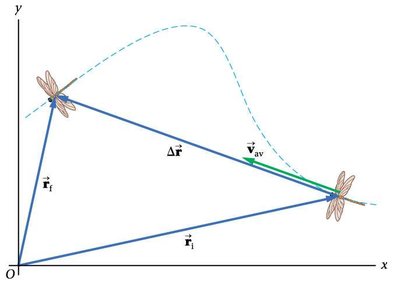
The position vector \( \vec{r} \) specifies the location of an object in space relative to the origin. It is expressed as:
SI unit: meters (m)
Displacement Vector
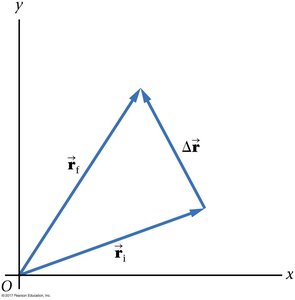
The displacement vector \( \Delta \vec{r} \) represents the change in position of an object:
SI unit: meters (m)
Example: Components of a Position Vector
Given: \( |\vec{r}_i| = 3.50\,\text{m} \), direction CCW from positive x-axis
Components:
Unit Vector Notation:
Example: Calculating Displacement
Given: ,
Displacement:
Average and Instantaneous Velocity
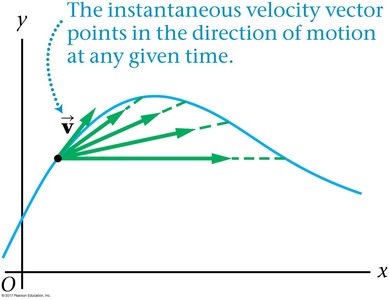
Velocity describes the rate of change of position. The average velocity is the displacement divided by the time interval, while the instantaneous velocity is the velocity at a specific instant.
Average Velocity:
Instantaneous Velocity:
SI unit: meters per second (m/s)
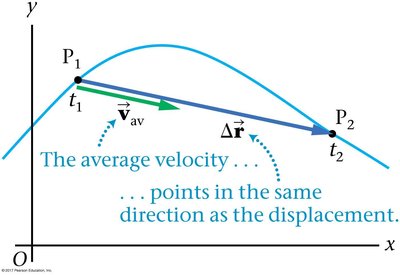
The average velocity vector points in the direction of the displacement vector.
The instantaneous velocity vector is tangent to the path at any given instant.
Example: Calculating Average Velocity
Given: ,
Average Velocity:
Average and Instantaneous Acceleration
Acceleration describes the rate of change of velocity. The average acceleration is the change in velocity divided by the time interval, while the instantaneous acceleration is the acceleration at a specific instant.
Average Acceleration:
Instantaneous Acceleration:
SI unit: meters per second squared (m/s2)
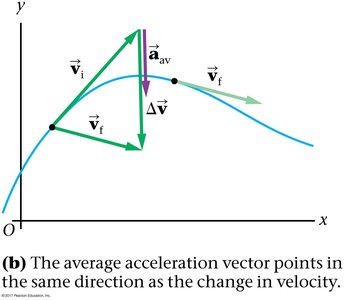
The average acceleration vector points in the direction of the change in velocity.
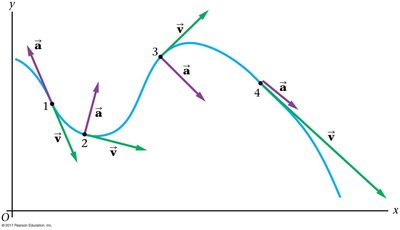
The instantaneous acceleration vector points in the direction of the change in velocity over an infinitesimal time interval.
Example: Calculating Average Acceleration
Given: , ,
Change in Velocity:
Average Acceleration:
Magnitude:
Direction:
Velocity and Acceleration Directions
The velocity vector always points in the direction of motion.
The acceleration vector may point in a different direction than the velocity vector, especially in curved motion (e.g., projectile motion).
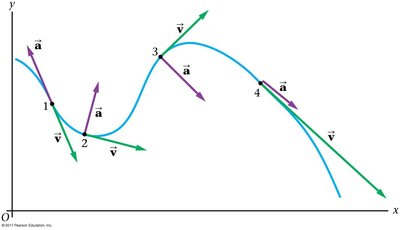
Example: In free fall, while moving upward, the velocity vector points upward but the acceleration vector (due to gravity) points downward. While moving downward, both vectors point downward.
