 뒤로
Waves, Sound Propagation, and Standing Waves: Refraction, Attenuation, and Resonance
스터디 가이드 - 스마트 노트
 자료에 맞춘 맞춤형 노트, 핵심 정의, 예시, 맥락을 확장해 제공합니다.
Waves & Sound Propagation
Refraction of Sound Waves
Refraction is a fundamental phenomenon in wave physics, describing the change in direction of a wave as it passes from one medium to another with a different propagation speed. In acoustics, refraction occurs when sound waves encounter a boundary between two media with different sound velocities, causing the waves to bend.
Refraction: The bending of sound waves due to a change in speed at a boundary interface between two media.
Reflection: Some sound energy is reflected and remains in the original medium.
Absorption/Transmission: Some energy is absorbed and transmitted into the new medium.
Impedance: If two media differ in characteristic impedances, the speed of sound may differ, leading to refraction.
Wavelength Change: If the speed of sound increases in the new medium, the wavelength increases and the wave bends away from the normal; if it decreases, the wavelength decreases and the wave bends toward the normal.
Frequency: Remains constant across the boundary.
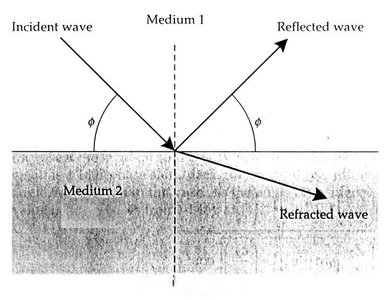
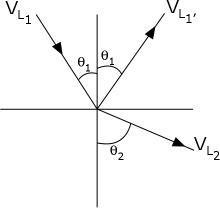
Snell's Law quantitatively describes the relationship between the angles and velocities of incident and refracted waves:
Snell's Law:
Where is the angle of incidence, is the angle of refraction, and are the sound velocities in media 1 and 2, respectively.
This ratio is constant up to the critical angle, beyond which total internal reflection occurs.
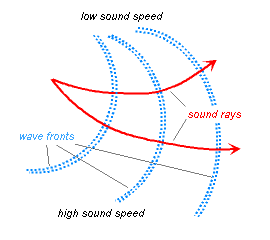
Refraction in the Atmosphere: Wind and Temperature Effects
Atmospheric conditions such as wind, temperature, humidity, and altitude can significantly affect the speed of sound, leading to complex refraction patterns in the real world.
Constant Speed: Sound waves propagate linearly when the speed of sound is constant.
Wind Effects: Wind speed varies with height, altering the speed of sound and causing refraction.
Temperature Gradients: A decrease in temperature with altitude or upwind propagation causes sound waves to refract upward, creating an acoustic shadow where sound cannot penetrate directly.
Temperature Inversion/Downwind: An increase in temperature with altitude or downwind propagation causes sound waves to refract downward toward the ground, enhancing sound propagation near the surface.
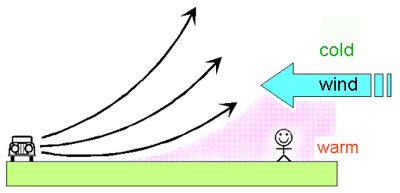
Multiple reflections and refractions near the ground can lead to favorable sound propagation over large distances.
Sound Attenuation
Frequency, Humidity, and Temperature Dependence
Sound attenuation refers to the reduction in sound intensity as it propagates through a medium. This effect is frequency-dependent and influenced by environmental factors such as humidity and temperature.
Frequency Dependence: Attenuation increases with frequency; high-frequency sounds are absorbed more rapidly due to increased molecular friction, converting sound energy into heat.
Humidity: Attenuation is non-linear with humidity. Dry air increases absorption and dampening of sound.
Temperature: Attenuation varies with temperature, as described by the equation (where is the speed of sound in m/s and is temperature in °C).
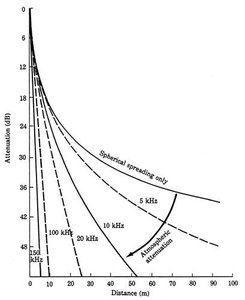
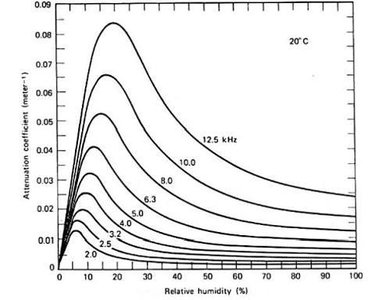
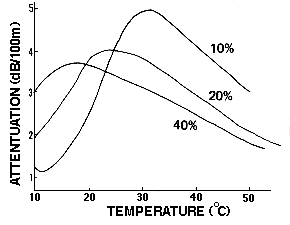
Example: Thunder sounds like a low-frequency rumble because high-frequency components are attenuated more quickly in the atmosphere.
Standing Waves and Resonance
Formation of Standing Waves
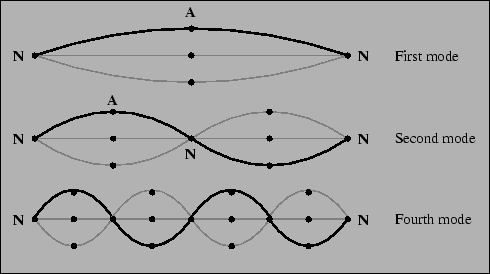
Standing waves are produced when two waves of the same frequency and amplitude travel in opposite directions through the same medium, resulting in a pattern of nodes (points of no vibration) and antinodes (points of maximum vibration).
Nodes: Points of minimum vibration (destructive interference).
Antinodes: Points of maximum vibration (constructive interference).
Distance: The distance between successive nodes or antinodes is half a wavelength ().
Resonance: Standing waves occur at specific frequencies (resonant frequencies) determined by the geometry of the system.
Standing Waves on Strings and in Tubes
For a string of length fixed at both ends, the longest wavelength (fundamental mode) is . Higher harmonics occur at integer multiples of the fundamental frequency.
Fundamental Frequency (First Harmonic):
Second Harmonic:
Third Harmonic:
Fourth Harmonic:
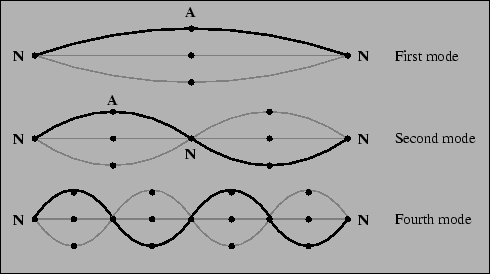
For tubes, the boundary conditions determine the harmonic series:
Open at Both Ends or Closed at Both Ends: Harmonics occur at integer multiples of the fundamental frequency.
Open at One End, Closed at the Other: Only odd harmonics are present (e.g., , , ).
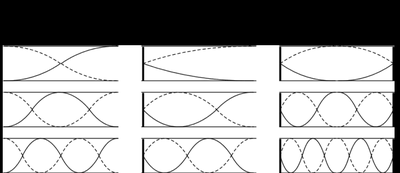
Application: Resonance in the Ear Canal
The human ear canal acts as a tube closed at one end and open at the other, supporting only odd harmonics. The fundamental frequency and higher resonant frequencies can be calculated using:
(for a tube open at one end, closed at the other)
Example: For a 25 cm tube,
Next harmonics: ,
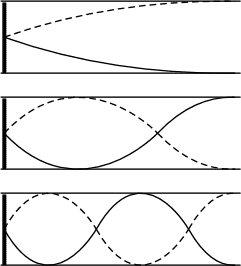
Summary Table: Standing Wave Harmonics in Tubes
Tube Type | Boundary Conditions | Allowed Harmonics | Fundamental Frequency |
|---|---|---|---|
Open at Both Ends | Antinodes at both ends | All integer multiples | |
Closed at Both Ends | Nodes at both ends | All integer multiples | |
Open at One End, Closed at Other | Node at closed end, antinode at open end | Odd multiples only |
Additional info: The notes above integrate and expand upon the provided lecture content, including academic context on wave behavior, resonance, and environmental effects on sound propagation, as appropriate for a college-level Physics with Calculus course.
