 뒤로
Waves, Standing Waves, and Fourier Analysis in Physics with Calculus
스터디 가이드 - 스마트 노트
 자료에 맞춘 맞춤형 노트, 핵심 정의, 예시, 맥락을 확장해 제공합니다.
Waves and Standing Waves
Introduction to Standing Waves
Standing waves are a fundamental concept in wave physics, arising when two waves of the same frequency and amplitude travel in opposite directions and interfere. This phenomenon is crucial for understanding resonance in tubes and strings, which is foundational in acoustics and many areas of physics.
Nodes: Points of minimal (zero) vibration, where destructive interference occurs.
Antinodes: Points of maximal vibration, where constructive interference occurs.
Tube Geometry: The placement of nodes and antinodes depends on whether the tube is open or closed at its ends.
Closed End: Always a node (no air particle vibration).
Open End: Always an antinode (maximal air particle vibration).
Distance Between Nodes/Antinodes: The distance between successive nodes or antinodes is .
Resonators: Tubes open or closed at both ends are resonators; tubes closed at one end and open at the other are resonators.
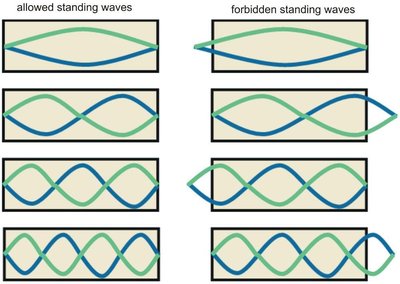
Example: In a tube closed at one end and open at the other, the fundamental frequency has a node at the closed end and an antinode at the open end.
Complex Sounds and Fourier Analysis
Simple vs. Complex Waves
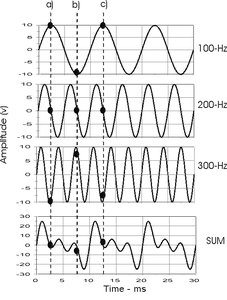
Most sounds in nature are complex, composed of multiple sine waves. A simple wave is a pure sine wave, while a complex wave is formed by adding two or more sine waves together. The complexity depends on the number, amplitude, phase, and frequency of the component sine waves.
Fourier's Theorem: Any complex periodic sound can be represented as a sum of simple sinusoidal signals with different amplitudes, phases, and frequencies.
Harmonics: Integer multiples of a fundamental frequency () present in a complex sound.
Example: A musical note played on a guitar consists of a fundamental frequency and several harmonics, giving the note its unique timbre.
Time and Frequency Domain Displays
Sound waves can be analyzed in two main domains:
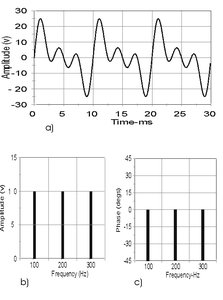
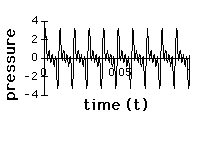
Time Domain: Shows how amplitude (e.g., pressure) varies over time.
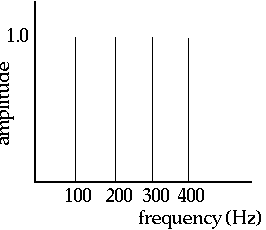
Frequency Domain: Shows the amplitude and phase of each frequency component present in the sound (magnitude and phase spectra).
Fourier Series and Discrete Fourier Analysis
The Fourier series allows us to express any periodic function as a sum of sines and cosines:
is the DC (constant) component.
is the amplitude of the nth harmonic.
is the phase of the nth harmonic.
is the angular frequency of the fundamental.
Example: The sound of a tuning fork is nearly a pure sine wave, while a piano note is a complex wave with many harmonics.
Effect of Amplitude and Phase on Complex Sounds
Changing the amplitude of harmonics alters the shape of the time-domain waveform and the frequency-domain spectrum. Changing the relative phase of harmonics alters the time-domain waveform but does not affect the magnitude spectrum in the frequency domain.
Square Waves and Additive Synthesis
Square Wave Construction
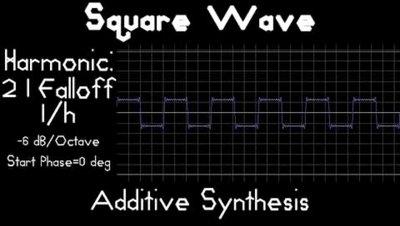
A square wave is a type of periodic waveform that can be constructed by adding together only the odd harmonics of a fundamental frequency, each with decreasing amplitude. This process is called additive synthesis.
The amplitude of the nth harmonic in a square wave is proportional to for odd n.
All even harmonics are absent.
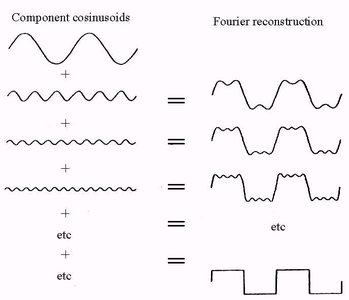
Example: Electronic music synthesizers use additive synthesis to create complex waveforms like square waves.
Acoustic Transients and Modulation
Acoustic Transients (Clicks)
Acoustic transients are short-duration sounds, such as clicks. Their amplitude spectrum is continuous, and the spectrum's width is inversely related to the duration of the transient.
Short Duration: Broad frequency spectrum.
Long Duration: Narrow frequency spectrum.
Amplitude Modulated (AM) Signals
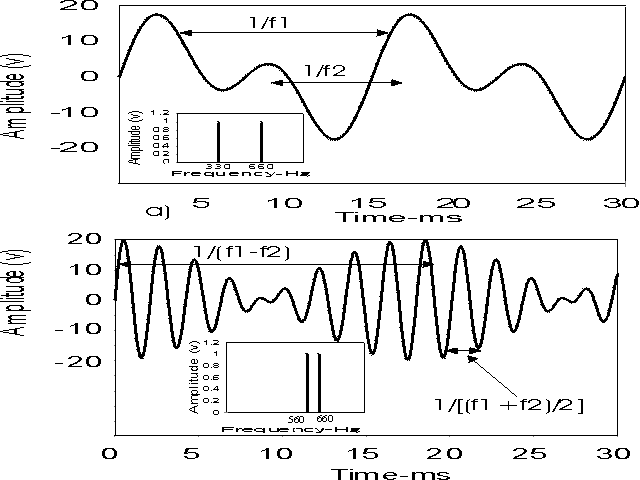
Amplitude modulation occurs when the amplitude of a carrier wave is varied in time, either by adding two sine waves or by modulating a single sine wave's amplitude with another sine wave.
AM by Addition: If two frequencies and are added, the resulting signal shows beats if $f_1$ and $f_2$ are close.
Beating Frequency: The beat frequency is .
General AM Equation: , where is the carrier frequency and is the modulation frequency.
Frequency Modulated (FM) Signals
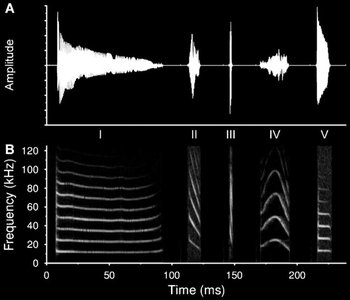
Frequency modulation involves varying the frequency of a carrier wave in time, which is essential in communication systems and animal echolocation (e.g., bats).
FM Equation: The instantaneous frequency of the signal varies as a function of time.
Applications: Used in FM radio, sonar, and animal echolocation.
Applications: Bats and Echolocation
Big Brown Bats and Frequency Modulated Calls
Bats use frequency modulated (FM) calls for echolocation, allowing them to detect objects and navigate in the dark. The frequency and amplitude of their calls change rapidly, which can be analyzed using the concepts of FM signals discussed above.
Example: The rapid frequency sweeps in bat calls are essential for distinguishing between objects at different distances.
Additional info: The notes above expand on the original lecture content by providing definitions, equations, and examples relevant to a college-level Physics with Calculus course, specifically in the context of waves, sound, and Fourier analysis.
