 뒤로
ch 6:Work and Kinetic Energy
스터디 가이드 - 스마트 노트
 자료에 맞춘 맞춤형 노트, 핵심 정의, 예시, 맥락을 확장해 제공합니다.
Work and Kinetic Energy
Introduction to Work and Energy
Work and kinetic energy are fundamental concepts in mechanics, describing how forces transfer energy to objects and how this energy manifests as motion. Understanding these concepts allows us to solve problems where Newton's laws alone are insufficient, such as those involving energy conservation and varying forces.

Definition of Work
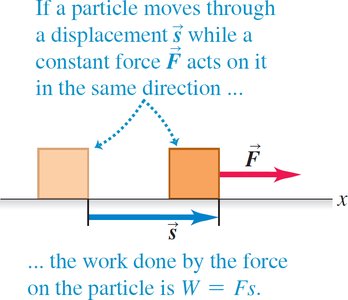
Work is done by a force when it causes a displacement of an object. The amount of work depends on the magnitude of the force, the displacement, and the angle between them.
Work Formula (Constant Force, Same Direction):
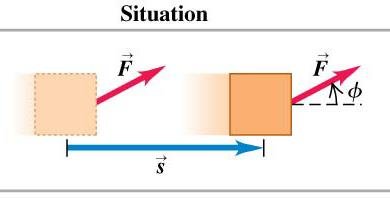
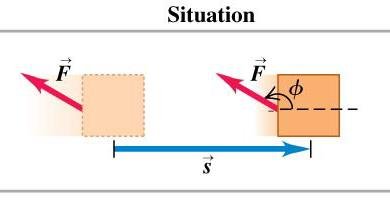
Work Formula (Constant Force, Any Angle):
Vector Dot Product Form:



Units of Work
The SI unit of work is the joule (J), defined as one newton-meter (1 J = 1 N·m). If you lift an object with a weight of 1 N a distance of 1 m at constant speed, you do 1 J of work.
Types of Work: Positive, Negative, and Zero
The sign of work depends on the direction of the force relative to the displacement:
Positive Work: Force has a component in the direction of displacement.
Negative Work: Force has a component opposite to displacement.
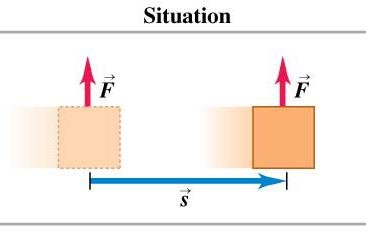
Zero Work: Force is perpendicular to displacement or object is stationary.
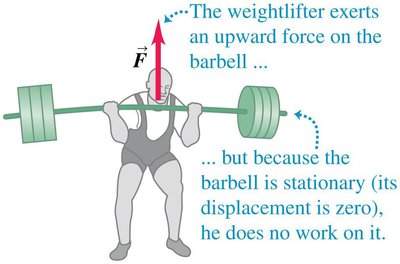
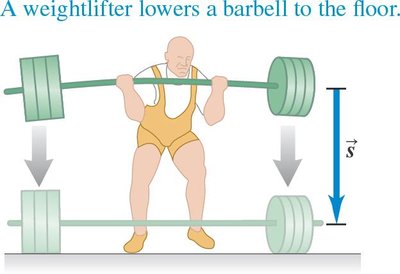
Work in Practical Scenarios: Weightlifting Example
When a weightlifter lowers a barbell, different forces do positive or negative work depending on their direction relative to displacement.
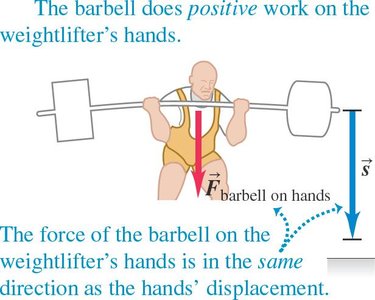
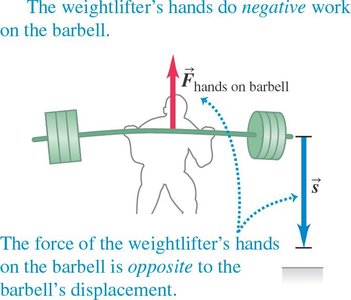
Total Work and Its Effects
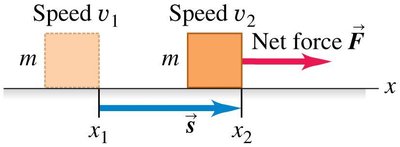
The total work done by the net force on a particle determines whether it speeds up, slows down, or maintains its speed:
Wtot > 0: Particle speeds up
Wtot < 0: Particle slows down
Wtot = 0: Speed remains constant
Kinetic Energy
Definition and Properties
Kinetic energy is the energy of motion, defined for a particle as:
Formula:
Kinetic energy is a scalar quantity, depending only on mass and speed.
Kinetic energy is always non-negative and is zero only when the object is at rest.
SI unit: joule (J)

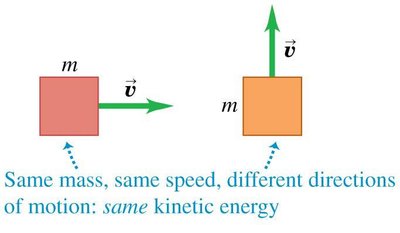
Direction Independence
Kinetic energy does not depend on the direction of motion; only mass and speed matter.
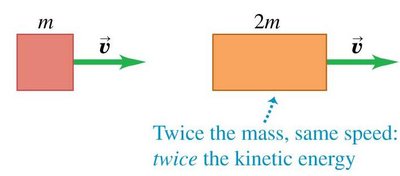
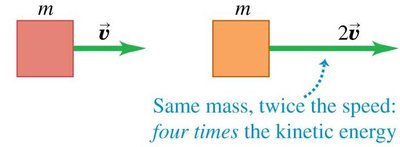
Dependence on Mass and Speed
Kinetic energy increases linearly with mass.
Kinetic energy increases with the square of speed.
The Work-Energy Theorem
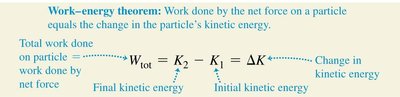
The work-energy theorem states that the work done by the net force on a particle equals the change in its kinetic energy:
Formula:
Work and Energy in Composite Systems
Composite Systems Example
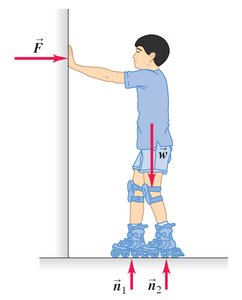
In systems where the object cannot be represented as a single point mass (e.g., a skater), external forces may do zero work, yet kinetic energy can change due to internal forces or redistribution of energy within the system.
Work and Energy with Varying Forces
Work Done by a Varying Force
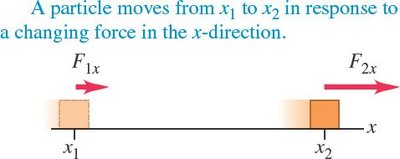
When forces are not constant, the work done is calculated by integrating the force over the displacement:
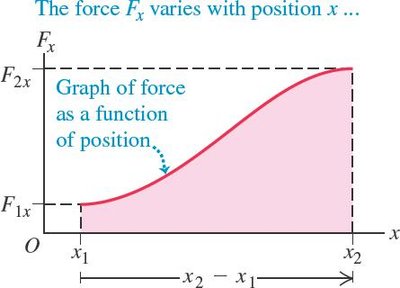
For a force varying along the x-axis:
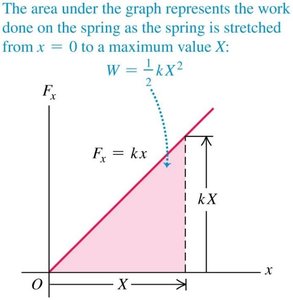
The area under the force vs. position graph represents the total work.
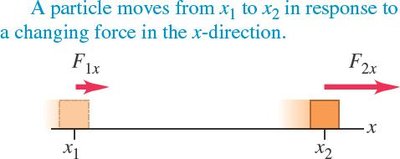
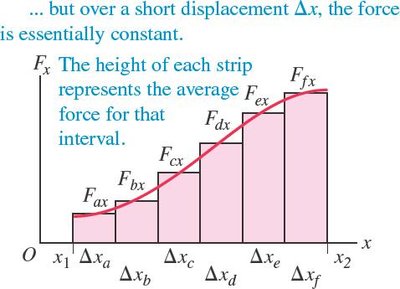
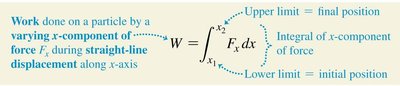
Work Done by a Constant Force (Graphical Representation)
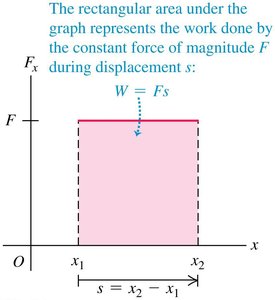
For a constant force, the work is the area of a rectangle under the force vs. position graph:
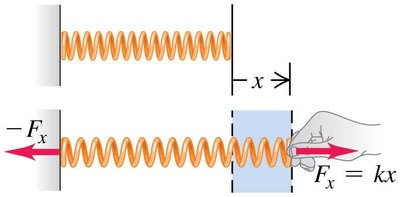
Stretching a Spring
The force required to stretch a spring is proportional to the displacement (Hooke's Law): . The work done to stretch the spring to a distance X is:
Work–Energy Theorem for Motion Along a Curve
Curved Path and Varying Force
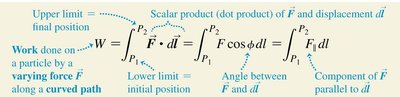
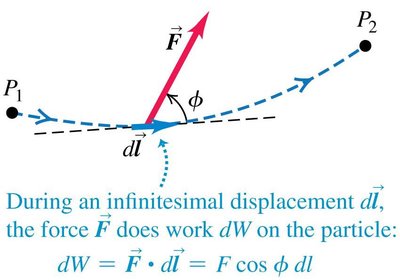
For a particle moving along a curved path under a varying force, work is calculated using a line integral:
During an infinitesimal displacement ,
Power
Definition and Formulas
Power is the rate at which work is done. It can be average or instantaneous:
Average Power:
Instantaneous Power:
SI unit: watt (W), where 1 W = 1 J/s. Horsepower (hp) is also used: 1 hp = 746 W.


Power in Lifting Objects
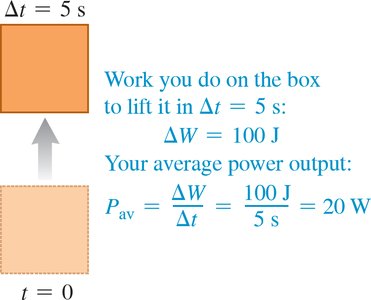
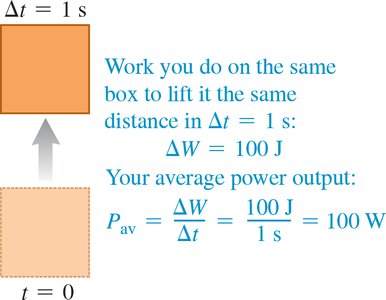
The power output depends on how quickly work is done. Lifting a box slowly or quickly changes the average power, even if the work done is the same.
Power in Terms of Force and Velocity
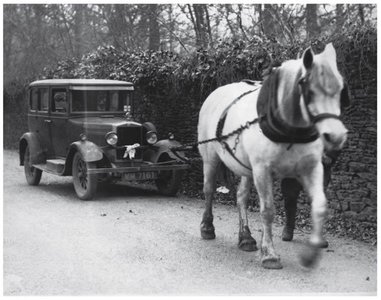
In mechanics, power can also be expressed as the dot product of force and velocity:

Summary Table: Work, Energy, and Power Formulas
Concept | Formula | SI Unit |
|---|---|---|
Work (constant force) | Joule (J) | |
Work (angle) | Joule (J) | |
Work (dot product) | Joule (J) | |
Kinetic Energy | Joule (J) | |
Work-Energy Theorem | Joule (J) | |
Work (varying force) | Joule (J) | |
Work (curved path) | Joule (J) | |
Power (average) | Watt (W) | |
Power (instantaneous) | Watt (W) | |
Power (force & velocity) | Watt (W) |
Additional info: The notes above expand on brief points with academic context, definitions, and examples to ensure completeness and clarity for exam preparation.
