Ch. 17 - Temperature, Thermal Expansion, and the Ideal Gas Law
Giancoli Douglas - Physics for Scientists and Engineers 5th edition
Giancoli Douglas5th editionPhysics for Scientists and EngineersISBN: 9780137488179당신이 사용하는 게 아니라요?교과서 변경
17장, 문제 76b

Assume that in an alternate universe, the laws of physics are very different from ours and that “ideal” gases behave as follows: At constant pressure, the volume varies directly with the 2/3 power of the temperature.

검증된 단계별 안내
1
Identify the relationship given in the problem: At constant pressure, the volume (V) varies directly with the 2/3 power of the temperature (T). This can be expressed mathematically as \( V \propto T^{\frac{2}{3}} \).
Introduce a proportionality constant \( k \) to replace the proportionality symbol, resulting in the equation \( V = k T^{\frac{2}{3}} \). This equation describes the behavior of the gas under the given conditions.
To determine the value of \( k \), you would need specific values for \( V \) and \( T \) at a particular state. If these values are provided, substitute them into the equation \( V = k T^{\frac{2}{3}} \) and solve for \( k \).
If the problem involves comparing two states of the gas (e.g., initial and final states), use the relationship \( \frac{V_1}{V_2} = \left( \frac{T_1}{T_2} \right)^{\frac{2}{3}} \). This equation is derived by dividing the expressions for \( V \) at two different temperatures while keeping pressure constant.
Substitute the known values for \( V_1 \), \( V_2 \), \( T_1 \), and \( T_2 \) into the equation \( \frac{V_1}{V_2} = \left( \frac{T_1}{T_2} \right)^{\frac{2}{3}} \) to solve for the unknown variable, whether it is a volume or a temperature.

비슷한 문제에 대한 검증된 영상 답변:

이 영상 해법은 위 문제에 도움이 된다고 튜터들이 추천한 것입니다.
영상 길이:
3m

주요 개념

질문에 올바르게 답하기 위해 반드시 이해해야 하는 핵심 개념들은 다음과 같습니다.

Ideal Gas Law

The Ideal Gas Law is a fundamental equation in thermodynamics that relates the pressure, volume, temperature, and number of moles of an ideal gas. It is typically expressed as PV = nRT, where P is pressure, V is volume, n is the number of moles, R is the ideal gas constant, and T is temperature. Understanding this law is crucial for analyzing gas behavior under various conditions.
추천 영상:
가이드 코스
07:21
Ideal Gases and the Ideal Gas Law

Volume-Temperature Relationship

In thermodynamics, the relationship between volume and temperature is often described by Charles's Law, which states that at constant pressure, the volume of a gas is directly proportional to its absolute temperature. In this alternate universe scenario, the volume varies with the 2/3 power of temperature, indicating a non-linear relationship that deviates from classical gas behavior, necessitating a new approach to understanding gas dynamics.
추천 영상:
가이드 코스
05:21
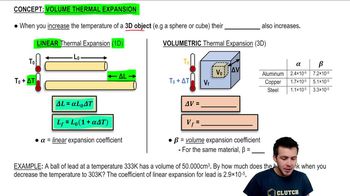
Volume Thermal Expansion

Non-Linear Relationships

Non-linear relationships occur when changes in one variable do not produce proportional changes in another variable. In the context of the question, the volume of the gas varies as the temperature raised to the 2/3 power, which means that as temperature increases, volume increases at a decreasing rate. This concept is essential for analyzing systems where traditional linear assumptions do not apply.
추천 영상:
가이드 코스
07:31
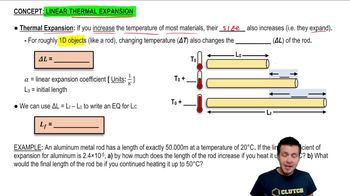
Linear Thermal Expansion
관련 실천
교과서 질문

Show that the bulk modulus (Section 12–5) for an ideal gas held at constant temperature is B = P, where P is the pressure.

1297
views

교과서 질문

Estimate how many molecules of air are in each 2.0-L breath you inhale that were also in the last breath Galileo took. Assume the atmosphere is about 10 km high and of constant density. What other assumptions did you make?

110
views
교과서 질문

A brass lid screws tightly onto a glass jar at 15°C. To help open the jar, it can be placed into a bath of hot water. After this treatment, the temperatures of the lid and the jar are both 55°C. The inside diameter of the lid is 7.0 cm. Find the size of the gap (difference in radius) that develops by this procedure.

1058
views
교과서 질문

Assume that in an alternate universe, the laws of physics are very different from ours and that “ideal” gases behave as follows: At 273.15 K and 1.00 atm pressure, 1.00 mole of an ideal gas is found to occupy 22.4 L. Obtain the form of the ideal gas law in this alternate universe, including the value of the gas constant R.

1187
views
교과서 질문

Assume that in an alternate universe, the laws of physics are very different from ours and that “ideal” gases behave as follows: At constant temperature, pressure is inversely proportional to the square of the volume.

1309
views
교과서 질문

From the known value of atmospheric pressure at the surface of the Earth, estimate the total number of air molecules in the Earth’s atmosphere.

1073
views