Ch. 17 - Temperature, Thermal Expansion, and the Ideal Gas Law
Giancoli Douglas - Physics for Scientists and Engineers 5th edition
Giancoli Douglas5th editionPhysics for Scientists and EngineersISBN: 9780137488179당신이 사용하는 게 아니라요?교과서 변경
17장, 문제 80

From the known value of atmospheric pressure at the surface of the Earth, estimate the total number of air molecules in the Earth’s atmosphere.

검증된 단계별 안내
1
Start by recalling that atmospheric pressure at the Earth's surface is approximately 101,325 Pa (Pascals). This pressure is due to the weight of the air column above a unit area. Use the relationship between pressure, force, and area: \( P = \frac{F}{A} \), where \( F \) is the force due to the weight of the air column and \( A \) is the area.
The force \( F \) can be expressed as \( F = mg \), where \( m \) is the total mass of the atmosphere and \( g \) is the acceleration due to gravity (approximately 9.8 m/s²). Substituting this into the pressure equation gives \( P = \frac{mg}{A} \). Rearrange to solve for \( m \): \( m = \frac{P \cdot A}{g} \).
Next, calculate the total surface area of the Earth, \( A \), using the formula for the surface area of a sphere: \( A = 4\pi R^2 \), where \( R \) is the radius of the Earth (approximately 6.371 \(\times\) 10^6 \) m. Substitute this value into the equation for \( m \).
To estimate the total number of air molecules, use the relationship between the mass of the atmosphere and the number of molecules. The molar mass of air is approximately 29 g/mol (or 0.029 kg/mol). The number of moles, \( n \), is given by \( n = \frac{m}{M} \), where \( M \) is the molar mass. Then, use Avogadro's number, \( N_A = 6.022 \times 10^{23} \) molecules/mol, to find the total number of molecules: \( N = n \cdot N_A \).
Combine all the expressions and substitute the known values (\( P = 101,325 \) Pa, \( g = 9.8 \) m/s², \( R = 6.371 \times 10^6 \) m, \( M = 0.029 \) kg/mol, and \( N_A = 6.022 \times 10^{23} \) molecules/mol) to calculate the total number of air molecules in the Earth's atmosphere. Ensure unit consistency throughout the calculation.

비슷한 문제에 대한 검증된 영상 답변:

이 영상 해법은 위 문제에 도움이 된다고 튜터들이 추천한 것입니다.
영상 길이:
5m

주요 개념

질문에 올바르게 답하기 위해 반드시 이해해야 하는 핵심 개념들은 다음과 같습니다.

Atmospheric Pressure

Atmospheric pressure is the force exerted by the weight of air above a given point, typically measured in pascals (Pa) or atmospheres (atm). At sea level, the average atmospheric pressure is approximately 101,325 Pa. This pressure is crucial for understanding how air density and the number of air molecules can be estimated, as it relates directly to the mass of air in a given volume.
추천 영상:
가이드 코스
17:04
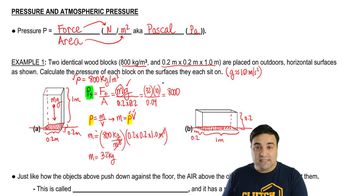
Pressure and Atmospheric Pressure

Ideal Gas Law

The Ideal Gas Law is a fundamental equation in physics and chemistry that relates the pressure, volume, temperature, and number of moles of a gas. It is expressed as PV = nRT, where P is pressure, V is volume, n is the number of moles, R is the ideal gas constant, and T is temperature in Kelvin. This law allows us to calculate the number of air molecules by rearranging the equation to solve for n, given the atmospheric pressure and volume of the atmosphere.
추천 영상:
가이드 코스
07:21
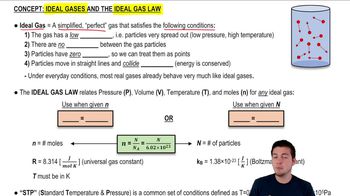
Ideal Gases and the Ideal Gas Law

Molar Volume

Molar volume is the volume occupied by one mole of a substance at standard temperature and pressure (STP), which is approximately 22.4 liters for an ideal gas. This concept is essential for converting between the number of moles of air and the total number of molecules, as Avogadro's number (approximately 6.022 x 10^23 molecules per mole) can be used to find the total number of molecules in the atmosphere once the number of moles is determined.
추천 영상:
가이드 코스
05:21
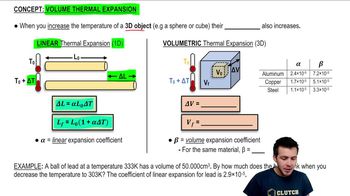
Volume Thermal Expansion
관련 실천
교과서 질문

A brass lid screws tightly onto a glass jar at 15°C. To help open the jar, it can be placed into a bath of hot water. After this treatment, the temperatures of the lid and the jar are both 55°C. The inside diameter of the lid is 7.0 cm. Find the size of the gap (difference in radius) that develops by this procedure.

1058
views
교과서 질문

Assume that in an alternate universe, the laws of physics are very different from ours and that “ideal” gases behave as follows: At constant pressure, the volume varies directly with the 2/3 power of the temperature.

1136
views
교과서 질문

Assume that in an alternate universe, the laws of physics are very different from ours and that “ideal” gases behave as follows: At 273.15 K and 1.00 atm pressure, 1.00 mole of an ideal gas is found to occupy 22.4 L. Obtain the form of the ideal gas law in this alternate universe, including the value of the gas constant R.

1187
views
교과서 질문

A helium balloon has volume V₀ and temperature T₀ at sea level where the pressure is P₀ and the air density is ρ₀. The balloon is allowed to float up in the air to altitude y where the temperature is T₁. Show that the buoyant force does not depend on altitude y. Assume that the skin of the balloon maintains the helium pressure at a constant factor of 1.05 times greater than the outside pressure. [Hint: Assume that the pressure change with altitude is P = P₀ e⁻ᶜʸ , Eq. 13–6c in Chapter 13.]

1290
views
교과서 질문

Assume that in an alternate universe, the laws of physics are very different from ours and that “ideal” gases behave as follows: At constant temperature, pressure is inversely proportional to the square of the volume.

1309
views
교과서 질문

A copper wire sags 54.0 cm between two utility poles 30.0 m apart when the temperature is -15° C. Estimate the amount of sag when the temperature is + 35° C. [Hint: An estimate can be made by assuming the shape of the wire is approximately an arc of a circle; hard equations can sometimes be solved by guessing values.]

1180
views