Ch. 18 - Kinetic Theory of Gases
Giancoli Douglas - Physics for Scientists and Engineers 5th edition
Giancoli Douglas5th editionPhysics for Scientists and EngineersISBN: 9780137488179당신이 사용하는 게 아니라요?교과서 변경
18장, 문제 26a

Water is in which phase when the pressure is 0.01 atm and the temperature is 90°C?

검증된 단계별 안내
1
Understand the problem: The question asks about the phase of water at a specific pressure (0.01 atm) and temperature (90°C). To determine the phase, we need to compare these conditions to the phase diagram of water, which shows the relationship between pressure, temperature, and phase (solid, liquid, or gas).
Recall the concept of a phase diagram: A phase diagram is a graphical representation of the states of matter (solid, liquid, gas) of a substance as a function of pressure and temperature. For water, the phase diagram includes the triple point (where all three phases coexist) and the critical point (beyond which liquid and gas are indistinguishable).
Locate the given conditions on the phase diagram: At a pressure of 0.01 atm, check the temperature range for the phase boundaries. The triple point of water occurs at approximately 0.006 atm and 0.01°C. At 0.01 atm, the boiling point of water (liquid-gas boundary) is significantly lower than 100°C, and water is likely in the gas phase at 90°C.
Analyze the phase boundaries: Since the given temperature (90°C) is well above the boiling point of water at 0.01 atm, the water will have transitioned to the gas phase. This is because the liquid phase cannot exist at such low pressures and high temperatures.
Conclude the phase: Based on the analysis of the phase diagram, water is in the gas phase (steam) at a pressure of 0.01 atm and a temperature of 90°C.

비슷한 문제에 대한 검증된 영상 답변:

이 영상 해법은 위 문제에 도움이 된다고 튜터들이 추천한 것입니다.
영상 길이:
1m

주요 개념

질문에 올바르게 답하기 위해 반드시 이해해야 하는 핵심 개념들은 다음과 같습니다.

Phase of Matter

The phase of matter refers to the distinct forms that different phases of matter take on. The three primary phases are solid, liquid, and gas, each characterized by different properties such as shape and volume. Understanding the phase of a substance is crucial for predicting its behavior under varying conditions of temperature and pressure.
추천 영상:
가이드 코스
08:59
Phase Constant of a Wave Function

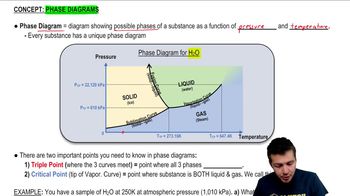
Phase Diagram

A phase diagram is a graphical representation that shows the phases of a substance at different temperatures and pressures. It typically includes lines that separate different phases, indicating the conditions under which a substance will exist as a solid, liquid, or gas. Analyzing a phase diagram helps in determining the state of a substance at specific temperature and pressure conditions.
추천 영상:

Boiling Point and Vapor Pressure

The boiling point of a liquid is the temperature at which its vapor pressure equals the external pressure surrounding it. At lower pressures, such as 0.01 atm, the boiling point of water decreases significantly. This concept is essential for understanding how water can exist in different phases under varying pressure conditions, particularly in relation to its boiling point.
추천 영상:
가이드 코스
17:04
Pressure and Atmospheric Pressure
관련 실천
교과서 질문

At about what pressure would the mean free path of air molecules be equal to the diameter of air molecules, ≈ 3 x 10⁻¹⁰ m? Assume T = 20° C.

1385
views

교과서 질문

Below a certain threshold pressure, the air molecules (0.3-nm diameter) within a research vacuum chamber are in the “collision-free regime,” meaning that a particular air molecule is as likely to cross the container and collide with the opposite wall as it is to collide with another air molecule. Estimate the threshold pressure for a vacuum chamber of side 1.0 m at 20°C.

1281
views
교과서 질문

Estimate how many air molecules rebound from a wall in a typical room per second, assuming an ideal gas of N molecules contained in a cubic room with sides of length ℓ at temperature T and pressure P.

(a) Show that the frequency f with which gas molecules strike a wall is ƒ = (υx‾\(\overline{\upsilon_{x}\)} /2)(P/kT) ℓ² where υx‾\(\overline{\upsilon_{x}\)} is the average x component of the molecule’s velocity.

(b) Show that the equation can then be written as ƒ≈ Pℓ² /4mkT\(\sqrt{4mkT}\) where m is the mass of a gas molecule.

1360
views
교과서 질문

A gas consisting of 14,500 molecules, each of mass 2.00 x 10⁻²⁶ kg, has the following distribution of speeds, which crudely mimics the Maxwell distribution. Determine vᵣₘₛ for this distribution of speeds.

949
views
교과서 질문

At about what pressure would the mean free path of air molecules be 0.30 m? Assume T = 20° C.

1411
views
교과서 질문

For what range of pressures and temperatures can CO₂ be a liquid? Refer to Fig. 18-6.

491
views