
교과서 질문
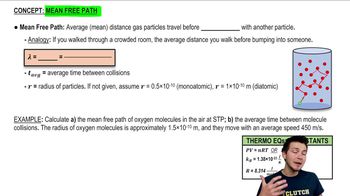
At about what pressure would the mean free path of air molecules be equal to the diameter of air molecules, ≈ 3 x 10⁻¹⁰ m? Assume T = 20° C.
1385
views

 검증된 단계별 안내
 08:20
08:20
 17:04
17:04 07:21
07:21At about what pressure would the mean free path of air molecules be equal to the diameter of air molecules, ≈ 3 x 10⁻¹⁰ m? Assume T = 20° C.
Water is in which phase when the pressure is 0.01 atm and the temperature is 90°C?
Below a certain threshold pressure, the air molecules (0.3-nm diameter) within a research vacuum chamber are in the “collision-free regime,” meaning that a particular air molecule is as likely to cross the container and collide with the opposite wall as it is to collide with another air molecule. Estimate the threshold pressure for a vacuum chamber of side 1.0 m at 20°C.
The escape speed from the Earth is 1.12 x 10⁴ m/s (Section 8–7). So a gas molecule traveling away from Earth near the outer boundary of the Earth’s atmosphere would, at this speed, be able to escape from the Earth’s gravitational field and be lost to the atmosphere. Can you explain why our atmosphere contains oxygen but not helium?
For what range of pressures and temperatures can CO₂ be a liquid? Refer to Fig. 18-6.
Estimate the time needed for a glycine molecule (see Table 18–3) to diffuse a distance of 25μm in water at 20°C if its concentration varies over that distance from 1.00 mol/m³ to 0.50 mol/m³. Compare this “speed” to its rms (thermal) speed. The molecular mass of glycine is about 75 u.