Ch 12: Rotation of a Rigid Body
Knight Calc - Physics for Scientists and Engineers 5th Edition
Knight Calc5th EditionPhysics for Scientists and EngineersISBN: 9780137344796당신이 사용하는 게 아니라요?교과서 변경
12장, 문제 13a

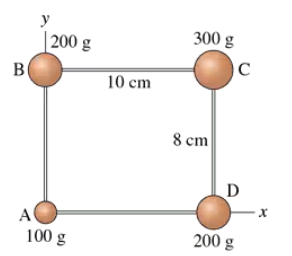
The four masses shown in FIGURE EX12.13 are connected by massless, rigid rods. Find the coordinates of the center of mass.

검증된 단계별 안내
1
Step 1: Understand the problem. The center of mass (COM) is the weighted average position of all the masses in the system. To find the coordinates of the center of mass, we use the formulas: \( x_{COM} = \frac{\sum m_i x_i}{\sum m_i} \) and \( y_{COM} = \frac{\sum m_i y_i}{\sum m_i} \), where \( m_i \) is the mass of each object, and \( x_i \) and \( y_i \) are the coordinates of each mass.
Step 2: Extract the data from the image. The masses and their coordinates are: \( m_A = 70 \, \text{g}, (x_A, y_A) = (0, 0) \), \( m_B = 190 \, \text{g}, (x_B, y_B) = (20, 0) \), and \( m_C = 400 \, \text{g}, (x_C, y_C) = (20, 12) \).
Step 3: Calculate the total mass \( \sum m_i \). Add the masses: \( \sum m_i = m_A + m_B + m_C \).
Step 4: Compute \( x_{COM} \). Use the formula \( x_{COM} = \frac{m_A x_A + m_B x_B + m_C x_C}{\sum m_i} \). Substitute the values of \( m_i \) and \( x_i \) from the data.
Step 5: Compute \( y_{COM} \). Use the formula \( y_{COM} = \frac{m_A y_A + m_B y_B + m_C y_C}{\sum m_i} \). Substitute the values of \( m_i \) and \( y_i \) from the data.

비슷한 문제에 대한 검증된 영상 답변:

이 영상 해법은 위 문제에 도움이 된다고 튜터들이 추천한 것입니다.
영상 길이:
9m

주요 개념

질문에 올바르게 답하기 위해 반드시 이해해야 하는 핵심 개념들은 다음과 같습니다.

Center of Mass

The center of mass of a system is the point where the total mass of the system can be considered to be concentrated. It is calculated as the weighted average of the positions of all masses in the system, taking into account their respective masses. The formula for the center of mass in two dimensions is given by the coordinates (x_cm, y_cm) = (Σ(m_i * x_i) / Σm_i, Σ(m_i * y_i) / Σm_i), where m_i is the mass and (x_i, y_i) are the coordinates of each mass.
추천 영상:
가이드 코스
06:30
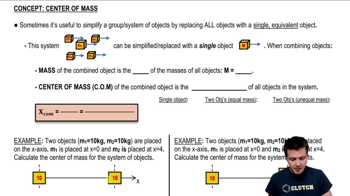
Intro to Center of Mass

Mass Distribution

Mass distribution refers to how mass is spread out in a system. In this problem, the masses A, B, and C are located at specific coordinates, and their distribution affects the calculation of the center of mass. Understanding how different masses contribute to the overall center of mass is crucial, as heavier masses will have a greater influence on the position of the center of mass compared to lighter ones.
추천 영상:
가이드 코스
03:42
Moment of Inertia & Mass Distribution

Coordinate System

A coordinate system provides a framework for locating points in space using numerical values. In this problem, a Cartesian coordinate system is used, where each point is defined by its x (horizontal) and y (vertical) coordinates. This system is essential for calculating the center of mass, as it allows for precise determination of the positions of the masses involved in the calculation.
추천 영상:
가이드 코스
05:17
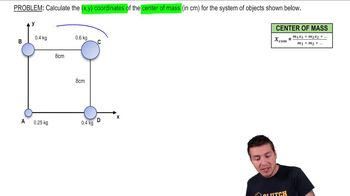
Coordinates of Center of Mass of 4 objects