A thin, 100 g disk with a diameter of 8.0 cm rotates about an axis through its center with 0.15 J of kinetic energy. What is the speed of a point on the rim?
Ch 12: Rotation of a Rigid Body
12장, 문제 14b
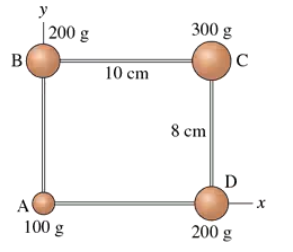
The four masses shown in FIGURE EX12.13 are connected by massless, rigid rods. Find the moment of inertia about a diagonal axis that passes through masses B and D.

검증된 단계별 안내1
Step 1: Understand the concept of moment of inertia. The moment of inertia (I) is a measure of an object's resistance to rotational motion about a given axis. It is calculated using the formula: , where is the mass of the ith particle and is the perpendicular distance of the ith particle from the axis of rotation.
Step 2: Identify the axis of rotation. The problem specifies a diagonal axis passing through masses B and D. This means that masses B and D lie directly on the axis, so their perpendicular distance from the axis is zero. Therefore, their contribution to the moment of inertia is zero.
Step 3: Determine the perpendicular distances of masses A and C from the diagonal axis. To do this, use geometry to calculate the shortest distance from each mass to the diagonal axis. This may involve finding the coordinates of the masses and using the formula for the distance between a point and a line in 2D space.
Step 4: Calculate the contributions to the moment of inertia from masses A and C. For each mass, use the formula , where is the perpendicular distance calculated in Step 3.
Step 5: Sum the contributions from masses A and C to find the total moment of inertia about the diagonal axis. Since masses B and D contribute zero, the total moment of inertia is simply the sum of the values calculated for masses A and C.

비슷한 문제에 대한 검증된 영상 답변:
이 영상 해법은 위 문제에 도움이 된다고 튜터들이 추천한 것입니다.
영상 길이:
9m주요 개념
질문에 올바르게 답하기 위해 반드시 이해해야 하는 핵심 개념들은 다음과 같습니다.
Moment of Inertia
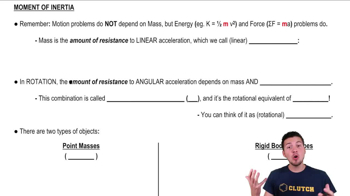
The moment of inertia is a measure of an object's resistance to rotational motion about a specific axis. It depends on the mass distribution relative to the axis of rotation, calculated as the sum of the products of each mass and the square of its distance from the axis. For a system of particles, it is expressed as I = Σ(m_i * r_i^2), where m_i is the mass and r_i is the distance from the axis.
추천 영상:
가이드 코스
Intro to Moment of Inertia
Parallel Axis Theorem
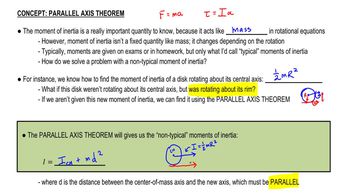
The parallel axis theorem allows the calculation of the moment of inertia of a body about any axis parallel to an axis through its center of mass. It states that I = I_cm + Md^2, where I_cm is the moment of inertia about the center of mass axis, M is the total mass, and d is the distance between the two axes. This theorem is useful when the axis of rotation does not pass through the center of mass.
추천 영상:
가이드 코스
Parallel Axis Theorem
Rigid Body Dynamics
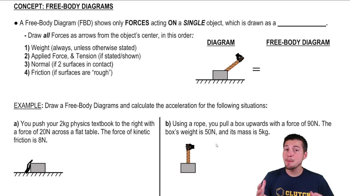
Rigid body dynamics studies the motion of solid objects that do not deform under stress. In this context, the masses connected by massless rods behave as a rigid body, allowing the application of rotational motion principles. Understanding how forces and torques affect the motion of such systems is crucial for analyzing their behavior, particularly when calculating moments of inertia about various axes.
추천 영상:
가이드 코스
Free-Body Diagrams
관련 실천
교과서 질문
1687
views
교과서 질문
The three 200 g masses in FIGURE EX12.11 are connected by massless, rigid rods. What is the triangle's kinetic energy if it rotates about the axis at 5.0 rev/s?
2156
views
교과서 질문
A 25 kg solid door is 220 cm tall, 91 cm wide. What is the door's moment of inertia for rotation on its hinges?
1531
views
2
comments
교과서 질문
The four masses shown in FIGURE EX12.13 are connected by massless, rigid rods. Find the coordinates of the center of mass.
1747
views
교과서 질문
The three masses shown in FIGURE EX12.15 are connected by massless, rigid rods. Find the coordinates of the center of mass.
2454
views
교과서 질문
The three masses shown in FIGURE EX12.15 are connected by massless, rigid rods. Find the moment of inertia about an axis that passes through mass A and is perpendicular to the page.
3431
views