Ch 19: Work, Heat, and the First Law of Thermodynamics
Knight Calc - Physics for Scientists and Engineers 5th Edition
Knight Calc5th EditionPhysics for Scientists and EngineersISBN: 9780137344796당신이 사용하는 게 아니라요?교과서 변경
19장, 문제 58

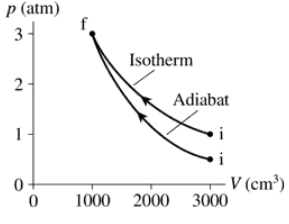
0.10 mol of nitrogen gas follow the two processes shown in FIGURE P19.58. How much heat is required for each?

검증된 단계별 안내
1
Identify the two processes described in the problem (e.g., isothermal, isochoric, isobaric, or adiabatic) based on the information provided in FIGURE P19.58. Each process will have a specific thermodynamic equation to calculate heat transfer.
For the first process, determine the type of process (e.g., isothermal). If it is isothermal, use the formula for heat transfer: Q = nRT⁢ln(VfVi), where n is the number of moles, R is the gas constant, T is the temperature, and Vf and Vi are the final and initial volumes, respectively.
For the second process, determine the type of process (e.g., isochoric). If it is isochoric, use the formula for heat transfer: Q = nCv⁢∆T, where Cv is the molar heat capacity at constant volume and ∆T is the change in temperature.
Substitute the given values (e.g., n = 0.10 mol, specific temperatures, and volume ratios) into the appropriate formulas for each process. Ensure that the units are consistent (e.g., temperature in Kelvin, volume in cubic meters).
Combine the results from both processes to determine the total heat required. If the problem asks for heat for each process separately, ensure that the calculations for each process are clearly distinguished.

비슷한 문제에 대한 검증된 영상 답변:

이 영상 해법은 위 문제에 도움이 된다고 튜터들이 추천한 것입니다.

주요 개념

질문에 올바르게 답하기 위해 반드시 이해해야 하는 핵심 개념들은 다음과 같습니다.

Ideal Gas Law

The Ideal Gas Law relates the pressure, volume, temperature, and number of moles of a gas through the equation PV = nRT. This law is essential for understanding the behavior of gases under various conditions and is crucial for calculating changes in state, such as during heating or cooling processes.
추천 영상:
가이드 코스
07:21
Ideal Gases and the Ideal Gas Law

First Law of Thermodynamics

The First Law of Thermodynamics states that energy cannot be created or destroyed, only transformed. It is expressed as ΔU = Q - W, where ΔU is the change in internal energy, Q is the heat added to the system, and W is the work done by the system. This principle is vital for determining the heat required in thermodynamic processes.
추천 영상:
가이드 코스
08:04
The First Law of Thermodynamics

Specific Heat Capacity

Specific heat capacity is the amount of heat required to raise the temperature of a unit mass of a substance by one degree Celsius. It varies for different substances and is crucial for calculating the heat transfer involved in temperature changes during the processes described in the question.
추천 영상:
가이드 코스
06:50
Specific Heat & Temperature Changes