Ch 19: Work, Heat, and the First Law of Thermodynamics
Knight Calc - Physics for Scientists and Engineers 5th Edition
Knight Calc5th EditionPhysics for Scientists and EngineersISBN: 9780137344796당신이 사용하는 게 아니라요?교과서 변경
19장, 문제 57b

5.0 g of nitrogen gas at 20°C and an initial pressure of 3.0 atm undergo an isobaric expansion until the volume has tripled. How much heat energy is transferred to the gas to cause this expansion?

검증된 단계별 안내
1
Determine the number of moles of nitrogen gas using the ideal gas law: \( PV = nRT \). Rearrange to solve for \( n \): \( n = \frac{PV}{RT} \). Use the given pressure \( P = 3.0 \; \text{atm} \), the initial temperature \( T = 20^{\circ}C = 293 \; \text{K} \), and the gas constant \( R = 0.0821 \; \text{L·atm/(mol·K)} \). Convert the mass of nitrogen gas (5.0 g) to moles if needed.
Recognize that the process is isobaric (constant pressure). For an isobaric process, the heat energy transferred \( Q \) is given by \( Q = nC_p\Delta T \), where \( C_p \) is the molar specific heat capacity at constant pressure for nitrogen gas (\( C_p = 29.1 \; \text{J/(mol·K)} \) for diatomic gases like nitrogen).
Calculate the final temperature \( T_f \) after the volume has tripled. Since the process is isobaric, the relationship between volume and temperature is \( \frac{V_f}{V_i} = \frac{T_f}{T_i} \). Use \( V_f = 3V_i \) and solve for \( T_f \): \( T_f = 3T_i \).
Determine the temperature change \( \Delta T \) using \( \Delta T = T_f - T_i \). Substitute the initial temperature \( T_i = 293 \; \text{K} \) and the calculated \( T_f \).
Substitute the values of \( n \), \( C_p \), and \( \Delta T \) into the equation \( Q = nC_p\Delta T \) to calculate the heat energy transferred to the gas during the expansion.

비슷한 문제에 대한 검증된 영상 답변:

이 영상 해법은 위 문제에 도움이 된다고 튜터들이 추천한 것입니다.
영상 길이:
6m

주요 개념

질문에 올바르게 답하기 위해 반드시 이해해야 하는 핵심 개념들은 다음과 같습니다.

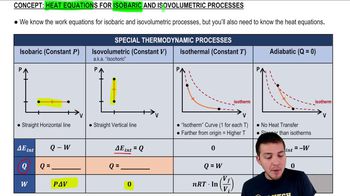
Isobaric Process

An isobaric process is a thermodynamic process in which the pressure remains constant while the volume and temperature of the gas change. In this scenario, as the nitrogen gas expands, it does so at a constant pressure of 3.0 atm, which simplifies the calculations for heat transfer since the pressure does not vary.
추천 영상:
가이드 코스
06:44
Heat Equations for Isobaric & Isovolumetric Processes

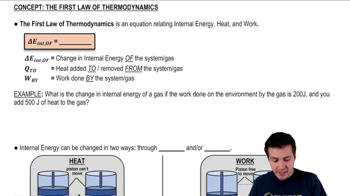
First Law of Thermodynamics

The First Law of Thermodynamics states that the change in internal energy of a system is equal to the heat added to the system minus the work done by the system. In the context of the isobaric expansion, the heat energy transferred to the gas can be calculated by considering both the work done during the expansion and the change in internal energy.
추천 영상:
가이드 코스
08:04
The First Law of Thermodynamics

Heat Transfer in Gases

In an isobaric process, the heat transfer (Q) can be calculated using the formula Q = nCpΔT, where n is the number of moles, Cp is the specific heat capacity at constant pressure, and ΔT is the change in temperature. This relationship is crucial for determining how much heat energy is required to achieve the desired expansion of the gas.
추천 영상:
가이드 코스
05:14
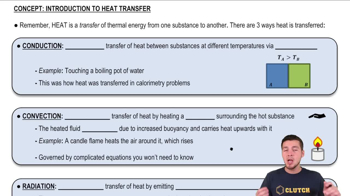
Overview of Heat Transfer