Ch 19: Work, Heat, and the First Law of Thermodynamics
Knight Calc - Physics for Scientists and Engineers 5th Edition
Knight Calc5th EditionPhysics for Scientists and EngineersISBN: 9780137344796당신이 사용하는 게 아니라요?교과서 변경
19장, 문제 3

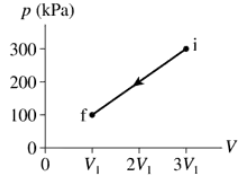
80 J of work are done on the gas in the process shown in FIGURE EX19.3. What is V1 in cm3?

검증된 단계별 안내
1
Step 1: Identify the relationship between work done on the gas and the pressure-volume graph. Work done on a gas is calculated using the formula \( W = - \int P \, dV \), where \( W \) is the work, \( P \) is the pressure, and \( dV \) is the change in volume.
Step 2: Analyze the graph provided in FIGURE EX19.3 to determine the pressure \( P \) and the volume change \( \Delta V \). The graph will provide the necessary data points for pressure and volume.
Step 3: Rearrange the formula to solve for \( V_1 \), the initial volume. If \( W \) is given as 80 J and \( P \) is constant, the formula simplifies to \( W = -P(V_2 - V_1) \). Rearrange to \( V_1 = V_2 - \frac{W}{P} \).
Step 4: Convert the final volume \( V_2 \) and pressure \( P \) into consistent units if necessary (e.g., converting \( V \) to \( \text{cm}^3 \) and \( P \) to appropriate units). Ensure all values are in SI units before performing calculations.
Step 5: Substitute the known values for \( W \), \( P \), and \( V_2 \) into the equation \( V_1 = V_2 - \frac{W}{P} \) to find \( V_1 \). Perform the calculation to determine the initial volume in \( \text{cm}^3 \).

비슷한 문제에 대한 검증된 영상 답변:

이 영상 해법은 위 문제에 도움이 된다고 튜터들이 추천한 것입니다.
영상 길이:
6m

주요 개념

질문에 올바르게 답하기 위해 반드시 이해해야 하는 핵심 개념들은 다음과 같습니다.

Work and Energy

Work is defined as the energy transferred to or from an object via the application of force along a displacement. In thermodynamics, work done on a gas can change its internal energy, affecting its volume and pressure. The relationship between work, energy, and volume is crucial for understanding how gases behave under different conditions.
추천 영상:
가이드 코스
04:10
The Work-Energy Theorem

Ideal Gas Law

The Ideal Gas Law relates the pressure, volume, temperature, and number of moles of an ideal gas through the equation PV = nRT. This law is fundamental in thermodynamics and helps predict how a gas will respond to changes in work and energy. Understanding this relationship is essential for solving problems involving gas behavior.
추천 영상:
가이드 코스
07:21
Ideal Gases and the Ideal Gas Law

Volume and Units

Volume is a measure of the space occupied by a substance, commonly expressed in cubic centimeters (cm³) in this context. When calculating work done on a gas, it is important to convert units appropriately to ensure consistency in calculations. Understanding how to manipulate and convert these units is vital for accurately determining the volume of the gas after work is applied.
추천 영상:
가이드 코스
05:21
Volume Thermal Expansion