 뒤로
Chapter 6: Ratio, Proportion, and Percent – Structured Study Notes
스터디 가이드 - 스마트 노트
 자료에 맞춘 맞춤형 노트, 핵심 정의, 예시, 맥락을 확장해 제공합니다.
Ratios and Rates
Understanding Ratios
Ratios are mathematical comparisons between two quantities, showing how many times one value contains or is contained within the other. Ratios can be written in three ways: using the word 'to', a colon ':', or as a fraction.
Definition: A ratio compares two quantities, often written as a to b, a:b, or as a fraction \( \frac{a}{b} \).
Fraction Representation: Ratios can be expressed as fractions and should always be simplified to their lowest terms.
Example: In a class with 9 women and 11 men, the ratio of women to men is \( \frac{9}{11} \), and the ratio of men to women is \( \frac{11}{9} \).

Writing Ratios as Fractions
Ratios can be written as fractions to facilitate simplification and comparison. Always reduce the fraction to its simplest form.
Example: The ratio 4 oz to 14 oz is written as \( \frac{4}{14} \), which simplifies to \( \frac{2}{7} \).
Practice: Express 198:12 as a fraction: \( \frac{198}{12} \) simplifies to \( \frac{33}{2} \).
Practice: Express 3.6:5.4 as a fraction: \( \frac{3.6}{5.4} \) simplifies to \( \frac{2}{3} \).
Ratios with Mixed Numbers
Ratios can also involve mixed numbers, which are numbers composed of a whole number and a fraction.
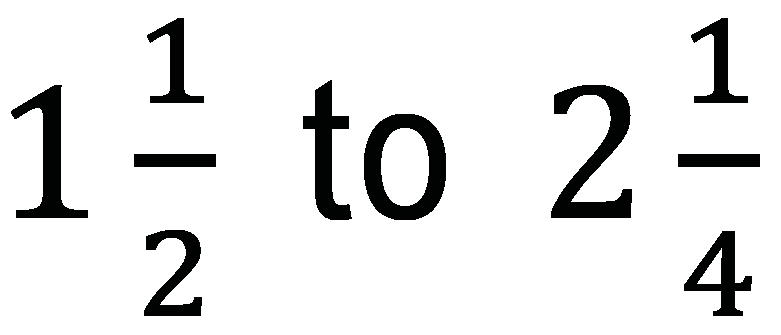
Example: The ratio of 1\( \frac{1}{2} \) to 2\( \frac{1}{4} \) is written as \( \frac{1\frac{1}{2}}{2\frac{1}{4}} \).
Rates and Unit Rates
A rate is a ratio comparing two quantities with different units. A unit rate is a rate with a denominator of 1.
Definition: A rate compares two quantities with different units, such as miles per hour or dollars per ounce.
Unit Rate: To find a unit rate, divide the numerator by the denominator so the denominator becomes 1.
Example: 420 miles in 8 hours: \( \frac{420}{8} = 52.5 \) miles per hour.
Example: $3600 for 6 weeks: \( \frac{3600}{6} = 600 \) dollars per week.
Proportions
Understanding Proportions
A proportion is an equation stating that two ratios or rates are equal. Proportions are used to solve problems involving equivalent ratios.
Definition: A proportion is written as \( \frac{a}{b} = \frac{c}{d} \).
Example: 5 is to 12 as 30 is to 72: \( \frac{5}{12} = \frac{30}{72} \).
Expressing Proportions
Proportions can be written from sentences or real-world situations.
Example: Four apples cost $12, and six apples cost $18: \( \frac{4}{12} = \frac{6}{18} \).
Determining True Proportions
A proportion is true if the ratios are equivalent. This can be checked by simplifying both ratios or using cross multiplication.
Cross Products: If \( \frac{a}{b} = \frac{c}{d} \), then \( a \times d = b \times c \).
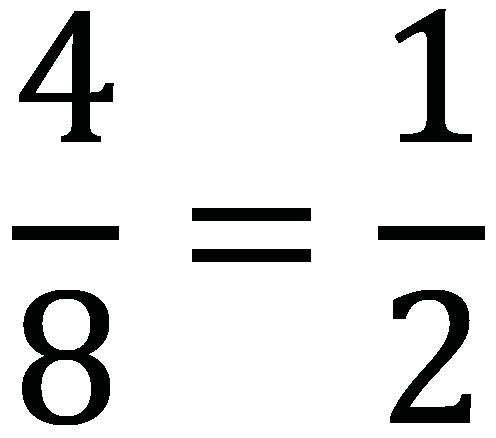
Example: Is \( \frac{4}{8} = \frac{1}{2} \)? Cross multiply: \( 4 \times 2 = 8 \times 1 \), both equal 8, so the proportion is true.
Solving Proportions
When one value in a proportion is unknown, use cross products to solve for the unknown.
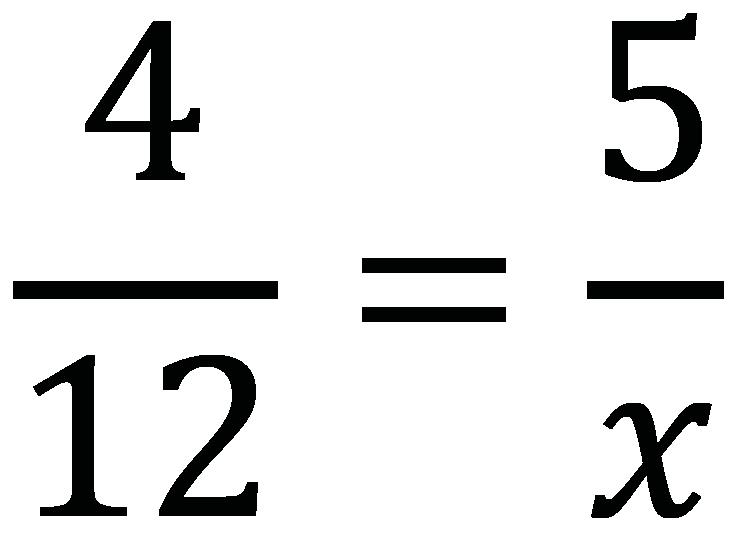
Example: \( \frac{4}{12} = \frac{5}{x} \). Cross multiply: \( 4 \times x = 12 \times 5 \), so \( 4x = 60 \), \( x = 15 \).
Percent
Understanding Percent
A percent is a ratio that compares a number to 100. Percents can be written as fractions or decimals.
Definition: Percent means 'per hundred'.
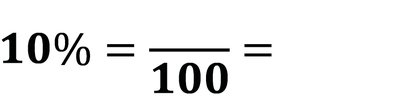
Conversion: 10% = \( \frac{10}{100} = 0.10 \).
Solving Percent Problems
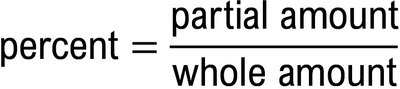
Percent problems can be solved using equations. The basic formula is:
Formula: Partial = Percent as decimal × Whole
Example: 4 is 5% of what number? \( 4 = 0.05 \times x \), \( x = \frac{4}{0.05} = 80 \).
Example: 35 is what percent of 28? \( \frac{35}{28} = 1.25 \), so 125%.
Percent Change
Percent change measures the difference between two values as a percentage of the original value.
Formula:
Example: If a population changes from 12,000 to 8,000: Amount of change = 4,000 decrease. Percent change = \( \frac{4000}{12000} \times 100 = 33.33\% \) decrease.
Discount and Mark-up
Discounts and mark-ups are applications of percent problems. A discount decreases the price, while a mark-up increases it.
Formula: or
Example: A $385 item is discounted by 85%. Discount = \( 0.85 \times 385 = 327.25 \). New price = \( 385 - 327.25 = 57.75 \).
Simple Interest
Simple interest is calculated on the principal amount using the formula:
Formula: where I is interest, P is principal, R is rate (as decimal), T is time (in years).
Example: Jenny borrows I = 1275 \times 0.068 \times 4 = 346.80$
Summary Table: Key Formulas
Concept | Formula | Example |
|---|---|---|
Ratio | 9 women to 11 men: | |
Unit Rate | (b=1) | 420 miles in 8 hours: mph |
Proportion | ||
Percent | 10% = | |
Percent Change | Population decrease: | |
Simple Interest |
Visual Aids


Additional info: These notes expand on the original content with definitions, formulas, and examples for clarity and completeness, suitable for Prealgebra & Beginning Algebra students.
