 뒤로
Analytic Trigonometry: Inverse Trigonometric Functions (Secant, Cosecant, Cotangent)
스터디 가이드 - 스마트 노트
 자료에 맞춘 맞춤형 노트, 핵심 정의, 예시, 맥락을 확장해 제공합니다.
Analytic Trigonometry
Inverse Trigonometric Functions: Secant, Cosecant, and Cotangent
This section explores the definitions, properties, and applications of the inverse secant, cosecant, and cotangent functions. These functions are essential for solving equations and evaluating expressions involving trigonometric relationships, especially when the original angle is unknown.
Definitions of Inverse Secant, Cosecant, and Cotangent Functions
Inverse Secant Function: The inverse secant function, denoted as , is defined such that if and only if and is in the restricted domain , , and .
Inverse Cosecant Function: The inverse cosecant function, denoted as , is defined such that if and only if and is in the restricted domain , , and .
Inverse Cotangent Function: The inverse cotangent function, denoted as , is defined such that if and only if and is in the restricted domain .
Note: The domains and ranges are chosen to ensure that each inverse function is one-to-one and thus a proper function.
Finding the Exact Value of Inverse Trigonometric Functions
To find the exact value of an inverse trigonometric function, identify the angle within the appropriate range whose trigonometric value matches the given number.
Example: when . Thus, .
Example: when , so .
Example: when .
Approximating the Value of Inverse Trigonometric Functions
When an exact value is not possible, use a calculator (in radian mode) to approximate the value of the inverse trigonometric function to two decimal places.
Set the calculator to radian mode.
Input the value and use the appropriate inverse function key.
Interpret the result within the correct range for the function.
Using Right Triangles to Find Exact Values
Right triangles are often used to visualize and solve for the exact values of expressions involving inverse trigonometric functions. The sides of the triangle correspond to the values in the trigonometric ratio, and the angle is determined accordingly.
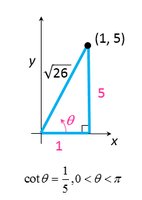
Example: If and , construct a right triangle with adjacent side 1 and opposite side 5. The hypotenuse is .
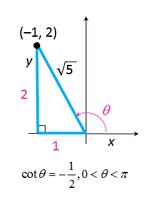
Example: If and , construct a right triangle with adjacent side -1 and opposite side 2. The hypotenuse is .
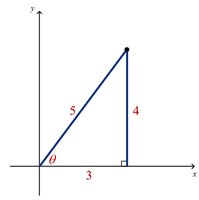
Example: If , construct a right triangle with opposite side 4 and adjacent side 3. The hypotenuse is .
Finding the Exact Value of Composite Functions Involving Inverse Trigonometric Functions
To evaluate expressions such as , use a right triangle to represent the inner function, then use the triangle to find the value of the outer function.
Let , so .
Construct a right triangle with opposite side and adjacent side $1\sqrt{x^2 + 1}$.
Then .
Writing a Trigonometric Expression as an Algebraic Expression
Trigonometric expressions involving inverse functions can often be rewritten as algebraic expressions by using right triangles and the Pythagorean Theorem.
Example: Let , so . The adjacent side is , the hypotenuse is $1\sqrt{1-u^2}\sin(\cos^{-1}(u)) = \sqrt{1-u^2}$.
Summary Table: Inverse Trigonometric Functions
Function | Definition | Domain | Range |
|---|---|---|---|
such that | |||
such that | |||
such that |
Additional info:
When using right triangles, always ensure the angle is in the correct quadrant as determined by the sign of the trigonometric value and the range of the inverse function.
Composite expressions involving inverse trigonometric functions are common in calculus and higher mathematics, making these skills foundational for further study.
