 뒤로
Analytic Trigonometry: Solving Trigonometric Equations
스터디 가이드 - 스마트 노트
 자료에 맞춘 맞춤형 노트, 핵심 정의, 예시, 맥락을 확장해 제공합니다.
Analytic Trigonometry
Solving Trigonometric Equations
Trigonometric equations are equations involving trigonometric functions of a variable, typically θ. Solving these equations is a fundamental skill in precalculus, enabling students to analyze periodic phenomena and solve geometric problems. This section covers several methods for solving trigonometric equations, including algebraic manipulation, use of identities, calculators, and graphing utilities.
Equations Involving a Single Trigonometric Function
Equations with only one trigonometric function can often be solved by isolating the function and using inverse trigonometric operations.
Key Point 1: Isolate the trigonometric function (e.g., sin θ, cos θ, tan θ).
Key Point 2: Apply the inverse function to find the principal solution.
Key Point 3: Use the periodicity of the function to write the general solution.
Example: Solve for all θ. The general solution is and , where k is any integer.
Checking Whether a Given Number Is a Solution
To verify if a specific value is a solution to a trigonometric equation, substitute the value into the equation and check if the equality holds.
Key Point: Substitute the candidate value for θ and evaluate both sides of the equation.
Example: If , check if is a solution by substituting.
Finding All Solutions of a Trigonometric Equation
Trigonometric functions are periodic, so equations often have infinitely many solutions. The general solution incorporates the function's period.
Key Point: For , the general solution is and .
Example: Solve . Solutions: and .
Table: General Solutions for Basic Trigonometric Equations
Equation | General Solution |
|---|---|
, | |
, | |
Solving Linear Trigonometric Equations
Linear trigonometric equations involve the function and the variable in a linear relationship. These can be solved by algebraic manipulation and using the inverse function.
Key Point: Rearrange the equation to isolate the trigonometric function.
Example: Solve . , so and .
Solving Trigonometric Equations Involving Double Angles
Equations with double angles (e.g., ) require the use of double-angle identities and careful consideration of the interval.
Key Point: Use identities such as to rewrite the equation.
Key Point: Find all solutions in the specified interval, then use periodicity for the general solution.
Example: Solve in . Solutions: so .
Solving Trigonometric Equations Using a Calculator
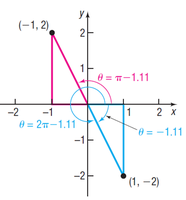
Some equations require numerical solutions, which can be found using a scientific calculator set to radians. The calculator provides the principal value, and periodicity is used to find additional solutions.
Key Point: Set calculator to radian mode and use inverse trigonometric functions.
Key Point: Consider the function's period to find all solutions in the interval.
Example: Solve in . Calculator yields . Other solutions: , .
Solving Trigonometric Equations Quadratic in Form
Some trigonometric equations resemble quadratic equations and can be solved by factoring or using the quadratic formula.
Key Point: Substitute or to rewrite the equation in quadratic form.
Key Point: Factor or use the quadratic formula, then solve for θ.
Example: Solve . Factor: .
Solving Trigonometric Equations Using Fundamental Identities
Trigonometric identities, such as the Pythagorean identity, can simplify equations involving multiple trigonometric functions.
Key Point: Use identities like to rewrite the equation in terms of a single function.
Key Point: Solve the resulting equation using methods above.
Example: Solve . Substitute and solve for .
Solving Trigonometric Equations with No Real Solution
Some equations, after simplification, have no real solutions. This occurs when the discriminant of the quadratic form is negative or the trigonometric function's value is outside its range.
Key Point: Check the discriminant or the range of the trigonometric function.
Example: If , there is no real solution since ranges from -1 to 1.
Solving Trigonometric Equations Using a Graphing Utility
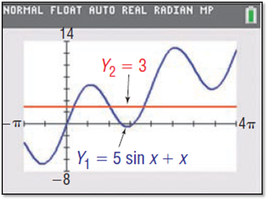
Graphing utilities can be used to solve equations that are not easily solved algebraically. The solution corresponds to the x-coordinate where the graphs intersect.
Key Point: Graph both sides of the equation and use the INTERSECT feature to find solutions.
Example: Solve by graphing and .
Summary Table: Methods for Solving Trigonometric Equations
Method | When to Use | Example |
|---|---|---|
Algebraic Manipulation | Single function, linear or quadratic form | |
Identities | Multiple functions, use identities to simplify | |
Calculator | Numerical solution required | |
Graphing Utility | Complex equations, intersection points |
Additional info: The images included visually reinforce the process of finding solutions graphically and using calculator methods for trigonometric equations. The notes are based on Chapter 8, Section 8.3 of a standard precalculus textbook, directly relevant to the analytic trigonometry curriculum.
