 뒤로
Composite Functions: Definitions, Domains, and Examples
스터디 가이드 - 스마트 노트
 자료에 맞춘 맞춤형 노트, 핵심 정의, 예시, 맥락을 확장해 제공합니다.
Exponential and Logarithmic Functions
Composite Functions
Composite functions are a fundamental concept in precalculus, allowing the combination of two functions to form a new function. Understanding how to form, evaluate, and determine the domain of composite functions is essential for further study in mathematics.
Definition: Given two functions f and g, the composite function, denoted by f ∘ g (read as "f composed with g"), is defined as (f ∘ g)(x) = f(g(x)).
Domain of Composite Function: The domain of f ∘ g is the set of all numbers x in the domain of g for which g(x) is in the domain of f.
Notation:
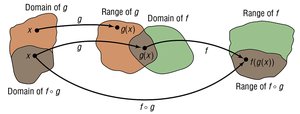
Forming a Composite Function
To form a composite function, substitute the output of one function into the input of another. This process is often used to simplify complex expressions or to analyze the behavior of combined functions.
Step 1: Identify the inner function g(x) and the outer function f(x).
Step 2: Substitute g(x) into f to obtain f(g(x)).
Example: If f(x) = x^2 and g(x) = 3x + 1, then .
Finding the Domain of a Composite Function
Determining the domain of a composite function requires careful analysis of both functions involved. Exclude values from the domain of g that result in outputs not allowed in the domain of f.
Step 1: Find the domain of g.
Step 2: Find the domain of f.
Step 3: Exclude values of x from the domain of g for which g(x) is not in the domain of f.
Example: If g(x) = x - 1 (domain: all real numbers except 1) and f(x) = 1/(x - 2) (domain: all real numbers except 2), then the domain of f ∘ g excludes x = 1 and x = 3 (since g(3) = 2).
Evaluating Composite Functions
To evaluate a composite function at a specific value, first apply the inner function, then use its output as the input for the outer function.
Example: If f(x) = x^2 and g(x) = 2x + 1, to find (f ∘ g)(2):
Step 1: Compute g(2) = 2(2) + 1 = 5.
Step 2: Compute f(5) = 5^2 = 25.
Thus, (f ∘ g)(2) = 25.
Examples of Composite Functions and Their Domains
Example 1: If f(x) = x^2 and g(x) = x + 3, then and the domain is all real numbers.
Example 2: If f(x) = 1/(x - 4) and g(x) = 1/(x - 1), then ; exclude x = 1 and solve for additional exclusions.
Showing Equality of Composite Functions
Sometimes, two composite functions can be shown to be equal for all values in their domain. This is done by algebraic manipulation and verifying the equality for all permissible values.
Example: If f(x) = 2x and g(x) = x + 1, then and ; these are not equal for all x.
Decomposing Composite Functions
Given a composite function, it is possible to find two functions f and g such that their composition yields the original function.
Example: If H(x) = (x^3 + 1)^{21}, let g(x) = x^3 + 1 and f(x) = x^{21}, so .
Example: If H(x) = 1/(x^2 + 1), let g(x) = x^2 + 1 and f(x) = 1/x, so .
Summary Table: Composite Function Domain Analysis
The following table summarizes the steps for finding the domain of a composite function:
Step | Description |
|---|---|
1 | Find the domain of the inner function g. |
2 | Find the domain of the outer function f. |
3 | Exclude values of x from the domain of g for which g(x) is not in the domain of f. |
4 | Combine exclusions to determine the domain of f ∘ g. |
