 뒤로
뒤로Division of Polynomials: Long Division, Synthetic Division, Remainder and Factor Theorems
스터디 가이드 - 스마트 노트
 자료에 맞춘 맞춤형 노트, 핵심 정의, 예시, 맥락을 확장해 제공합니다.
Division of Polynomials
Long Division of Polynomials
Polynomial long division is a method for dividing a polynomial (the dividend) by another polynomial (the divisor), resulting in a quotient and possibly a remainder. The process is analogous to long division with numbers and is essential for simplifying rational expressions and solving polynomial equations.
Step 1: Divide the leading term of the dividend by the leading term of the divisor to obtain the first term of the quotient.
Step 2: Multiply the entire divisor by this term and subtract the result from the dividend.
Step 3: Bring down the next term from the original dividend and repeat the process until the degree of the remainder is less than the degree of the divisor.
Step 4: The final expression is written as: where is the dividend, is the divisor, is the quotient, and is the remainder.
Example: Divide by .
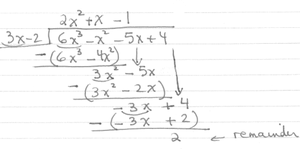
The result is with a remainder of $2$, so:

Example: Divide by (note the missing term in the dividend, so use a zero coefficient).
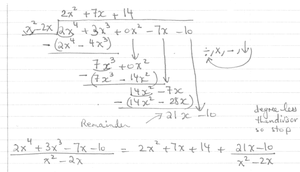
The result is with a remainder of , so:
Synthetic Division
Synthetic division is a shortcut method for dividing a polynomial by a linear divisor of the form . It is more efficient than long division for this specific case and is especially useful for evaluating polynomials and finding zeros.
Step 1: Write the coefficients of the dividend in order, using zero for any missing terms.
Step 2: Write the value (from ) to the left.
Step 3: Bring down the leading coefficient. Multiply it by and add to the next coefficient. Repeat for all coefficients.
Step 4: The last number is the remainder; the other numbers are the coefficients of the quotient.
Example: Divide by using synthetic division ():
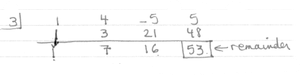
The quotient is and the remainder is $53$:
Example: Divide by using synthetic division ():

The quotient is and the remainder is $0$:
Remainder Theorem
The Remainder Theorem states that if a polynomial is divided by , the remainder is . This theorem provides a quick way to evaluate polynomials at specific values and check for factors.
Statement: If is divided by , then the remainder is .
Application: Use synthetic division to find the remainder when dividing by .
Example: Given , find using synthetic division:
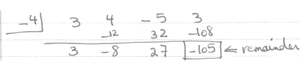
The remainder is , so .
Factor Theorem
The Factor Theorem is a special case of the Remainder Theorem. It states that is a factor of if and only if . This theorem is fundamental for factoring polynomials and finding their zeros.
Statement: is a factor of if and only if .
Application: Use synthetic division or direct substitution to test if is a factor.
Example: Solve given that is a zero (i.e., is a factor):

The quotient is and the remainder is $0x + 1$ is a factor. Further factoring gives the complete solution set for the equation.
Summary Table: Division Methods
Method | When to Use | Key Steps |
|---|---|---|
Long Division | Any divisor (especially degree > 1) | Divide, multiply, subtract, bring down next term, repeat |
Synthetic Division | Divisor of form | Use coefficients, multiply and add, last entry is remainder |
Remainder Theorem | Find remainder for | Evaluate or use synthetic division |
Factor Theorem | Test if is a factor | Check if |
