 뒤로
Exponential Functions: Properties, Graphs, and Applications
스터디 가이드 - 스마트 노트
 자료에 맞춘 맞춤형 노트, 핵심 정의, 예시, 맥락을 확장해 제공합니다.
Exponential Functions
Definition and Basic Properties
An exponential function is a function of the form , where a is a positive real number (, ), and C is a nonzero real number. The domain of is all real numbers, and the range is all positive real numbers. The base a is called the growth factor, and is the initial value since .
Domain:
Range:
Y-intercept:
Horizontal asymptote:
One-to-one function: Each input yields a unique output.
Laws of Exponents
The following properties hold for all real numbers , , , and with and :
Evaluating Exponential Functions
To evaluate an exponential function, substitute the value of and compute the result. Calculators are often used for non-integer exponents.
Example:
Graphing Exponential Functions
Graphs of ,
When the base is greater than 1, the function is increasing and exhibits exponential growth. The graph passes through and , and as , .
Key points: , ,
Horizontal asymptote:
Graph is smooth and continuous.
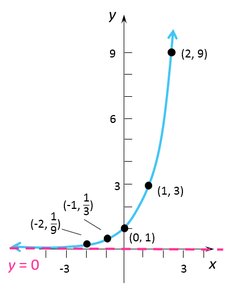
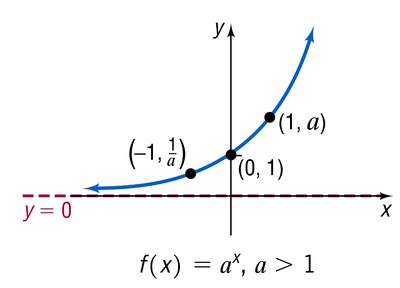
Graphs of ,
When the base is between 0 and 1, the function is decreasing and exhibits exponential decay. The graph passes through and , and as , .
Key points: , ,
Horizontal asymptote:
Graph is smooth and continuous.
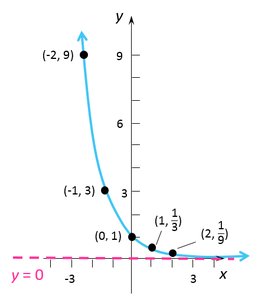
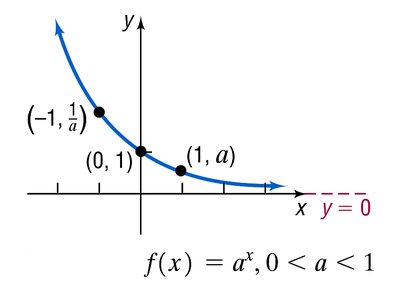
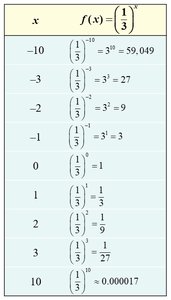
Tabular Representation of Exponential Functions
Tables help visualize how exponential functions change for different values of .
x | f(x) = (1/3)^x |
|---|---|
-10 | |
-3 | |
-2 | |
-1 | |
0 | |
1 | |
2 | |
3 | |
10 |
Transformations of Exponential Functions
Reflections and Shifts
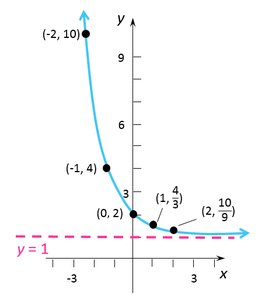
Exponential functions can be transformed by reflecting, shifting, or stretching. For example, is obtained by reflecting about the y-axis and then shifting up by 1 unit.
Domain:
Range:
Horizontal asymptote:
Y-intercept:
The Number e
Definition and Properties
The number e is a fundamental constant in mathematics, defined as the limit:
Approximate value:
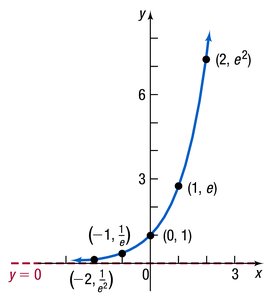
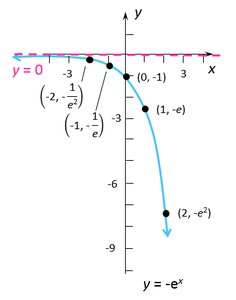
Graphs of and
The function is an exponential growth function, while is its reflection over the x-axis.
Key points for : , , , ,
Key points for : , , , ,
Horizontal asymptote:
x | |
|---|---|
-2 | |
-1 | |
0 | |
1 | |
2 |
Solving Exponential Equations
Basic Principle
If , then (for , ). This property is used to solve exponential equations by equating exponents.
Example: Solve . Rewrite $8, so .
Example: Solve . Rewrite $9 and $27, so .
Example: Solve . Set exponents equal: .
Summary Table: Exponential Function Properties
Base | Growth/Decay | Domain | Range | Asymptote | Y-intercept |
|---|---|---|---|---|---|
Growth | |||||
Decay | |||||
Growth |
Additional info: The notes above expand on the original slides by providing full definitions, examples, and context for each property and transformation. All included images directly illustrate the graphs or tables referenced in the explanations.
