 뒤로
Functions and Their Graphs: Precalculus Study Notes
스터디 가이드 - 스마트 노트
 자료에 맞춘 맞춤형 노트, 핵심 정의, 예시, 맥락을 확장해 제공합니다.
Functions and Their Graphs
Section 2.1: Functions
This section introduces the concept of functions, their notation, and their graphical representations. It covers how to describe relations, determine if a relation is a function, use function notation, find the domain, and perform operations on functions.
Describing a Relation
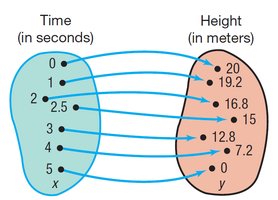
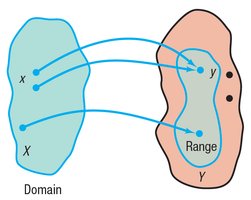
A relation is a correspondence between two sets: the domain (set X) and the range (set Y). Each element from the domain corresponds to at least one element from the range. Relations can be expressed verbally, numerically (tables or ordered pairs), graphically, or as mappings.
Domain: The set of all possible input values (x).
Range: The set of all possible output values (y).
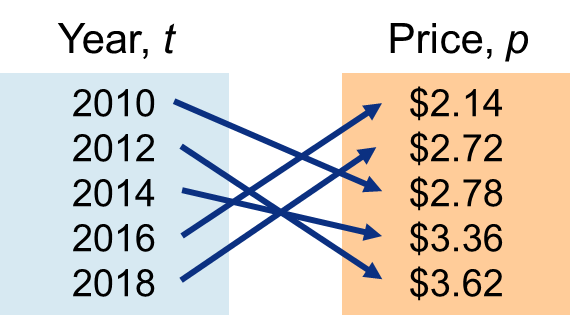
Mapping: Drawing arrows from domain elements to range elements to show correspondence.
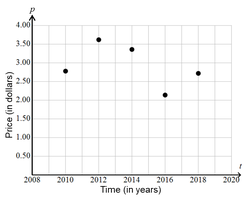
Graph: Plotting points (x, y) to visually represent the relation.
Example: Gasoline Prices Over Years
Domain: {2010, 2012, 2014, 2016, 2018}
Range: {$2.78, $3.62, $3.36, $2.14, $2.72}
Ordered pairs: {(2010, $2.78), (2012, $3.62), (2014, $3.36), (2016, $2.14), (2018, $2.72)}
Definition of a Function
A function is a special type of relation where each element of the domain is associated with exactly one element of the range. The domain is the set of input values, and the range is the set of output values. Not all elements in the range need to be images of domain elements.
Notation: If f is a function, then y = f(x).
Domain: Set X (inputs)
Range: Set of all images of X in Y (outputs)
Determining Whether a Relation Is a Function
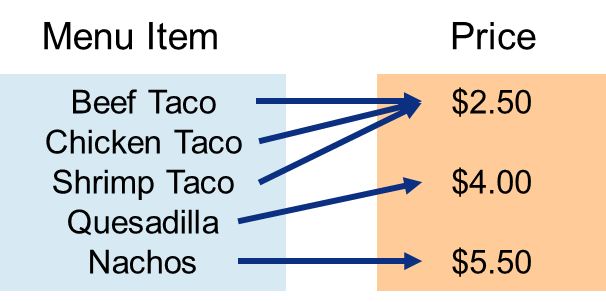
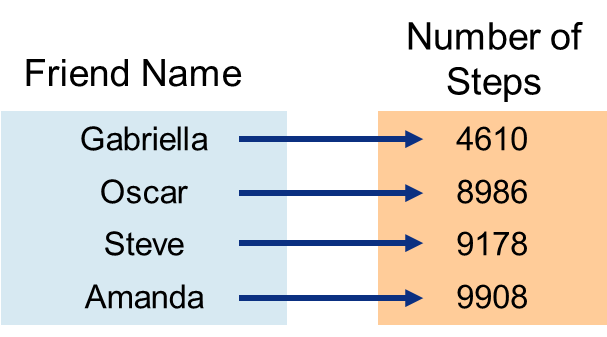
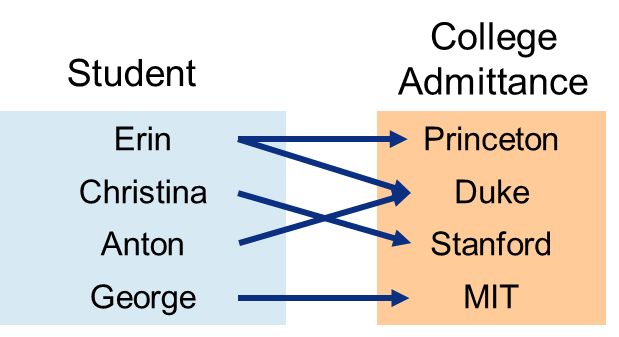
To determine if a relation is a function, check if each input corresponds to exactly one output. This can be done using mappings or sets of ordered pairs.
Mapping Example: Menu items to prices
Ordered Pair Example: {(1, 5), (3, 9), (5, 1), (9, 2)} is a function; {(−5, 1), (−5, −3)} is not a function.
Function Notation and Values
Function notation uses symbols like f(x) to denote the value of the function f at x. The variable x is the independent variable (argument), and y = f(x) is the dependent variable (output).
Example: y = 2x − 5 can be written as f(x) = 2x − 5.
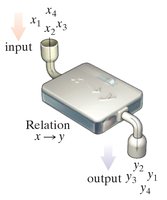
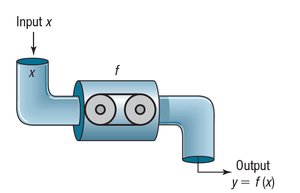
Machine analogy: Think of a function as a machine that takes an input, processes it, and produces an output.
Calculator Examples
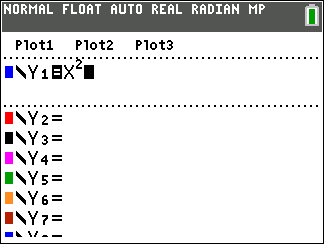
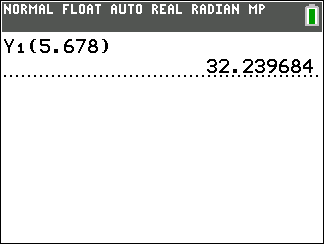
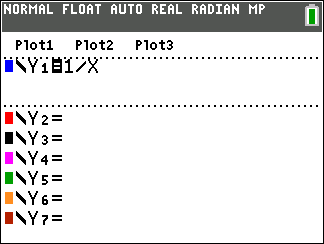
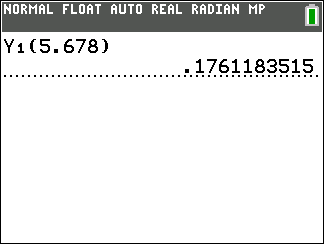
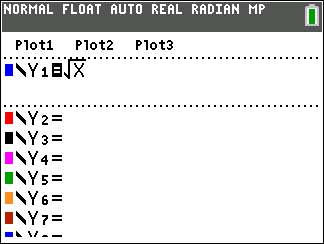
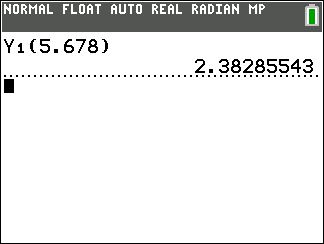
To evaluate f(x) for specific values, use a calculator or substitute directly.
Implicit and Explicit Forms of Functions
A function is given implicitly if defined by an equation in x and y. If it is possible to solve for y in terms of x, the function is given explicitly.
Implicit: Equation not solved for y.
Explicit: y = f(x)
Difference Quotient
The difference quotient is a fundamental concept in calculus, used to measure the average rate of change of a function. It is defined as:
Formula: $\frac{f(x+h) - f(x)}{h}$
Finding the Domain of a Function
The domain of a function is the set of all real numbers for which the function is defined. Restrictions may arise from denominators (cannot be zero) or radicands (must be nonnegative for even roots).
Example: $f(x) = x^2 + 1$ has domain all real numbers.
Example: $g(x) = \frac{x}{x^2 - 25}$ has domain $x \neq -5, 5$.
Example: $h(t) = \sqrt{5 - 5t}$ has domain $t \leq 1$.
Example: $F(x) = \frac{\sqrt{2x + 6}}{x - 2}$ has domain $x \geq -3, x \neq 2$.
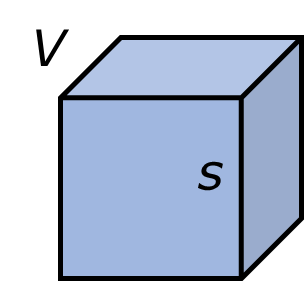
Application Example: Volume of a Cube
The volume V of a cube with side length s is given by:
Formula: $V = s^3$
Domain: $s > 0$ (side length must be positive)
Operations on Functions
Functions can be combined using addition, subtraction, multiplication, and division. The domain of the resulting function is the intersection of the domains of the original functions, with additional restrictions for division (denominator cannot be zero).
Sum: $(f + g)(x) = f(x) + g(x)$
Difference: $(f - g)(x) = f(x) - g(x)$
Product: $(f \cdot g)(x) = f(x) \cdot g(x)$
Quotient: $\left(\frac{f}{g}\right)(x) = \frac{f(x)}{g(x)}$, $g(x) \neq 0$
Summary Table: Types of Relations and Functions
Type | Definition | Example |
|---|---|---|
Relation | Any correspondence between domain and range | Mapping years to gasoline prices |
Function | Each domain element maps to exactly one range element | Menu item to price |
Not a Function | Domain element maps to multiple range elements | Student to multiple college admittances |
Additional info: Academic context and examples were expanded for clarity and completeness. All included images directly reinforce the explanation of the adjacent paragraph.
