 뒤로
One-to-One and Inverse Functions: Precalculus Study Guide
스터디 가이드 - 스마트 노트
 자료에 맞춘 맞춤형 노트, 핵심 정의, 예시, 맥락을 확장해 제공합니다.
Exponential and Logarithmic Functions
One-to-One Functions and Inverse Functions
This section explores the concepts of one-to-one functions and their inverses, which are foundational for understanding exponential and logarithmic functions in Precalculus. Mastery of these ideas is essential for solving equations, analyzing graphs, and understanding function transformations.
Definition of One-to-One Function
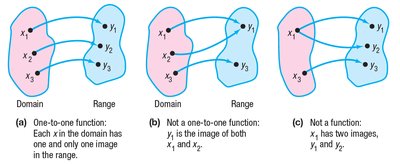
One-to-One Function: A function is one-to-one if every two different inputs in the domain correspond to two different outputs in the range. Formally, if and are two different inputs of a function , then $f$ is one-to-one if .
Key Point: No two distinct domain values map to the same range value.
Example: The function is one-to-one, but is not (since ).
Horizontal-Line Test
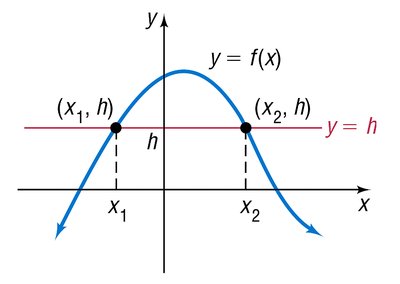
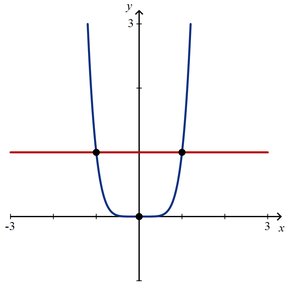
Definition: If every horizontal line intersects the graph of a function in at most one point, then $f$ is one-to-one.
Application: Use the horizontal-line test to visually determine if a function is one-to-one.
Example: fails the test, passes.
Increasing and Decreasing Functions
Theorem: A function that is increasing or decreasing on an interval is one-to-one on $I$.
Key Point: Monotonicity (always increasing or decreasing) guarantees one-to-one behavior.
Inverse Functions
If is a one-to-one function, then the correspondence from the range of to the domain of $f$ is called the inverse function of , denoted . The inverse function reverses the roles of inputs and outputs.
Notation: if .
Key Point: Only one-to-one functions have inverses that are also functions.
Domain and Range Relationships
Domain of = Range of
Range of = Domain of

Properties of Inverse Functions
where is in the domain of
where is in the domain of

Graphical Symmetry of Inverse Functions
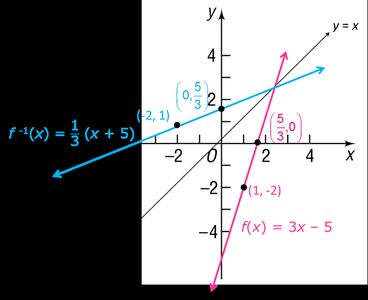
The graph of a one-to-one function and its inverse are symmetric with respect to the line .
Key Point: Reflecting the graph of over the line yields the graph of .

Finding the Inverse of a Function
In , interchange the variables and to obtain (implicit form).
Solve for in terms of to obtain the explicit form .
Check the result by showing and .
Examples of Inverse Functions
Example: Find the inverse of .
Step 1:
Step 2: Interchange and :
Step 3: Solve for :
Thus,
Example: Find the inverse of for .
Step 1:
Step 2: Interchange and :
Step 3: Solve for :
Thus, for

Inverse Functions Defined by Ordered Pairs
To find the inverse of a function defined by ordered pairs, swap each pair's components.
Example: The function has inverse .
Domain and Range: The domain of the original function becomes the range of the inverse, and vice versa.
Verifying Inverse Functions
To verify that is the inverse of , check that and for all in the appropriate domains.
Example: If , then .
Inverse of Domain-Restricted Functions
Some functions are not one-to-one on their entire domain, but become one-to-one when restricted.
Example: is not one-to-one for all , but is one-to-one for .
Summary Table: Properties of One-to-One and Inverse Functions
Property | One-to-One Function | Inverse Function |
|---|---|---|
Definition | Each input maps to a unique output | Reverses the mapping of the original function |
Existence | Must be one-to-one | Exists only for one-to-one functions |
Graphical Test | Horizontal-line test | Symmetry about |
Domain/Range | Domain: Range: | Domain: Range: |
Additional info: These notes expand on the brief points in the original slides, providing full definitions, examples, and step-by-step procedures for finding and verifying inverse functions. Images included are directly relevant to the explanation of one-to-one functions, the horizontal-line test, domain/range relationships, and graphical symmetry of inverse functions.
