 뒤로
Polynomial and Rational Functions: Precalculus Study Guide
스터디 가이드 - 스마트 노트
 자료에 맞춘 맞춤형 노트, 핵심 정의, 예시, 맥락을 확장해 제공합니다.
Polynomial Functions
Definition and Properties
A polynomial function in one variable is a function of the form , where are constants (coefficients), is an integer, and is a variable. The degree of the polynomial is if . The leading coefficient is , and the constant term is . The domain of a polynomial function is all real numbers.
Zero polynomial: All coefficients are zero; has no degree.
Standard form: Terms are written in descending order of degree.
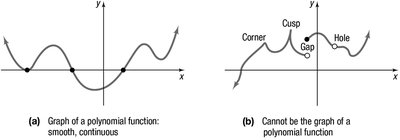
Graph properties: The graph of a polynomial function is always smooth (no sharp corners or cusps) and continuous (no gaps or holes).
Classification by Degree
Degree 0: Constant function (horizontal line)
Degree 1: Linear function (nonvertical, nonhorizontal line)
Degree 2: Quadratic function (parabola)
Degree n: Higher-degree polynomials (more complex curves)
Identifying Polynomial Functions
To determine if a function is a polynomial:
Check for integer exponents and real coefficients.
Functions involving roots, division by variables, or negative exponents are not polynomials.
Zeros of Polynomial Functions
Real Zeros and Their Multiplicity
A real zero of a polynomial function is a real number such that . The following are equivalent:
is a real zero of
is an x-intercept of the graph of
is a factor of
is a real solution to
If is a factor of and is not, then is a real zero of multiplicity m.
Graphical Behavior at Zeros
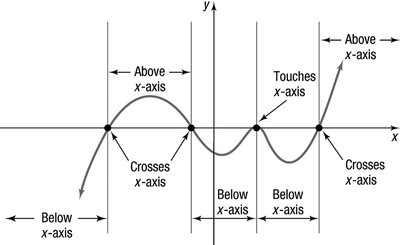
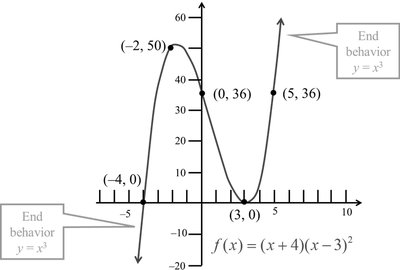
Even multiplicity: The graph touches the x-axis at but does not cross.
Odd multiplicity: The graph crosses the x-axis at .
Graphing Polynomial Functions
Steps for Graphing
Determine end behavior (based on degree and leading coefficient).
Find x- and y-intercepts.
Identify zeros and their multiplicities.
Determine maximum number of turning points ( for degree ).
Analyze behavior near each x-intercept.
Draw a smooth, continuous curve connecting the points.
Turning Points
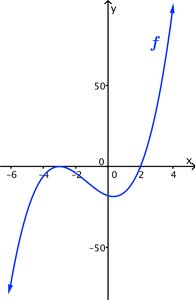
A turning point is where the graph changes direction (local maximum or minimum).
The graph of a polynomial of degree has at most turning points.
End Behavior
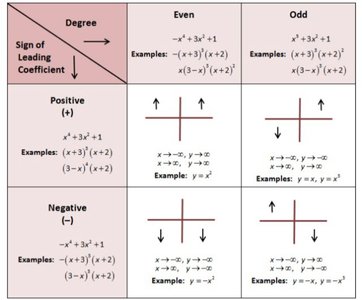
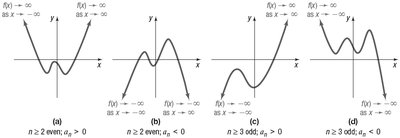
The end behavior of a polynomial function depends on the degree and the sign of the leading coefficient:
Even degree, positive leading coefficient: Both ends up.
Even degree, negative leading coefficient: Both ends down.
Odd degree, positive leading coefficient: Left end down, right end up.
Odd degree, negative leading coefficient: Left end up, right end down.
Rational Functions
Definition and Domain
A rational function is a function of the form , where and are polynomial functions and . The domain is all real numbers except where .
Asymptotes
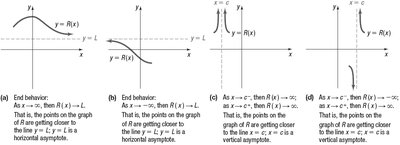
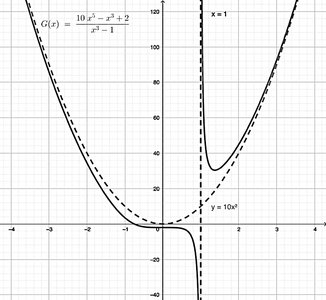
Vertical asymptotes: Occur at real zeros of the denominator (where ).
Horizontal asymptotes: Determined by the degrees of numerator and denominator.
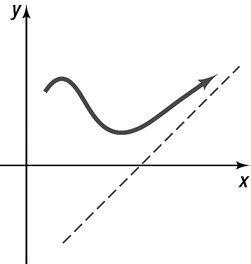
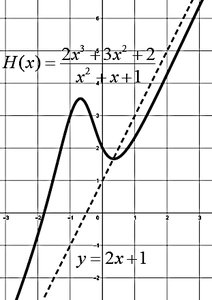
Oblique (slant) asymptotes: Occur when the degree of the numerator is one more than the denominator.
Multiplicity and Asymptotes
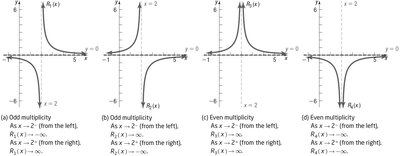
Odd multiplicity: Graph approaches on one side and on the other.
Even multiplicity: Graph approaches the same infinity on both sides.
Finding Asymptotes
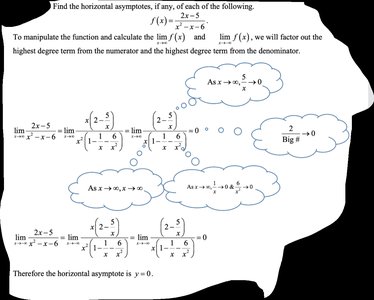
If degree of numerator < degree of denominator: is a horizontal asymptote.
If degrees are equal: (ratio of leading coefficients) is a horizontal asymptote.
If degree of numerator is one more: Use polynomial division for oblique asymptote.
Graphing Rational Functions
Steps for Graphing
Factor numerator and denominator; find domain.
Write in lowest terms.
Find and plot intercepts; use multiplicity for behavior at x-intercepts.
Find and graph vertical asymptotes (dashed lines).
Find and graph horizontal/oblique asymptotes (dashed lines); plot intersections.
Divide x-axis into intervals using zeros and undefined points; determine where graph is above/below x-axis.
Draw the complete graph.
Polynomial and Rational Inequalities
Solving Polynomial Inequalities
Determine end behavior.
Find x- and y-intercepts.
Identify real zeros and their multiplicities.
Divide the real number line into intervals using zeros.
Test values in each interval to determine where the function is positive or negative.
Solving Rational Inequalities
Write the inequality with the rational function on one side and zero on the other.
Find real zeros and points where the function is undefined.
Divide the real number line into intervals using these points.
Test values in each interval to determine sign.
Synthetic Division and the Division Algorithm
Synthetic Division
Synthetic division is a shortcut for dividing a polynomial by a linear factor . It is useful for finding zeros and simplifying polynomials.
Division Algorithm for Polynomials
If and are polynomials, and $g(x)$ has degree greater than zero, then there exist unique polynomials and such that:
, where is either zero or has degree less than .
The Real Zeros of a Polynomial Function
Remainder and Factor Theorems
Remainder Theorem: The remainder when is divided by is .
Factor Theorem: is a factor of if and only if .
Rational Zeros Theorem
If is a polynomial with integer coefficients, any rational zero must have as a factor of the constant term and as a factor of the leading coefficient.
Intermediate Value Theorem
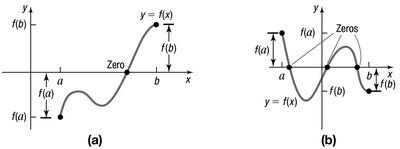
If and are of opposite sign, then there is at least one real zero between and .
Complex Zeros and the Fundamental Theorem of Algebra
Complex Variables and Polynomials
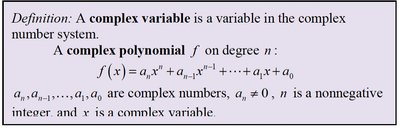
A complex variable is a variable in the complex number system. A complex polynomial of degree is , where are complex numbers.
Fundamental Theorem of Algebra
Every complex polynomial function of degree has at least one complex zero.

Factorization of Complex Polynomials
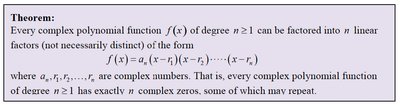
Every complex polynomial function of degree can be factored into linear factors:
Conjugate Pairs Theorem
If is a zero of (with real coefficients), then its complex conjugate is also a zero.

