 뒤로
Precalculus Study Guide: Trigonometric Functions and Their Applications (Sections 5.4–5.8)
스터디 가이드 - 스마트 노트
 자료에 맞춘 맞춤형 노트, 핵심 정의, 예시, 맥락을 확장해 제공합니다.
Trigonometric Functions of Real Numbers
Unit Circle and Trigonometric Definitions
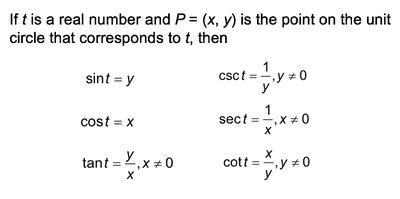
The unit circle is a fundamental concept in trigonometry, defined as a circle with radius 1 centered at the origin. It allows us to define trigonometric functions for all real numbers, not just angle measures. If t is a real number and P = (x, y) is the point on the unit circle corresponding to t, the trigonometric functions are defined as follows:
sin t = y
cos t = x
tan t = \frac{y}{x},\ x \neq 0
csc t = \frac{1}{y},\ y \neq 0
sec t = \frac{1}{x},\ x \neq 0
cot t = \frac{x}{y},\ y \neq 0
Domain and Range:
Function | Domain | Range |
|---|---|---|
sin x | All real numbers | [−1, 1] |
cos x | All real numbers | [−1, 1] |
tan x | All real numbers except odd multiples of | All real numbers |
sec x | All real numbers except odd multiples of | |
csc x | All real numbers except multiples of | |
cot x | All real numbers except multiples of | All real numbers |
Even/Odd and Periodic Properties
Trigonometric functions exhibit symmetry and periodicity:
Even functions: ,
Odd functions: , , ,
Periodicity: , , , , ,
Graphs of Sine and Cosine
Key Properties and Transformations
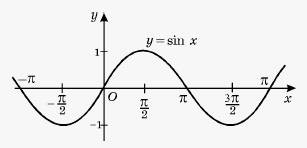
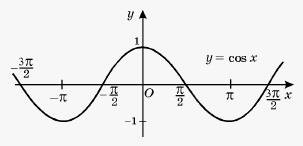
The graphs of sine and cosine functions are periodic and exhibit specific symmetries:
y = sin x: Domain: , Range: [−1, 1], Period: , Symmetry: odd
y = cos x: Domain: , Range: [−1, 1], Period: , Symmetry: even
Transformations:
General form: or
Amplitude:
Period:
Phase shift:
Key points transformation: , ,
Graphs of Tangent and Cotangent
Key Properties and Graphs
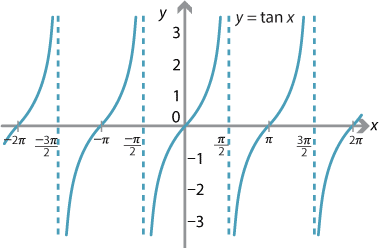
The tangent and cotangent functions have distinct domains, ranges, and periods:
y = tan x: Domain: all real numbers except odd multiples of , Range: , Period: , Symmetry: odd
y = cot x: Domain: all real numbers except multiples of , Range: , Period: , Symmetry: odd
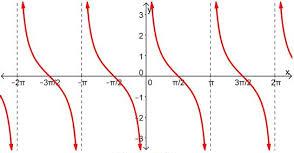
Key points for tangent:
x | y |
|---|---|
Asymptote | |
−1 | |
0 | 0 |
1 | |
Asymptote |
Key points for cotangent:
x | y |
|---|---|
0 | Asymptote |
1 | |
0 | |
−1 | |
Asymptote |
Inverse Trigonometric Functions
Restricting Domains and Evaluating Inverses
Inverse trigonometric functions are defined by restricting the domains of the original functions to make them one-to-one. This ensures each input has a unique output.
Function | Restricted Domain (Angles) | Range (Ratios) |
|---|---|---|
y = sin x | ||
y = cos x | ||
y = tan x |
Inverse function notation:
(arcsin)
(arccos)
(arctan)
Types of questions:
Evaluate inverse functions for common ratios (e.g., )
Recognize when the inverse cannot be evaluated if the ratio is out of domain
Trig Function Composition
Types of Trigonometric Compositions
Compositions of trigonometric and inverse trigonometric functions require careful attention to domains and ranges:
(only if is in the domain of ; otherwise undefined)
(evaluate using the unit circle)
(assign an angle, draw a triangle using SOHCAHTOA, determine quadrant, and find the correct ratio)
(evaluate using the unit circle)
Applications of Trigonometric Functions
Solve a Right Triangle
Solving right triangles involves finding unknown sides and angles using trigonometric relationships. The triangle has three sides (a, b, c) and three angles (A, B, C), with C typically representing the right angle.
Angle and side relationships: Each angle is opposite its corresponding side.
Given three out of six values: Find the missing three using trigonometric tools.
Tools:
(Pythagorean Theorem)
SOHCAHTOA:
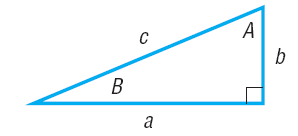
Solving application problems:
If a diagram is not given, create one.
Locate the right triangles.
Pick a tool from above that leads to the answer.
Use algebra and trigonometry to solve the problem.
