 뒤로
뒤로Precalculus Study Notes: Equations, Inequalities, and Functions
스터디 가이드 - 스마트 노트
 자료에 맞춘 맞춤형 노트, 핵심 정의, 예시, 맥락을 확장해 제공합니다.
Solving Other Types of Equations
Equations Involving Absolute Value
Absolute value equations are solved by considering the definition of absolute value, which measures the distance from zero. If and , then or . If , there are no solutions because absolute value cannot be negative.
Key Point: is equivalent to or for .
Key Point: No solution exists for if .
Example: Solve by setting or .
Solving Polynomials by Common Factor or Factor by Grouping
Polynomials can often be solved by factoring and applying the zero-product principle, which states that if , then or .
Key Point: Factor the equation and set each factor equal to zero.
Example: can be rewritten as and factored.
Equations Involving Radicals or Rational Exponents
To solve equations with radicals or rational exponents, isolate the term, raise both sides to the appropriate power, and check all solutions in the original equation.
Key Point: Isolate the radical or exponent, then eliminate it by raising both sides to the necessary power.
Key Point: Always check solutions for extraneous roots.
Example: Solve by squaring both sides.
Inequalities
Basic Properties and Notation
Inequalities compare two expressions using symbols: , , , . Solutions are often written in interval notation or graphed on a number line.
Key Point: Parentheses indicate endpoints are not included; brackets indicate endpoints are included.
Key Point: Intervals are always open at .
Example: is written as .
Solving Linear Inequalities
When multiplying or dividing both sides of an inequality by a negative number, reverse the direction of the inequality symbol.
Key Point: Reverse the inequality when multiplying/dividing by a negative.
Example: Solve for .
Compound Inequalities
Compound inequalities involve three parts and are solved by isolating the variable in the middle.
Key Point: Work with all three parts simultaneously.
Example: .
Intersections and Unions of Intervals
The intersection () of two intervals is the set of numbers common to both. The union () is the set of numbers in either interval.
Key Point: Intersection is the overlap; union is the total collection.
Example: is .
Absolute Value Inequalities
Absolute value inequalities are solved by rewriting as compound inequalities or separating into two linear inequalities.
Key Point: becomes ; becomes or .
Example: becomes .
Functions
Definition and Notation
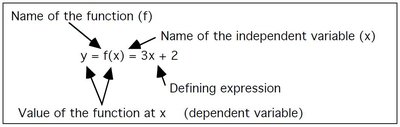
A function is a relation in which each element in the domain corresponds to exactly one element in the range. Function notation is used to denote the value of the function at .
Key Point: The domain is the set of all input values (x-values).
Key Point: The range is the set of all output values (y-values).
Example:
Domain and Range
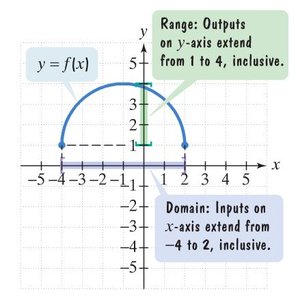
The domain and range of a function can be determined from a set of ordered pairs, an equation, or a graph. The domain is the set of possible x-values; the range is the set of possible y-values.
Key Point: For , the domain is .
Example: For , the domain is all real numbers except .
Using Graphs to Find Domain and Range
To find the domain from a graph, observe the x-values covered by the graph. To find the range, observe the y-values.
Key Point: Domain: left to right; Range: bottom to top.
Example: State domain and range for a given graph.
Vertical Line Test
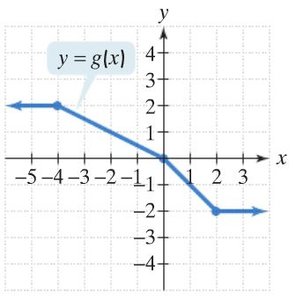
The vertical line test determines if a graph represents a function. If every vertical line intersects the graph at most once, the graph is a function.
Key Point: Use the vertical line test to check if a relation is a function.
Relative Extrema
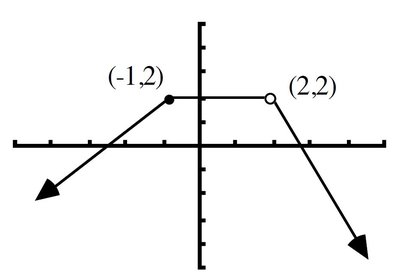
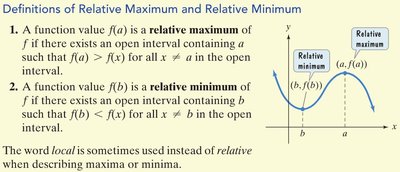
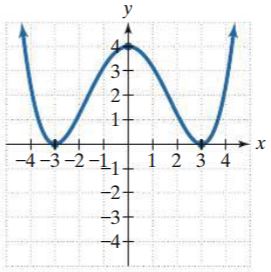
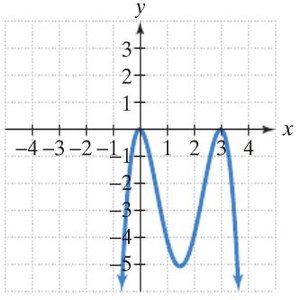
Relative maxima and minima are points where the function reaches a local highest or lowest value within an interval. These are important for analyzing the behavior of functions.
Key Point: A relative maximum occurs at if for all near .
Key Point: A relative minimum occurs at if for all near .
Even and Odd Functions
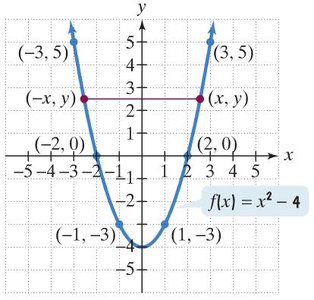
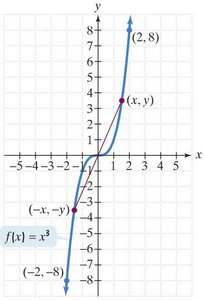
An even function satisfies and is symmetric about the y-axis. An odd function satisfies and is symmetric about the origin.
Key Point: Even functions: symmetry about y-axis.
Key Point: Odd functions: symmetry about origin.
Example: is even; is odd.
Piecewise Functions
Piecewise functions are defined by different expressions for different intervals of the domain. Evaluate by determining which interval the input belongs to.
Key Point: Use the appropriate expression for the given interval.
Example:
The Difference Quotient
Definition and Application
The difference quotient is a fundamental concept in calculus, used to compute the average rate of change of a function. It is given by:
Formula:
Key Point: Used to find slopes of secant lines and analyze function behavior.
Linear Functions and Slope
Slope of a Line
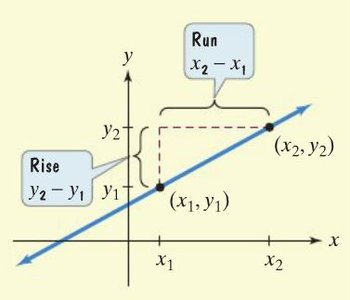
The slope of a line passing through and is:
Formula:
Key Point: Slope is the rate of change; positive slope rises, negative slope falls.
Point-Slope and Slope-Intercept Forms
Point-slope form: Slope-intercept form:
Key Point: Use point-slope form when a point and slope are known.
Key Point: Use slope-intercept form to easily identify slope and y-intercept.
Horizontal and Vertical Lines
The equation of a vertical line is . The equation of a horizontal line is .
Key Point: Vertical lines have undefined slope; horizontal lines have zero slope.
More on Slope
Parallel and Perpendicular Lines
Parallel lines have equal slopes. Perpendicular lines have slopes that are negative reciprocals.
Key Point: If , lines are parallel.
Key Point: If , lines are perpendicular.
Average Rate of Change
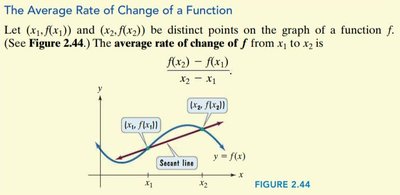
The average rate of change of a function between two points is the slope of the secant line connecting those points:
Formula:
Key Point: For linear functions, the average rate of change is constant.
Graphs of Basic (Parent) Functions
Common Parent Functions
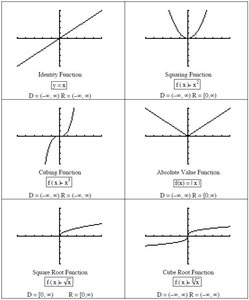
Parent functions are the simplest forms of functions in each family. Examples include the identity function, squaring function, cubing function, absolute value function, square root function, and cube root function.
Key Point: Understanding parent functions is essential for graph transformations.
Shifting, Reflecting, and Stretching Graphs
Vertical and Horizontal Shifts
Vertical shifts move the graph up or down; horizontal shifts move the graph left or right. The transformation depends on whether the constant is grouped with the term.
Key Point: shifts up; shifts down.
Key Point: shifts left; shifts right.
Vertical Stretching and Shrinking
Multiplying the function by a constant stretches or shrinks the graph vertically. If , the graph is narrower; if , the graph is wider.
Key Point: , stretches; shrinks.
Reflecting Graphs
Reflecting a graph over the x-axis is done by multiplying the function by .
Key Point: reflects over the x-axis.
Combining Transformations
Multiple transformations can be combined, such as shifting, stretching, and reflecting, to produce new graphs from parent functions.
Example: is a horizontal shift left by 6 and a vertical shrink.
