 뒤로
뒤로Rational Functions: Domains, Asymptotes, and Graphing
스터디 가이드 - 스마트 노트
 자료에 맞춘 맞춤형 노트, 핵심 정의, 예시, 맥락을 확장해 제공합니다.
Rational Functions
Definition
A rational function is any function that can be written as the quotient of two polynomial functions. Formally, if p(x) and q(x) are polynomials and q(x) \neq 0, then:
f(x) = \frac{p(x)}{q(x)}
The denominator q(x) must not be zero for any value in the domain.
Finding the Domain of Rational Functions
Domain Exclusion Principle
The domain of a rational function excludes all real values of x that make the denominator zero.
For f(x) = \frac{x^2 - 25}{x - 5}, exclude x = 5 since x - 5 = 0 at x = 5.
Domain in interval notation: (-\infty, 5) \cup (5, \infty)
Domain in set-builder notation: \{x \mid x \neq 5\}
For g(x) = \frac{x}{x^2 - 25}, exclude x = 5 and x = -5 since x^2 - 25 = 0 at these values.
Domain in interval notation: (-\infty, -5) \cup (-5, 5) \cup (5, \infty)
Domain in set-builder notation: \{x \mid x \neq 5, x \neq -5\}
For h(x) = \frac{x+5}{x^2 + 25}, the denominator never equals zero for real x, so the domain is all real numbers.
Domain in interval notation: (-\infty, \infty)
Domain in set-builder notation: \{x \mid x \in \mathbb{R}\}
Graphing Rational Functions
Basic Rational Functions
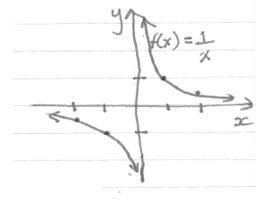
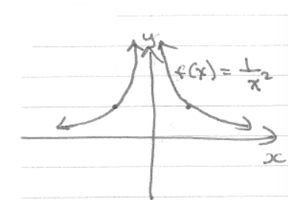
The most basic rational functions are f(x) = \frac{1}{x} and f(x) = \frac{1}{x^2}. Their graphs illustrate key features such as asymptotes and end behavior.
f(x) = \frac{1}{x} has a domain of \{x \mid x \neq 0\} and vertical/horizontal asymptotes at x = 0 and y = 0 respectively.
Sample points: f(1) = 1, f(-1) = -1, etc.
f(x) = \frac{1}{x^2} has a domain of \{x \mid x \neq 0\} and vertical/horizontal asymptotes at x = 0 and y = 0 respectively.
For all real x \neq 0, f(x) > 0.
End Behavior
End behavior describes how f(x) behaves as x approaches infinity or zero:
For f(x) = \frac{1}{x}:
As x \to -\infty, f(x) \to 0
As x \to \infty, f(x) \to 0
As x \to 0^-, f(x) \to -\infty
As x \to 0^+, f(x) \to \infty
For f(x) = \frac{1}{x^2}:
As x \to 0^-, f(x) \to \infty
As x \to 0^+, f(x) \to \infty
As x \to \pm\infty, f(x) \to 0
Vertical Asymptotes
Definition and Identification
A vertical asymptote occurs at x = a if f(x) \to \infty or f(x) \to -\infty as x \to a from either side. To locate vertical asymptotes:
Simplify f(x) if p(x) and q(x) have common factors.
Find zeros of q(x) (after simplification); each zero gives a vertical asymptote.
Example: For f(x) = \frac{x}{x^2 - 1}, factor denominator: x^2 - 1 = (x - 1)(x + 1). Vertical asymptotes at x = 1 and x = -1.
Example: For g(x) = \frac{x - 1}{x^2 - 1}, after simplification, vertical asymptote at x = -1 and a hole at x = 1.
Example: For h(x) = \frac{x - 1}{x^2 + 1}, no vertical asymptotes since denominator never equals zero for real x.
Horizontal and Slant Asymptotes
Horizontal Asymptotes
A horizontal asymptote is a line y = b where f(x) \to b as x \to \pm\infty. The rules depend on the degrees of p(x) and q(x):
If degree of numerator n < m (denominator), y = 0 is the horizontal asymptote.
If n = m, y = \frac{a_n}{b_m} where a_n and b_m are leading coefficients.
If n > m, no horizontal asymptote.
Slant (Oblique) Asymptotes
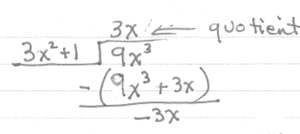
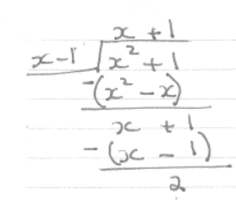
If the degree of the numerator is exactly one more than the denominator (n = m + 1), there is a slant asymptote given by the quotient of polynomial division.
For f(x) = \frac{9x^3}{3x^2 + 1}, division yields y = 3x as the slant asymptote.
For f(x) = \frac{x^2 + 1}{x - 1}, division yields y = x + 1 as the slant asymptote.
Using Transformations to Graph Rational Functions
Transformations
Rational functions can be graphed using transformations of basic functions:
Shifting f(x) = \frac{1}{x} left/right or up/down by adjusting the argument and adding/subtracting constants.
For example, g(x) = \frac{1}{x+2} - 1 is \frac{1}{x} shifted 2 units left and 1 unit down.
h(x) = \frac{1}{x^2 + 4} is \frac{1}{x^2} shifted 4 units up.
Graphing Rational Functions: Step-by-Step
Procedure
To graph f(x) = \frac{p(x)}{q(x)}:
Check for symmetry: If f(-x) = f(x), the function is even and symmetric about the y-axis.
Find the y-intercept: Evaluate f(0).
Find x-intercepts: Solve p(x) = 0.
Find vertical asymptotes: Solve q(x) = 0.
Find horizontal/slant asymptotes as described above.
Plot additional points between and beyond intercepts and asymptotes.
Draw the graph, respecting asymptotes and symmetry.
Example: For f(x) = \frac{3x^2}{x^2 - 4}:
Symmetry: f(-x) = f(x) (even function).
Y-intercept: f(0) = 0.
X-intercept: x = 0.
Vertical asymptotes: x = 2 and x = -2.
Horizontal asymptote: y = 3 (degrees equal, leading coefficients 3/1).
Additional points: f(-3) = \frac{27}{5}, f(-1) = -1, f(1) = -1, f(3) = \frac{27}{5}.
Summary Table: Asymptote Types
Type | Equation | How to Find |
|---|---|---|
Vertical | x = a | Zeros of denominator after simplification |
Horizontal | y = b | Degree comparison: n < m, n = m |
Slant | y = mx + c | Numerator degree = denominator degree + 1 |
Additional info: Images included are directly relevant: image_1 and image_4 show polynomial division for slant asymptotes; image_2 and image_3 show basic rational function graphs.
