 뒤로
뒤로Rational Zero Theorem and Roots of Polynomial Functions
스터디 가이드 - 스마트 노트
 자료에 맞춘 맞춤형 노트, 핵심 정의, 예시, 맥락을 확장해 제공합니다.
Rational Zero Theorem
Statement and Application
The Rational Zero Theorem provides a systematic way to list all possible rational zeros of a polynomial function with integer coefficients. If and is a rational zero, then:
p is a factor of the constant term
q is a factor of the leading coefficient
Thus, the possible rational zeros are given by:
Example: Listing Possible Rational Zeros
For , the possible rational zeros are:
Factors of 4 (constant term):
Factors of -1 (leading coefficient):
Possible rational zeros:
Example:
Factors of -3:
Factors of 4:
Possible rational zeros:
Finding Zeros of a Polynomial Function
Procedure
To find the zeros of a polynomial function:
List all possible rational zeros using the Rational Zero Theorem.
Use synthetic division to test each candidate zero.
If the remainder is zero, the candidate is a zero of the function.
Repeat the process with the reduced polynomial until all zeros are found.
Example:
Possible rational zeros:
Test using synthetic division:
Synthetic Division Example
Coefficients: 1, 2, -5, -6
Testing :
Resulting coefficients: 1, 4, 3, 0
Remainder is 0, so is a zero.
Reduced polynomial:
Factoring:
Zeros:
Solving Polynomial Equations
Example:
Possible rational zeros:
Use synthetic division to test candidates.
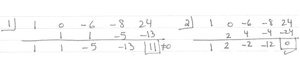
After synthetic division, zeros found: (multiplicity 2), and the quadratic yields complex zeros using the quadratic formula:
Linear Factorization Theorem
Statement
If is a polynomial of degree and , then:
are the complex roots of
Finding a Polynomial Function with Given Zeros
Example
Find a 4th degree polynomial with real coefficients and zeros , and .
Since is a zero, is also a zero.
Factors:
Expanded:
Using , solve for :
Final polynomial:
Descartes' Rule of Signs
Determining Number of Real Zeros
Count the number of sign changes in for positive real zeros, and in for negative real zeros. The number of real zeros is equal to or less than the number of sign changes by an even integer.
Example:
Sign changes in : 3 (so 3 or 1 positive real zeros)
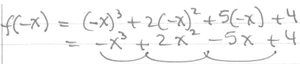
Sign changes in : 4 (so 4, 2, or 0 negative real zeros)

Example:
No sign changes in : 0 positive real zeros
Sign changes in : 3 (so 3 or 1 negative real zeros)
Important Facts about Roots of Polynomials
If is a polynomial of degree , then has exactly complex roots, counted with multiplicity.
If is a root, its conjugate is also a root.
Multiplicity: If a root is repeated, it is counted as many times as its multiplicity.
Synthetic Division
Process Overview
Synthetic division is a simplified method for dividing a polynomial by a linear factor . It is used to test possible rational zeros efficiently.
Write the coefficients of the polynomial.
Use the candidate zero outside the division chart.
Perform the addition and multiplication steps as described above.
If the remainder is zero, the candidate is a zero.
Quadratic Formula
Solving Quadratic Equations
When a quadratic factor cannot be factored by inspection, use the quadratic formula:
This formula yields real or complex roots depending on the discriminant .
Summary Table: Rational Zero Theorem
Step | Description |
|---|---|
List Factors | List factors of constant term and leading coefficient |
Form Possible Zeros | Form all possible fractions |
Test Candidates | Use synthetic division to test each candidate |
Find Zeros | Zeros are candidates with zero remainder |
Summary Table: Descartes' Rule of Signs
Function | Sign Changes | Possible Real Zeros |
|---|---|---|
Count sign changes | Positive real zeros: equal or less by even integer | |
Count sign changes | Negative real zeros: equal or less by even integer |
