 뒤로
Study Guide: Logarithmic Functions in Precalculus
스터디 가이드 - 스마트 노트
 자료에 맞춘 맞춤형 노트, 핵심 정의, 예시, 맥락을 확장해 제공합니다.
Exponential and Logarithmic Functions
Introduction to Logarithmic Functions
Logarithmic functions are the inverses of exponential functions and are fundamental in Precalculus for solving equations involving exponentials and understanding their graphs.
Definition: The logarithmic function with base a (where a > 0 and a \neq 1) is defined as y = \log_a x if and only if x = a^y.
Domain: The domain of y = \log_a x is x > 0.
Range: The range is all real numbers, (-\infty, \infty).
Inverse Relationship: Logarithmic and exponential functions are inverses of each other.
Changing Between Exponential and Logarithmic Forms
Understanding how to convert between exponential and logarithmic forms is essential for solving equations and interpreting graphs.
Exponential to Logarithmic: If a^y = x, then y = \log_a x.
Logarithmic to Exponential: If y = \log_a x, then x = a^y.
Example:
Exponential: 2^3 = 8 → Logarithmic: \log_2 8 = 3
Logarithmic: \log_5 25 = 2 → Exponential: 5^2 = 25
Evaluating Logarithmic Expressions
Logarithmic expressions can be evaluated exactly using their definition and properties.
Example:
Find \log_3 81: Since 3^4 = 81, \log_3 81 = 4.
Find \log_5 125: Since 5^3 = 125, \log_5 125 = 3.
Domain and Range of Logarithmic Functions
The domain and range of logarithmic functions are closely related to those of exponential functions.
Domain: (0, \infty) (only positive real numbers)
Range: (-\infty, \infty) (all real numbers)
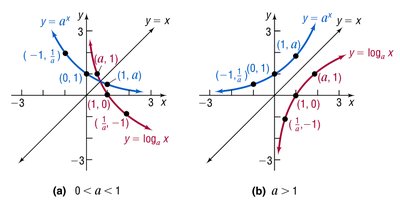
Vertical Asymptote: The y-axis (x = 0) is a vertical asymptote.
Properties of Logarithmic Functions
Logarithmic functions have several important properties that affect their graphs and behavior.
Increasing/Decreasing:
If a > 1, y = \log_a x is increasing.
If 0 < a < 1, y = \log_a x is decreasing.
Key Points: The graph passes through (1, 0) and (a, 1).
Smooth and Continuous: The graph has no corners or gaps.
Natural Logarithm Function
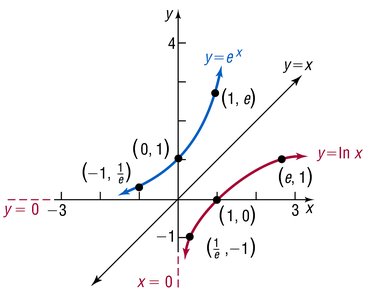
The natural logarithm, denoted ln x, is the logarithm with base e (where e \approx 2.718).
Definition: y = \ln x if and only if x = e^y.
Domain: x > 0
Range: (-\infty, \infty)
Graphing Logarithmic Functions and Their Inverses
Graphing logarithmic functions often involves transformations such as shifts, reflections, and stretches.
Transformations:
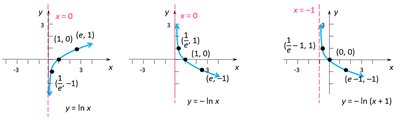
Horizontal shifts: y = \log_a(x - h) shifts right by h.
Vertical stretches: y = k \log_a x stretches by factor k.
Reflections: y = -\log_a x reflects about the x-axis.
Inverse: The inverse of y = \log_a x is y = a^x.
Example: For f(x) = -\ln(x + 1):
Domain: x + 1 > 0 \Rightarrow x > -1
Range: (-\infty, \infty)
Vertical asymptote: x = -1
Inverse: f^{-1}(x) = e^{-x} - 1

Common Logarithm Function
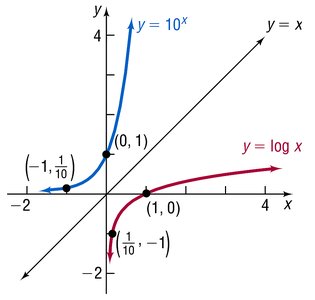
The common logarithm uses base 10 and is written as log x.
Definition: y = \log x if and only if x = 10^y.
Domain: x > 0
Range: (-\infty, \infty)
Solving Logarithmic Equations
Logarithmic equations can be solved by converting to exponential form or using properties of logarithms.
Example:
Solve \log_5(3x - 4) = 3: Convert to exponential: 3x - 4 = 5^3 = 125 Solve: 3x = 129 \Rightarrow x = 43
Solve \log_x 81 = 2: Convert to exponential: x^2 = 81 \Rightarrow x = 9 (since domain requires x > 0)
Using Logarithms to Solve Exponential Equations
Logarithms are useful for solving equations where the variable is in the exponent.
Example:
Solve e^{3x} = 7: Take natural log: \ln(e^{3x}) = \ln 7 3x = \ln 7 \Rightarrow x = \frac{\ln 7}{3}
Summary Table: Logarithmic Function Properties
Property | Logarithmic Function | Exponential Function |
|---|---|---|
Domain | (0, \infty) | (-\infty, \infty) |
Range | (-\infty, \infty) | (0, \infty) |
Vertical Asymptote | x = 0 | None |
Inverse | y = a^x | y = \log_a x |
Key Takeaways
Logarithmic functions are the inverses of exponential functions.
Understanding domain, range, and transformations is essential for graphing and solving equations.
Logarithms are powerful tools for solving exponential equations and modeling real-world phenomena.
