 뒤로
AP Statistics Quiz Review – Probability, Independence, and Conditional Probability
스터디 가이드 - 스마트 노트
 자료에 맞춘 맞춤형 노트, 핵심 정의, 예시, 맥락을 확장해 제공합니다.
Q1. If you pick four M&M’s in a row, what is the probability that they are all Blue?
Background
Topic: Basic Probability (Multiplication Rule for Independent Events)
This question tests your understanding of calculating the probability of multiple independent events occurring in sequence.
Key Terms and Formulas:
Probability of an event: $P(A)$
Multiplication Rule for independent events: $P(A \text{ and } B) = P(A) \times P(B)$
Step-by-Step Guidance
Identify the probability of picking a Blue M&M: $P(\text{Blue}) = 0.20$
Since each pick is independent, multiply the probability for each pick: $P(\text{all 4 Blue}) = P(\text{Blue}) \times P(\text{Blue}) \times P(\text{Blue}) \times P(\text{Blue})$
Set up the calculation: $P(\text{all 4 Blue}) = (0.20)^4$
Try solving on your own before revealing the answer!
Final Answer: 0.0016
By multiplying $0.20 \times 0.20 \times 0.20 \times 0.20 = 0.0016$, you find the probability that all four M&Ms are Blue.
Q2. If you pick four M&M’s in a row, what is the probability that none are green?
Background
Topic: Probability of Complementary Events
This question tests your ability to find the probability that a certain color (green) does not appear in a sequence of picks.
Key Terms and Formulas:
Complementary probability: $P(\text{not Green}) = 1 - P(\text{Green})$
Multiplication Rule for independent events
Step-by-Step Guidance
Calculate the probability of picking a non-green M&M: $P(\text{not Green}) = 1 - P(\text{Green})$
Multiply this probability for four picks: $P(\text{none Green}) = [P(\text{not Green})]^4$
Try solving on your own before revealing the answer!
Final Answer: 0.4096
Using the given probabilities, $P(\text{not Green}) = 0.80$, so $0.80^4 = 0.4096$.
Q3. If you pick four M&M’s in a row, what is the probability that at least one is red?
Background
Topic: Probability of "At Least One" Events (Using Complements)
This question tests your ability to use the complement rule to find the probability that at least one event occurs.
Key Terms and Formulas:
Complement Rule: $P(\text{at least one Red}) = 1 - P(\text{none Red})$
Probability of not picking Red: $P(\text{not Red})$
Step-by-Step Guidance
Find the probability of not picking a Red M&M: $P(\text{not Red}) = 1 - P(\text{Red})$
Calculate the probability that none of the four are Red: $[P(\text{not Red})]^4$
Use the complement rule: $P(\text{at least one Red}) = 1 - [P(\text{not Red})]^4$
Try solving on your own before revealing the answer!
Final Answer: 0.3439
By calculating $P(\text{not Red}) = 0.90$, then $0.90^4 = 0.6561$, and $1 - 0.6561 = 0.3439$.
Q4. If you pick four M&M’s in a row, what is the probability that the fourth one is the first one that is brown?
Background
Topic: Probability of First Occurrence in a Sequence (Geometric Probability)
This question tests your understanding of finding the probability that a specific event occurs for the first time at a certain trial.
Key Terms and Formulas:
Probability of not picking Brown: $P(\text{not Brown})$
Probability of picking Brown: $P(\text{Brown})$
Geometric probability: $P(\text{first Brown at 4th}) = [P(\text{not Brown})]^3 \times P(\text{Brown})$
Step-by-Step Guidance
Find $P(\text{not Brown}) = 1 - P(\text{Brown})$
Calculate the probability that the first three are not Brown: $[P(\text{not Brown})]^3$
Multiply by the probability that the fourth is Brown: $[P(\text{not Brown})]^3 \times P(\text{Brown})$
Try solving on your own before revealing the answer!
Final Answer: 0.0729
Using $P(\text{Brown}) = 0.10$, $P(\text{not Brown}) = 0.90$, so $0.90^3 \times 0.10 = 0.0729$.
Q5. What is the probability that you win something (at least one of the six bottles is a winner) when buying a six-pack of Pepsi bottles, if 50% of all bottles are winners?
Background
Topic: Probability of "At Least One" Success (Binomial/Complement Rule)
This question tests your ability to use the complement rule to find the probability of at least one success in multiple trials.
Key Terms and Formulas:
Probability of not winning: $P(\text{not winner}) = 1 - P(\text{winner})$
Probability all six are not winners: $[P(\text{not winner})]^6$
Probability at least one winner: $P(\text{at least one winner}) = 1 - [P(\text{not winner})]^6$
Step-by-Step Guidance
Find $P(\text{not winner}) = 0.50$
Calculate $[P(\text{not winner})]^6$
Use the complement rule: $1 - [P(\text{not winner})]^6$
Try solving on your own before revealing the answer!
Final Answer: 0.984
By calculating $0.50^6 = 0.015625$, then $1 - 0.015625 = 0.984$.
Q6. The box contains 4 medium, 10 large, and 6 extra-large shirts. What is the probability that all three shirts you pull out (without replacement) are mediums?
Background
Topic: Probability Without Replacement (Hypergeometric Probability)
This question tests your understanding of calculating probabilities when sampling without replacement.
Key Terms and Formulas:
Probability without replacement: $P(\text{all mediums}) = \frac{4}{20} \times \frac{3}{19} \times \frac{2}{18}$
Step-by-Step Guidance
Calculate the probability for the first shirt: $\frac{4}{20}$
Calculate the probability for the second shirt: $\frac{3}{19}$
Calculate the probability for the third shirt: $\frac{2}{18}$
Multiply these probabilities together.
Try solving on your own before revealing the answer!
Final Answer: 0.0080
Multiplying the probabilities gives $\frac{4}{20} \times \frac{3}{19} \times \frac{2}{18} = 0.0080$.
Q7. The box contains 4 medium, 10 large, and 6 extra-large shirts. What is the probability that none of the three shirts you pull out (without replacement) are extra-large?
Background
Topic: Probability Without Replacement (Hypergeometric Probability)
This question tests your ability to calculate the probability of avoiding a specific category when sampling without replacement.
Key Terms and Formulas:
Probability of not picking extra-large: $P(\text{not XL}) = \frac{14}{20} \times \frac{13}{19} \times \frac{12}{18}$
Step-by-Step Guidance
Calculate the probability for the first shirt: $\frac{14}{20}$
Calculate the probability for the second shirt: $\frac{13}{19}$
Calculate the probability for the third shirt: $\frac{12}{18}$
Multiply these probabilities together.
Try solving on your own before revealing the answer!
Final Answer: 0.3193
Multiplying the probabilities gives $\frac{14}{20} \times \frac{13}{19} \times \frac{12}{18} = 0.3193$.
Q8. The box contains 4 medium, 10 large, and 6 extra-large shirts. What is the probability that at least one of the three shirts you pull out (without replacement) is a medium?
Background
Topic: Probability of "At Least One" (Using Complements)
This question tests your ability to use the complement rule to find the probability that at least one event occurs.
Key Terms and Formulas:
Complement Rule: $P(\text{at least one medium}) = 1 - P(\text{none medium})$
Probability of not picking medium: $P(\text{not medium}) = \frac{16}{20} \times \frac{15}{19} \times \frac{14}{18}$
Step-by-Step Guidance
Calculate the probability for the first shirt: $\frac{16}{20}$
Calculate the probability for the second shirt: $\frac{15}{19}$
Calculate the probability for the third shirt: $\frac{14}{18}$
Multiply these probabilities together to get $P(\text{none medium})$
Use the complement rule: $P(\text{at least one medium}) = 1 - P(\text{none medium})$
Try solving on your own before revealing the answer!
Final Answer: 0.5088
By calculating $1 - (\frac{16}{20} \times \frac{15}{19} \times \frac{14}{18}) = 0.5088$.
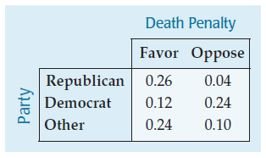
Q9. What’s the probability that a randomly chosen voter favors the death penalty?
Background
Topic: Joint and Marginal Probability from a Two-Way Table
This question tests your ability to find the marginal probability from a contingency table.
Key Terms and Formulas:
Marginal probability: $P(\text{Favor}) = \text{sum of probabilities in the Favor column}$
Step-by-Step Guidance
Add the probabilities for Favor across all parties: $0.26 + 0.12 + 0.24$
Try solving on your own before revealing the answer!
Final Answer: 0.62
Adding $0.26 + 0.12 + 0.24 = 0.62$ gives the probability that a randomly chosen voter favors the death penalty.
Q10. What’s the probability that a randomly chosen Republican favors the death penalty?
Background
Topic: Conditional Probability from a Two-Way Table
This question tests your ability to find conditional probabilities using a contingency table.
Key Terms and Formulas:
Conditional probability: $P(\text{Favor} | \text{Republican}) = \frac{P(\text{Republican and Favor})}{P(\text{Republican})}$
Step-by-Step Guidance
Find $P(\text{Republican and Favor}) = 0.26$
Find $P(\text{Republican}) = 0.26 + 0.04 = 0.30$
Set up the conditional probability formula: $P(\text{Favor} | \text{Republican}) = \frac{0.26}{0.30}$
Try solving on your own before revealing the answer!
Final Answer: 0.867
Dividing $0.26 \div 0.30 = 0.867$ gives the probability that a Republican favors the death penalty.
Q11. Is being Republican independent from favoring the death penalty? Why or why not?
Background
Topic: Independence of Events (Using Conditional Probability)
This question tests your understanding of independence by comparing $P(\text{Republican})$ and $P(\text{Republican} | \text{Favor})$.
Key Terms and Formulas:
Events are independent if $P(A) = P(A|B)$
Step-by-Step Guidance
Find $P(\text{Republican})$ from the table.
Find $P(\text{Republican} | \text{Favor})$ using $\frac{P(\text{Republican and Favor})}{P(\text{Favor})}$
Compare the two probabilities to determine independence.
Try solving on your own before revealing the answer!
Final Answer: B. No, the probability of a Republican does NOT equal to the probability of a Republican given the voter favors the death penalty.
Since $P(\text{Republican}) \neq P(\text{Republican} | \text{Favor})$, the events are not independent.
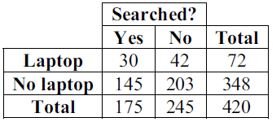
Q12. Does it appear that being subjected to an additional search is independent of carrying a laptop computer?
Background
Topic: Independence of Events (Contingency Table Analysis)
This question tests your ability to determine independence by comparing conditional probabilities.
Key Terms and Formulas:
Events are independent if $P(\text{Searched} | \text{Laptop}) = P(\text{Searched} | \text{No Laptop})$
Step-by-Step Guidance
Calculate $P(\text{Searched} | \text{Laptop}) = \frac{30}{72}$
Calculate $P(\text{Searched} | \text{No Laptop}) = \frac{145}{348}$
Compare these probabilities to determine independence.
Try solving on your own before revealing the answer!
Final Answer: A. No, being subjected to an additional search is independent of carrying a laptop computer. This is because the probability of being searched given carrying a laptop is Not equal to the probability of being searched given Not carrying a laptop.
The probabilities are not equal, so the events are not independent.
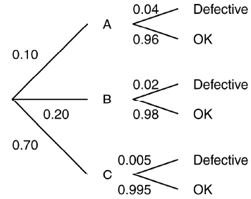
Q13. A manufacturing firm orders computer chips from three companies. What is the probability that a randomly selected chip is defective?
Background
Topic: Total Probability (Law of Total Probability)
This question tests your ability to use a probability tree to find the overall probability of an event.
Key Terms and Formulas:
Law of Total Probability: $P(\text{Defective}) = \sum P(\text{Company}) \times P(\text{Defective} | \text{Company})$
Step-by-Step Guidance
Multiply the probability of selecting each company by the probability of a defective chip from that company.
Add these products for all companies.
Try solving on your own before revealing the answer!
Final Answer: 0.0115
By calculating $0.10 \times 0.04 + 0.20 \times 0.02 + 0.70 \times 0.005 = 0.0115$.
Q14. Given that the chip is defective, what is the probability that it came from Company B?
Background
Topic: Conditional Probability (Bayes’ Theorem)
This question tests your ability to use Bayes’ Theorem to find the probability of a source given an outcome.
Key Terms and Formulas:
Bayes’ Theorem: $P(\text{B} | \text{Defective}) = \frac{P(\text{B}) \times P(\text{Defective} | \text{B})}{P(\text{Defective})}$
Step-by-Step Guidance
Calculate $P(\text{B}) \times P(\text{Defective} | \text{B})$
Divide by the total probability of defective chips found in the previous question.
Try solving on your own before revealing the answer!
Final Answer: 0.3478
By calculating $\frac{0.20 \times 0.02}{0.0115} = 0.3478$.
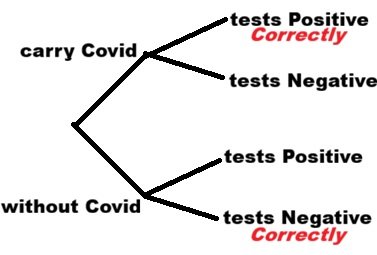
Q15. In a large study, among people with Covid, 99.7% of tests were positive; among people without Covid, 98.5% of tests were negative. If 14% of patients carry Covid, what is the probability that a patient testing negative is truly free of Covid?
Background
Topic: Conditional Probability (Bayes’ Theorem, Medical Testing)
This question tests your ability to use Bayes’ Theorem to interpret medical test results.
Key Terms and Formulas:
Bayes’ Theorem: $P(\text{No Covid} | \text{Negative Test}) = \frac{P(\text{No Covid}) \times P(\text{Negative} | \text{No Covid})}{P(\text{Negative})}$
Step-by-Step Guidance
Calculate $P(\text{No Covid}) = 0.86$
Calculate $P(\text{Negative} | \text{No Covid}) = 0.985$
Find $P(\text{Negative})$ using the law of total probability.
Set up Bayes’ formula.
Try solving on your own before revealing the answer!
Final Answer: 0.9995
By calculating $\frac{0.86 \times 0.985}{P(\text{Negative})} = 0.9995$.
