 뒤로
Fundamental Probability Concepts and Rules: Study Notes for Introductory Statistics
스터디 가이드 - 스마트 노트
 자료에 맞춘 맞춤형 노트, 핵심 정의, 예시, 맥락을 확장해 제공합니다.
Probability Foundations
Sample Space and Events
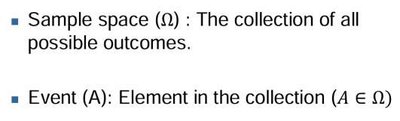
The sample space (\(\Omega\)) is the set of all possible outcomes of a random experiment. An event (A) is a subset of the sample space, representing one or more outcomes that satisfy a specific condition.
Sample space (\(\Omega\)): The collection of all possible outcomes.
Event (A): An element or subset in the collection (\(A \in \Omega\)).
Probability Function and Axioms
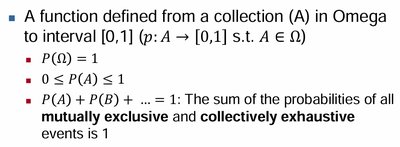
A probability function assigns a value between 0 and 1 to each event in the sample space, representing the likelihood of that event occurring. The function must satisfy certain axioms:
\(P(\Omega) = 1\): The probability of the entire sample space is 1.
\(0 \leq P(A) \leq 1\): The probability of any event is between 0 and 1.
The sum of probabilities of all mutually exclusive and collectively exhaustive events equals 1.
Marginal, Joint, and Conditional Probabilities
Marginal and Joint Probabilities
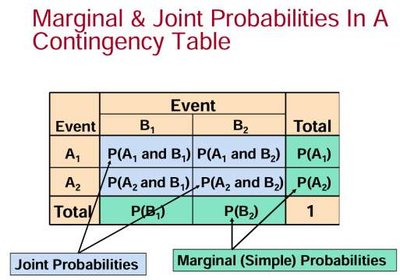
In a contingency table, joint probabilities represent the likelihood of two events occurring together, while marginal probabilities represent the probability of a single event regardless of the other.
Joint probability: \(P(A_i \text{ and } B_j)\) is the probability that both events \(A_i\) and \(B_j\) occur.
Marginal probability: \(P(A_i)\) or \(P(B_j)\) is the probability of event \(A_i\) or \(B_j\) occurring, summed over all possible outcomes of the other event.
Addition Rule for Probabilities
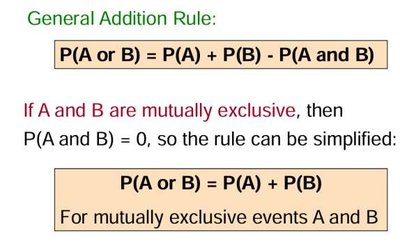
The general addition rule calculates the probability that at least one of two events occurs:
If A and B are mutually exclusive (cannot occur together), then , so
Conditional Probability
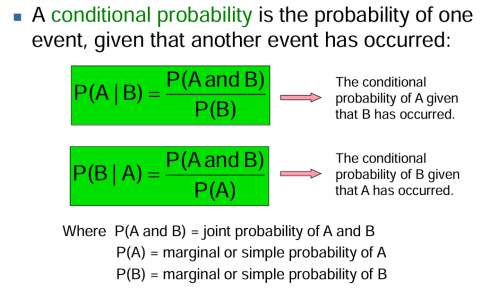
Conditional probability is the probability of one event occurring given that another event has already occurred. The formula is:
Where is the joint probability, and are marginal probabilities.
Conditional Probability Example
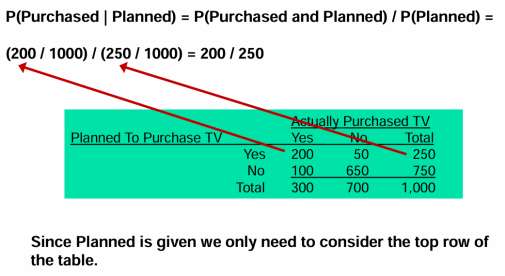
Conditional probability can be calculated from a contingency table. For example, the probability of purchasing a TV given that a household planned to purchase:
Only the relevant row (Planned) is considered for the denominator.
Decision Tree Representation
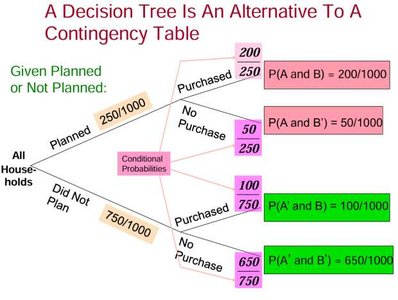
A decision tree is an alternative to a contingency table for visualizing conditional probabilities. Each branch represents a possible outcome and its probability.
Branches show joint probabilities, e.g., .
Conditional probabilities can be traced along the tree structure.
Independence and Multiplication Rule
Independence of Events
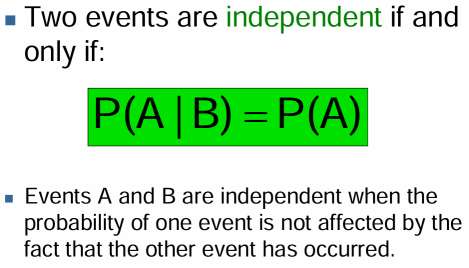
Two events are independent if the occurrence of one does not affect the probability of the other. Mathematically:
Events A and B are independent when the probability of one event is not affected by the other.
Multiplication Rule for Probabilities
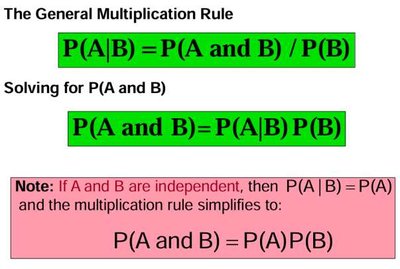
The general multiplication rule relates joint probability to conditional probability:
Solving for joint probability:
If A and B are independent:
Marginal Probability via Law of Total Probability
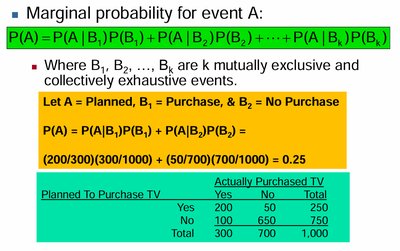
The law of total probability expresses the marginal probability of an event as the sum of its conditional probabilities across mutually exclusive and collectively exhaustive events:
Example:
Summary Table: Key Probability Rules
Rule | Formula (LaTeX) | Interpretation |
|---|---|---|
General Addition Rule | Probability of at least one event occurring | |
Conditional Probability | Probability of A given B | |
Independence | Events do not affect each other | |
Multiplication Rule | Joint probability via conditional probability | |
Law of Total Probability | Marginal probability across partitions |
