 뒤로
Guided Practice: Independent and Dependent Probability in Introductory Statistics
스터디 가이드 - 스마트 노트
 자료에 맞춘 맞춤형 노트, 핵심 정의, 예시, 맥락을 확장해 제공합니다.
Q1. Among four potential donors, what is the probability that:
all are Type O?
no one is Type AB?
at least one person is Type B?
the first Type A is the third person selected?
Background
Topic: Basic Probability with Independent Events
This question tests your understanding of calculating probabilities for independent events, using the multiplication rule, and working with complements and "at least one" probabilities.
Key Terms and Formulas:
Independent Events: The outcome of one does not affect the other.
Multiplication Rule: for independent events.
Complement Rule:
"At least one":
Step-by-Step Guidance
For each part, identify the relevant probability for a single person (e.g., probability of Type O, Type AB, etc.).
For independent selections, raise the single probability to the power of the number of people (e.g., ).
For "no one is Type AB," use the complement probability for not being Type AB, then raise to the fourth power.
For "at least one is Type B," use the complement rule: .
For "the first Type A is the third person," consider the probability that the first two are not Type A, and the third is Type A.
Try solving on your own before revealing the answer!
Final Answers:
All are Type O:
No one is Type AB:
At least one is Type B:
The first Type A is the third person:
Each answer uses the multiplication or complement rule for independent events.
Q2. Are the two events (taking Statistics and taking a computer course) independent?
Background
Topic: Independence of Events
This question tests your ability to determine if two events are independent using joint and marginal probabilities.
Key Terms and Formulas:
Independent Events:
Given: , ,
Step-by-Step Guidance
Recall the definition of independence: .
Calculate using the given probabilities.
Compare (given as 0.07) to your calculated value.
Try solving on your own before revealing the answer!
Final Answer:
No, the events are not independent because .
Since , the events are dependent.
Q3. Real estate ads: What is the probability that a home for sale has:
a) a pool or a garage?
b) neither a pool nor a garage?
c) a pool but no garage?
Background
Topic: General Addition Rule and Complements
This question tests your ability to use the general addition rule for probabilities and to find probabilities involving "neither" and "only" cases.
Key Terms and Formulas:
General Addition Rule:
Complement Rule:
"A but not B":
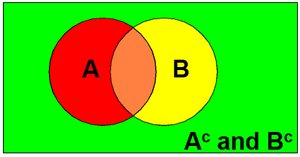
Step-by-Step Guidance
For (a), use the general addition rule with the given probabilities for garage, pool, and both.
For (b), use the complement rule to find the probability of neither feature.
For (c), subtract the probability of both from the probability of a pool to get "pool but no garage."
Try solving on your own before revealing the answer!
Final Answers:
a)
b)
c)
These answers use the addition and complement rules for probability.
Q4. Coffee and Bagels: What is the probability that a person drinks coffee or eats bagels if these two events are independent? What is the probability that a person does NOT drink coffee nor eats bagels?
Background
Topic: Probability with Independent Events and Complements
This question tests your ability to use the addition rule for independent events and to find the probability of neither event occurring.
Key Terms and Formulas:
For independent events:
Complement Rule:
Step-by-Step Guidance
For (a), plug the given probabilities into the addition rule for independent events.
For (b), subtract your answer from (a) from 1 to find the probability of neither event.
Try solving on your own before revealing the answer!
Final Answers:
a)
b)
These calculations use the addition rule for independent events and the complement rule.
Q5. M&M’s: If 3 M&Ms are selected at random, what is the probability that:
a) The first two you choose are green?
b) At least one of the first three is blue.
c) The first four you pick are all red.
d) You have to pick 5 M&M’s to find the first green.
Background
Topic: Probability with Independent Events, Complements, and Geometric Probability
This question tests your ability to use the multiplication rule, complement rule, and geometric probability for independent events.
Key Terms and Formulas:
Multiplication Rule:
Complement Rule:
Geometric Probability:
Step-by-Step Guidance
For (a), multiply the probability of green for the first and second pick.
For (b), use the complement rule: 1 minus the probability that none are blue.
For (c), raise the probability of red to the fourth power.
For (d), use the geometric probability formula for the first green on the fifth pick.
Try solving on your own before revealing the answer!
Final Answers:
a)
b)
c)
d)
Each answer uses the multiplication, complement, or geometric probability rule as appropriate.
Q6. Batteries: A junk box contains 12 old batteries, 5 of which are dead. Find the probability of each outcome:
a) The first two you choose are both good.
b) At least one of the first three works.
c) The first four you pick all work.
d) You have to pick 5 batteries to find one that works.
Background
Topic: Dependent Probability (without replacement) and Complements
This question tests your ability to calculate probabilities for dependent events (without replacement) and use the complement rule.
Key Terms and Formulas:
Dependent Probability:
Complement Rule:
Geometric Probability (for first success):
Step-by-Step Guidance
For (a), calculate the probability the first is good, then the second is good given the first was good (without replacement).
For (b), use the complement rule: 1 minus the probability that none of the first three work.
For (c), multiply the probabilities for each pick, adjusting the numerator and denominator each time (since batteries are not replaced).
For (d), use the geometric probability formula for the first working battery on the fifth pick.
Try solving on your own before revealing the answer!
Final Answers:
a)
b)
c)
d)
These answers use dependent probability and the complement rule.
Q7. Death penalty: The table shows the political affiliations of American voters and their positions on the death penalty.
a) Find the Probability that a randomly chosen American voter will Oppose the Death Penalty.
b) Find the Probability that a Republican voter will Oppose the Death Penalty.
c) Are the two events independent?
Background
Topic: Joint, Marginal, and Conditional Probability; Independence
This question tests your ability to read a two-way table, calculate marginal and conditional probabilities, and test for independence.
Key Terms and Formulas:
Marginal Probability: Probability of a single event (e.g., Oppose Death Penalty)
Conditional Probability:
Independence:
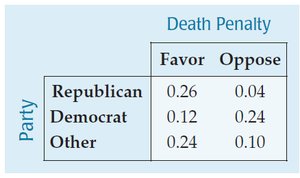
Step-by-Step Guidance
For (a), sum the probabilities for "Oppose" across all parties.
For (b), use the conditional probability formula: probability of Republican and Oppose divided by probability of Republican.
For (c), compare and to test for independence.
Try solving on your own before revealing the answer!
Final Answers:
a)
b)
c) No, the events are not independent because .
These answers use marginal and conditional probabilities from the table.
Q8. Travel: Suppose the probability that a U.S. resident has traveled to Canada is 0.18, to Mexico is 0.09, and to both countries is 0.04. What’s the probability that an American chosen at random has…
a) traveled to Canada but not Mexico?
b) traveled to either Canada or Mexico?
c) (i) traveled to Canada given they have traveled to Mexico? (ii) traveled to Mexico given they have traveled to Canada?
d) Are traveling to Canada and Mexico Independent events?
Background
Topic: Addition Rule, Conditional Probability, Independence
This question tests your ability to use the addition rule, calculate conditional probabilities, and test for independence.
Key Terms and Formulas:
General Addition Rule:
Conditional Probability:
Independence:
Step-by-Step Guidance
For (a), subtract the probability of both from the probability of Canada.
For (b), use the general addition rule.
For (c), use the conditional probability formula for each case.
For (d), compare to to test for independence.
Try solving on your own before revealing the answer!
Final Answers:
a)
b)
c) (i) ; (ii)
d) No, the events are not independent because .
These answers use the addition rule, conditional probability, and the definition of independence.
Q9. Cats and Dogs: In a monthly report, an animal shelter with 42 pets states that it currently has 24 dogs and 18 cats available for adoption. 8 dogs and 6 cats are male. Find the probability that:
a) The pet is male, given that it is a cat.
b) The pet is a cat, given that it is a female.
c) The pet is female, given that it is a dog.
Background
Topic: Conditional Probability
This question tests your ability to calculate conditional probabilities using counts from a contingency table.
Key Terms and Formulas:
Conditional Probability:
Step-by-Step Guidance
For each part, identify the relevant counts (e.g., number of male cats, total cats, total females, etc.).
Set up the conditional probability formula for each scenario.
Plug in the counts, but do not compute the final value yet.
Try solving on your own before revealing the answer!
Final Answers:
a)
b)
c)
Each answer uses the conditional probability formula with the appropriate counts.
