 뒤로
Independent and Dependent Probability: Study Guide
스터디 가이드 - 스마트 노트
 자료에 맞춘 맞춤형 노트, 핵심 정의, 예시, 맥락을 확장해 제공합니다.
Probability: Independent and Dependent Events
Warm-Up: Blood Type Probability
This section introduces probability calculations using real-world examples, such as blood type distributions among donors. These problems illustrate the application of probability rules to scenarios involving multiple selections and specific outcomes.
Key Point 1: Probability calculations often require knowledge of the proportion of each outcome in the population.
Key Point 2: Scenarios may involve finding the probability of all selections matching a certain type, none matching a type, at least one matching, or the first occurrence at a specific position.
Example: If 45% of the population has Type O blood, the probability that all four donors are Type O is .
Independent Probability
Definition and Properties
Independent events are those in which the occurrence of one event does not affect the probability of the other. This concept is fundamental in probability theory and is used to calculate joint probabilities.
Key Point 1: Independent Events:
Key Point 2: Mutually Exclusive Events: Events that cannot occur simultaneously.
Example: If the probability of drinking coffee is 0.62 and eating bagels is 0.25, and the events are independent, then the probability of both is .
General Addition Rule (OR) for Probability
The addition rule is used to find the probability that at least one of two events occurs. It accounts for the overlap between events.
Key Point 1: Addition Rule:
Key Point 2: Neither Event Occurs:
Example: If 64% of homes have garages, 21% have pools, and 17% have both, then the probability a home has a pool or garage is .
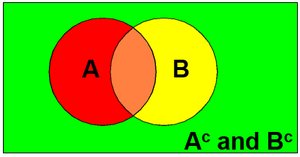
Application: Real Estate and Coffee Example
These examples demonstrate the use of probability rules in practical contexts, such as home features and food preferences.
Key Point 1: Use the addition rule for overlapping events.
Key Point 2: For independent events, multiply probabilities for joint occurrence.
Example: Probability that a person drinks coffee or eats bagels: if independent.
Dependent or Conditional Probability
Definition and Properties
Dependent events are those in which the outcome of one event affects the probability of the other. Conditional probability quantifies this relationship.
Key Point 1: Conditional Probability:
Key Point 2: If , then A and B are independent.
Example: If you select batteries from a box, the probability that the second battery is good depends on whether the first was good or dead.
Application: Batteries, Travel, and Pets
Conditional probability is applied to scenarios such as selecting batteries, travel history, and pet adoption, where the outcome of one event influences the next.
Key Point 1: For dependent events, adjust probabilities based on prior outcomes.
Key Point 2: Use conditional probability formulas to solve problems involving "given that" statements.
Example: Probability that a pet is male given it is a cat:
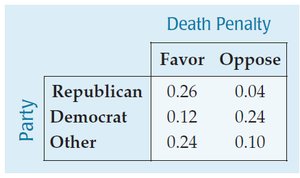
Death Penalty Example: Conditional Probability Table
This example uses a contingency table to calculate probabilities related to political affiliation and opinions on the death penalty. It illustrates how to use tabular data for probability calculations.
Key Point 1: Find marginal and conditional probabilities from the table.
Key Point 2: Compare conditional probabilities to test independence.
Example: Probability that a Republican opposes the death penalty:
Party | Favor | Oppose |
|---|---|---|
Republican | 0.26 | 0.04 |
Democrat | 0.12 | 0.24 |
Other | 0.24 | 0.10 |
Summary Table: Probability Rules
Rule | Formula | When to Use |
|---|---|---|
Multiplication Rule (Independent) | Events are independent | |
Addition Rule (General) | Events may overlap | |
Conditional Probability | Probability of B given A | |
Neither Event Occurs | Probability that neither A nor B occurs |
Additional info: Academic context and examples were expanded for clarity and completeness. All formulas are provided in LaTeX format for exam preparation.
