 뒤로
Independent and Dependent Probability: Study Notes for Introductory Statistics
스터디 가이드 - 스마트 노트
 자료에 맞춘 맞춤형 노트, 핵심 정의, 예시, 맥락을 확장해 제공합니다.
Probability: Independent and Dependent Events
Warm-Up: Blood Type Probability
Probability problems often use real-world contexts, such as blood types, to illustrate concepts. For example, if 45% of the US population has Type O blood, 40% Type A, 11% Type B, and the rest Type AB, we can calculate probabilities for various scenarios involving random selection.
Probability that all four selected are Type O: Multiply the probability for each selection: .
Probability that no one is Type AB: Use the complement rule; probability for each is not AB, then multiply for four selections.
Probability that at least one person is Type B: Use the complement rule: 1 minus the probability that none are Type B.
Probability that the first Type A is the third person selected: Probability that first two are not Type A, and third is Type A.
Independent Probability
Independent events are those where the occurrence of one event does not affect the probability of the other. This is a fundamental concept in probability theory.
Definition: Two events A and B are independent if .
Mutually Exclusive Events: These are events that cannot occur at the same time. For mutually exclusive events, .
Example: If a university requires biology majors to take either Statistics or a computer course, and 52% have taken Statistics, 23% a computer course, and 7% both, we can check independence by comparing to .
General Addition Rule (OR) for Probability
The addition rule allows us to find the probability that at least one of two events occurs.
Formula:
Neither Event Occurs:
Example: If 64% of homes have garages, 21% have pools, and 17% have both, the probability a home has a pool or garage is .
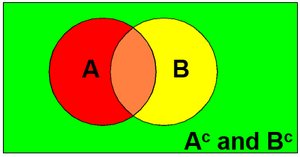
Visual Explanation: The Venn diagram above illustrates the region where neither event A nor event B occurs, corresponding to .
Examples of Independent Probability
Coffee and Bagels: If drinking coffee and eating bagels are independent, .
M&M’s: For random selection, multiply probabilities for each color as needed. For example, probability first two are green: .
Dependent or Conditional Probability
Conditional Probability
Dependent events are those where the outcome of one event affects the probability of the other. Conditional probability quantifies this relationship.
Definition: is the probability of event B occurring given that event A has occurred.
Formula:
Independence Check: If , then A and B are independent.
Examples of Dependent Probability
Batteries: If you pick batteries one at a time, the probability changes as you remove batteries from the box. For example, probability first two are good: .
Travel: Probability calculations for travel to Canada and Mexico use conditional probability and the addition rule.
Death Penalty: Conditional Probability Table
The table below shows the joint probabilities of political affiliation and position on the death penalty. This is useful for calculating conditional probabilities and checking independence.
Party | Favor | Oppose |
|---|---|---|
Republican | 0.26 | 0.04 |
Democrat | 0.12 | 0.24 |
Other | 0.24 | 0.10 |
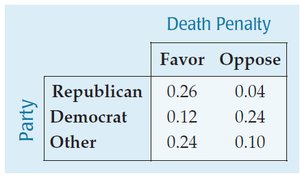
Applications: To find the probability a randomly chosen voter opposes the death penalty, sum the 'Oppose' column. To find the probability a Republican opposes, use the value in the Republican row and 'Oppose' column. Independence can be checked by comparing and .
Conditional Probability in Practice
Cats and Dogs: For example, probability a pet is male given it is a cat: .
Travel: Probability an American has traveled to Canada but not Mexico: .
Summary Table: Key Probability Formulas
Concept | Formula | Example |
|---|---|---|
Independent Events | Probability both are Type O: | |
Mutually Exclusive Events | Cannot be both Type A and Type B | |
Addition Rule | Pool or garage: | |
Conditional Probability | Male given cat: | |
Complement Rule | Not Type O: |
Additional info: These notes expand on the original content by providing definitions, formulas, and examples for each probability concept, ensuring a self-contained and comprehensive study guide for introductory statistics students.
