 뒤로
Introductory Statistics Probability and Counting Rules Study Guide
스터디 가이드 - 스마트 노트
 자료에 맞춘 맞춤형 노트, 핵심 정의, 예시, 맥락을 확장해 제공합니다.
Q1. What is a compound event?
Background
Topic: Compound Events in Probability
This question is testing your understanding of what constitutes a compound event in probability, which is foundational for applying addition and multiplication rules.
Key Terms:
Compound Event: An event formed by combining two or more simple events.
Simple Event: An event that cannot be broken down further.
Step-by-Step Guidance
Recall that a simple event is a single outcome that cannot be decomposed.
Think about what happens when you combine two or more simple events (e.g., rolling a die and flipping a coin).
Consider how the combination of these events forms a new event, which is called a compound event.
Try solving on your own before revealing the answer!
Final Answer:
A compound event is an event that consists of two or more simple events.
For example, "rolling a 4 and flipping heads" is a compound event.
Q2. Determine whether the given Venn diagram represents a disjoint or not disjoint event.
Background
Topic: Disjoint (Mutually Exclusive) vs. Not Disjoint Events
This question is testing your ability to interpret Venn diagrams and distinguish between events that can occur together (not disjoint) and those that cannot (disjoint).
Key Terms:
Disjoint Events: Events that cannot occur at the same time (no overlap).
Not Disjoint Events: Events that can occur together (overlap exists).
Step-by-Step Guidance
Look at the Venn diagram and observe whether the circles representing and overlap.
If there is an overlapping region, it means and can occur together (not disjoint).
If there is no overlap, the events are disjoint (mutually exclusive).
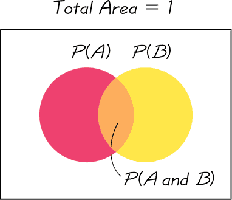
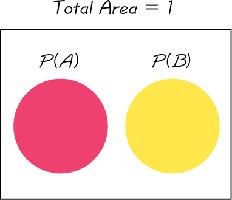
Try solving on your own before revealing the answer!
Final Answer:
The first diagram (image_1) represents not disjoint events (overlap exists), while the second diagram (image_2) represents disjoint events (no overlap).
Disjoint events cannot happen together; not disjoint events can.
Q3. What is the formal addition rule for probability?
Background
Topic: Addition Rule for Probability
This question is testing your understanding of how to calculate the probability of either event A or event B occurring, especially when the events may overlap.
Key Formula:
Where:
= Probability of event A
= Probability of event B
= Probability of both A and B occurring
Step-by-Step Guidance
Identify the probabilities for each event: and .
Determine if the events overlap (not disjoint). If so, find .
Apply the formula: .
Subtract the overlap to avoid double-counting.
Try solving on your own before revealing the answer!
Final Answer:
The formal addition rule is .
This formula ensures you do not double-count the probability of both events occurring together.
Q4. What is the multiplication rule for probability?
Background
Topic: Multiplication Rule for Probability
This question is testing your understanding of how to calculate the probability of two events both occurring, considering whether they are independent or dependent.
Key Formulas:
For independent events:
For dependent events:
Where:
= Probability of event A
= Probability of event B
= Probability of event B given that A has occurred
Step-by-Step Guidance
Determine if the events are independent or dependent.
If independent, multiply by .
If dependent, multiply by .
Set up the formula based on the scenario.
Try solving on your own before revealing the answer!
Final Answer:
The multiplication rule is for independent events, and for dependent events.
This rule helps you find the probability of both events occurring together.
