 뒤로
Introductory Statistics Study Guide: Conditional Probability & Independence
스터디 가이드 - 스마트 노트
 자료에 맞춘 맞춤형 노트, 핵심 정의, 예시, 맥락을 확장해 제공합니다.
Q1. What is the probability that at least one of the weatherman's 320 forecasts is incorrect?
Background
Topic: Probability of Complementary Events
This question tests your understanding of the complement rule in probability, specifically for repeated independent events.
Key Terms and Formulas
Complement Rule:
Probability of no errors in 320 forecasts: , where is the probability of being wrong.
Step-by-Step Guidance
Identify the probability of being wrong for a single forecast: .
Calculate the probability of being correct for a single forecast: .
Find the probability that all 320 forecasts are correct: .
Apply the complement rule to find the probability that at least one forecast is incorrect: .
Try solving on your own before revealing the answer!
Final Answer: 0.99 (or 99%)
With so many forecasts, the probability that at least one is incorrect is extremely high.
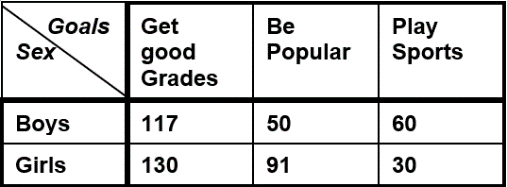
Q2. If a student is selected at random, what is the probability the student wants to be Popular?
Background
Topic: Basic Probability from a Two-Way Table
This question tests your ability to calculate simple probabilities using frequency tables.
Key Terms and Formulas
Probability:
Step-by-Step Guidance
Find the total number of students: Add all values in the table.
Find the number of students who want to be popular: Add the "Be Popular" values for boys and girls.
Set up the probability formula:
Try solving on your own before revealing the answer!
Final Answer: 0.295 (or 29.5%)
141 out of 478 students want to be popular.
Q3. What is the probability the student wants to be popular given it is a girl?
Background
Topic: Conditional Probability
This question tests your understanding of conditional probability using a two-way table.
Key Terms and Formulas
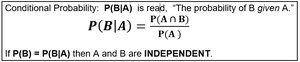
Conditional Probability:
Step-by-Step Guidance
Find the total number of girls: Add all values in the "Girls" row.
Find the number of girls who want to be popular: Use the "Be Popular" value for girls.
Set up the conditional probability formula:
Try solving on your own before revealing the answer!
Final Answer: 0.385 (or 38.5%)
About 38.5% of girls surveyed want to be popular.
Q4. What is the probability the student is a girl given we selected a student wanting to be popular?
Background
Topic: Conditional Probability (Reverse)
This question tests your ability to reverse the conditioning in probability using a two-way table.
Key Terms and Formulas
Conditional Probability:
Step-by-Step Guidance
Find the total number of students who want to be popular: Add "Be Popular" values for boys and girls.
Find the number of girls who want to be popular: Use the "Be Popular" value for girls.
Set up the conditional probability formula:
Try solving on your own before revealing the answer!
Final Answer: 0.646 (or 64.6%)
About 64.6% of students who want to be popular are girls.
Q5. Are being Popular and being a Girl independent?
Background
Topic: Independence of Events
This question tests your understanding of independence in probability, using conditional and marginal probabilities.
Key Terms and Formulas
Events are independent if
Step-by-Step Guidance
Recall the probability a student wants to be popular:
Recall the probability a student wants to be popular given they are a girl:
Compare these two probabilities. If they are equal, the events are independent; if not, they are dependent.
Try solving on your own before revealing the answer!
Final Answer: Not independent
and are not equal, so the events are not independent.
Being a girl affects the probability of wanting to be popular.
