 뒤로
Introductory Statistics Study Guide: Conditional Probability & Independence
스터디 가이드 - 스마트 노트
 자료에 맞춘 맞춤형 노트, 핵심 정의, 예시, 맥락을 확장해 제공합니다.
Q1. What is the probability that at least one of the weatherman's 320 forecasts is incorrect, given the probability of being completely wrong is 0.015?
Background
Topic: Probability of Complementary Events
This question tests your understanding of the probability of at least one event occurring in repeated independent trials, using the complement rule.
Key Terms and Formulas
Complement Rule:
Probability of none being incorrect:
Where is the probability of being wrong on a single day, and is the number of days.
Step-by-Step Guidance
Identify the probability of being wrong on a single day: .
Calculate the probability of being correct on a single day: .
Find the probability that the weatherman is correct every day for 320 days: .
Apply the complement rule to find the probability that at least one forecast is incorrect: .
Try solving on your own before revealing the answer!
Final Answer: 0.999
There is a very high probability that at least one forecast is incorrect over 320 days.
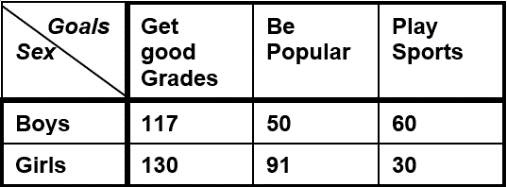
Q2. If a student is selected at random from the survey, what is the probability the student wants to be Popular?
Background
Topic: Basic Probability from a Two-Way Table
This question tests your ability to calculate simple probabilities using frequency data from a contingency table.
Key Terms and Formulas
Probability:
Step-by-Step Guidance
Find the total number of students surveyed: Add all values in the table.
Find the total number of students who want to be Popular: Add the "Be Popular" values for boys and girls.
Set up the probability formula: .
Try solving on your own before revealing the answer!
Final Answer: 0.295
About 29.5% of students surveyed want to be popular.
Q3. What is the probability the student wants to be popular given it is a girl?
Background
Topic: Conditional Probability
This question tests your ability to calculate conditional probabilities using a two-way table.
Key Terms and Formulas
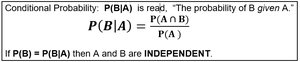
Conditional Probability:
Step-by-Step Guidance
Find the total number of girls: Add all values in the "Girls" row.
Find the number of girls who want to be Popular: Use the "Be Popular" value for girls.
Set up the conditional probability formula: .
Try solving on your own before revealing the answer!
Final Answer: 0.385
About 38.5% of girls surveyed want to be popular.
Q4. What is the probability the student is a girl given we selected a student wanting to be popular?
Background
Topic: Conditional Probability (Reverse)
This question tests your ability to calculate the probability of one event given another, using a two-way table.
Key Terms and Formulas
Conditional Probability:
Step-by-Step Guidance
Find the total number of students who want to be Popular: Add "Be Popular" values for boys and girls.
Find the number of girls who want to be Popular: Use the "Be Popular" value for girls.
Set up the conditional probability formula: .
Try solving on your own before revealing the answer!
Final Answer: 0.646
About 64.6% of students who want to be popular are girls.
Q5. Are being Popular and being a Girl independent?
Background
Topic: Independence of Events
This question tests your understanding of independence in probability, using conditional and marginal probabilities.
Key Terms and Formulas
Events A and B are independent if .
Compare and .
Step-by-Step Guidance
Calculate from the total table.
Calculate from the girls row.
Compare the two probabilities: If they are equal, the events are independent; if not, they are dependent.
Try solving on your own before revealing the answer!
Final Answer: Not Independent
and
Since these probabilities are not equal, being Popular and being a Girl are not independent events.
